
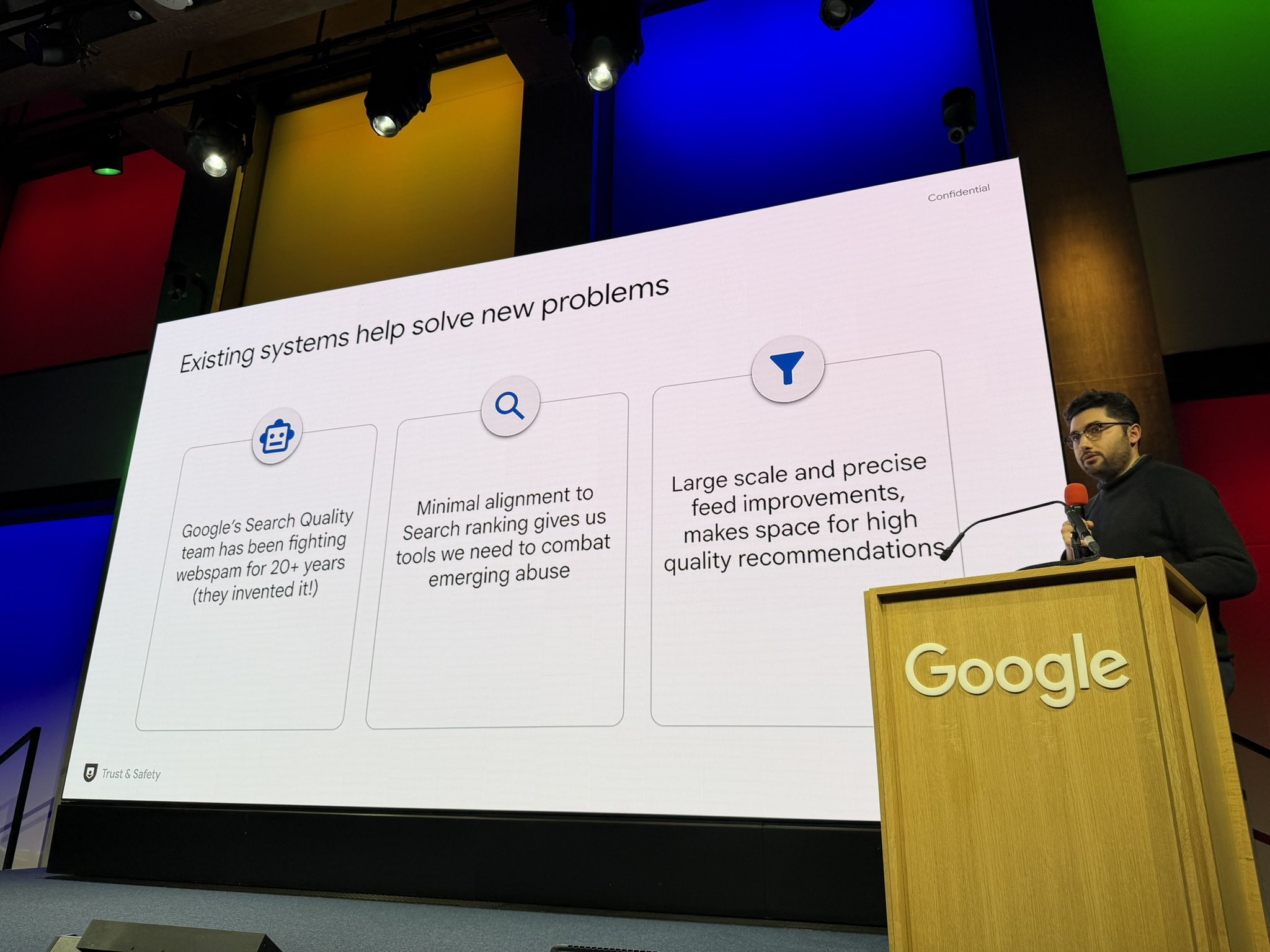
Google has confirmed that Google Discover now has only “minimal alignment” with Google Search ranking, a statement presented by Andy Almeida of Google Trust & Safety at the Search Central Live event in Zurich.
According to Almeida, Discover’s ranking logic is increasingly independent from traditional Google Search signals, allowing smaller and lesser-known publishers to be surfaced, even if they don’t rank well in standard search results.
This revelation immediately raises questions. If Discover no longer relies heavily on Google Search systems, what signals is it using?
These are not small adjustments, they suggest a philosophical change in how Google curates personalized content.
What Exactly Did Google Say About Discover’s Relationship to Search Ranking?
During his presentation in Zurich, Andy Almeida displayed a slide that included the line: “Minimal alignment to Search ranking…”
The phrase caught immediate attention from SEOs, including industry expert Glenn Gabe, who publicly asked for clarification. The claim seemed at odds with the long-held understanding that:
- Discover is an “extension of Search,”
- Discover uses similar quality and trust signals,
- Core updates influence Discover visibility.
But after the event, when asked directly about the meaning of the slide, Almeida clarified that the Discover team intentionally aims to promote smaller publishers who might not perform well in Search.
In other words: A website no longer needs strong Google Search rankings or even rankings at all, to appear in Discover.
This is a major departure from how SEOs have traditionally understood Discover.
Why Is Google Reducing Discover’s Dependence on Search Ranking?
According to Almeida’s explanation, the rationale is simple yet strategically important: Google wants to ensure Discover isn’t dominated solely by established, authoritative domains.
If Discover depended fully on Google Search quality signals, the feed would overwhelmingly show:
- Large publishers
- Long-established news outlets
- Highly authoritative blogs
- Major media brands
But Discover is meant to highlight: Timely content, new voices, niche publishers, fresh articles relevant to user interests.
To achieve this, it can’t rely exclusively on the same signals that power Google Search.
This aligns with Google’s broader mission of creating a more diverse content ecosystem inside Discover, something that traditional SEO ranking systems might not easily allow.
Does This Explain Why Discover Is More Prone to Spam?
Almeida’s explanation may inadvertently shed light on a longstanding criticism: Google Discover surfaces far more spam, low-quality posts, and clickbait than Google Search does.
If Discover uses fewer of the strict trust and authority signals from Google Search, it becomes easier for new sites to break in, spam sites to temporarily succeed, harder for Google to keep the feed clean without over-filtering smaller publishers.
Almeida acknowledged this tension when asked about the balance between discovery and quality control. He nodded when asked whether this requires “a delicate tweak” between:
- Using Search trust signals, and
- Not using them enough to block new or unknown publishers.
Discover has to walk a tightrope:
Use too much Search ranking → only large sites appear.
Use too little → feeds become compromised by spam.
And according to many in the community, the second scenario already feels too familiar.
What Did Almeida Say About Ranking Requirements for Discover?
Perhaps the most surprising statement was this: “You don’t even have to rank for most of your queries to show up in Google Discover.”
This directly contradicts long-standing assumptions that good Discover performance correlates with strong organic rankings.
The implications are significant:
- A brand-new site can gain early traction from Discover.
- Ranking poorly in Search does not disqualify a site from appearing.
- Discover’s algorithm emphasizes topical interest, recency, and user behavior but not necessarily SERP performance.
This also frames Discover not as an extension of Search, but as a personalized recommendation system, more like YouTube or TikTok than traditional Google SERPs.
How Did the SEO Community React to This Statement?
Industry analyst Glenn Gabe shared his reaction publicly on X, noting that the phrase: “Minimal alignment to Search ranking gives us the tools we need to combat emerging abuse.”
I am not there, but that second line sure caught my attention. We know that Discover is an extension of Search, but Google just presented “Minimal alignment to Search ranking gives us the tools we need to combat emerging abuse”. I’m trying to find more info about that line, but I… https://t.co/kNFbuBghbN
— Glenn Gabe (@glenngabe) December 9, 2025
stood out to him. The statement suggests that Discover’s independence from Search could help Google battle new types of spam but the real-world results paint a more complicated picture.
If Discover allows lesser-known and new publishers to rank without the same barriers faced in Search, the system becomes: more open, more inclusive but also more susceptible to manipulation.
This has already been observed in the wild.
Does This Change the Known Relationship Between Core Updates and Discover Visibility?
Historically, Google has stated that core updates do affect Discover visibility, because both rely on overlapping quality and trust signals.
But Almeida’s new statements indicate that this may no longer be the case, or at least that the relationship is weaker than before.
This raises questions:
- Have Discover ranking factors been rewritten?
- Does a core update now indirectly affect Discover via content or quality, but not via ranking?
- Is Google attempting to detach Discover from the volatility of core updates?
These are questions many SEOs will demand more clarity on.
What Signals Might Discover Be Using If Not Search Rankings?
Almeida did not disclose the exact signals used, but based on previous documentation and observed behavior, Discover likely prioritizes:
- User interest profiles
- Engagement likelihood
- Freshness and recency
- Topic relevance
- Device behavior
- Browsing patterns
- Visual content
However, without strong search-based authority signals, Google must rely more on: AI SEO, spam detection systems, behavioral signals and content safety and trust systems
This might explain why Discover sometimes surfaces unexpected or low-value content.
Does This Shift Create a New Opportunity for Smaller Publishers?
Absolutely. If Discover surfaces content independently of search ranking strength, smaller websites have a unique opening:
- They can bypass competitive SERPs entirely.
- They can gain meaningful traffic early in their lifecycle.
- They can reach audiences based on relevance, not domain age or backlink profiles.
This democratizes visibility but also challenges the belief that authority and longevity always determine discovery.
Key Takeaways
- Discover now has minimal reliance on Google Search ranking.
- Smaller publishers can appear in Discover even without ranking in Search.
- Reduced alignment with Search may be fueling more spam in Discover.
- Sites don’t need to rank for most queries to show up in Discover.
- Google is balancing new publisher visibility vs. spam control.
- Discover is shifting toward a recommendation engine, not a Search extension.

Dipti Arora
AuthorDipti Arora is a Senior Content Writer with over seven years of experience creating impactful content across Digital Marketing, SEO, technology, and business domains. She has a strong background in managing news verticals and delivering editorial excellence. Dipti has contributed to leading publications such as The Times of India and CEO News, where her research-driven storytelling and ability to simplify complex subjects have consistently stood out. She is passionate about crafting content that informs, engages, and drives meaningful results.
