
Websites that rank for multiple fan-out queries are dramatically more likely to be cited in Google’s AI Overviews, according to a new large-scale study analyzing 173,902 URLs.
The research shows a strong correlation between broader query coverage and visibility in AI-generated answers, reshaping how SEO performance is measured in the age of AI search.
The study, conducted by Joshua Hardwick, analyzed search results across thousands of keywords and revealed that ranking beyond a single “main” keyword.
These, especially across related fan-out queries, can significantly increase a page’s likelihood of being referenced in AI Overviews.
What Did the Study Analyze to Measure AI Overview Citations?
The Surfer SEO research examined the top 10 ranking pages for 10,000 keywords, finding that 76% of those keywords triggered AI Overviews.
From there, the study used Gemini to extract 33,000 fan-out queries, the follow-up questions AI systems expanded into and then scraped the top 10 organic results for those fan-outs as well.
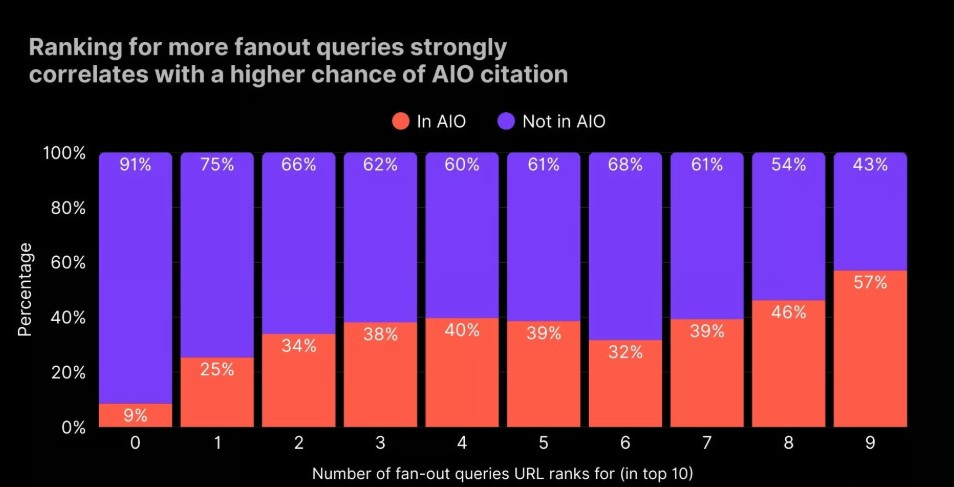
By mapping which URLs appeared as citations inside AI Overviews and comparing them against organic rankings for both main queries and fan-out queries, the study was able to quantify how query breadth impacts AI visibility.
The dataset ultimately covered 173,902 URLs, making it one of the most comprehensive analyses of AI Overview citations to date.
Why Do Fan-Out Queries Matter More for AI Overviews?
Fan-out queries represent the secondary and tertiary questions AI systems explore to construct a complete answer. Instead of relying solely on a single keyword, AI Overviews pull from content that covers multiple related angles of a topic.
The study found a Spearman correlation of 0.77 between the number of fan-out queries a URL ranks for and its likelihood of being cited in AI Overviews, a statistically strong relationship.
In practical terms, this means the more fan-out queries a page ranks for, the higher its probability of being included in AI-generated answers.
How Much Does Ranking for Fan-Out Queries Increase Citation Likelihood?
The data shows that ranking for the main query alone is no longer sufficient if the goal is AI visibility.
Pages ranked for both the main query and at least one fan-out query were 161% more likely to be cited in AI Overviews compared to pages ranking only for the main query.
More than half of all AI Overview citations that ranked in organic search, 51.2% ranked for both the main query and at least one fan-out query.
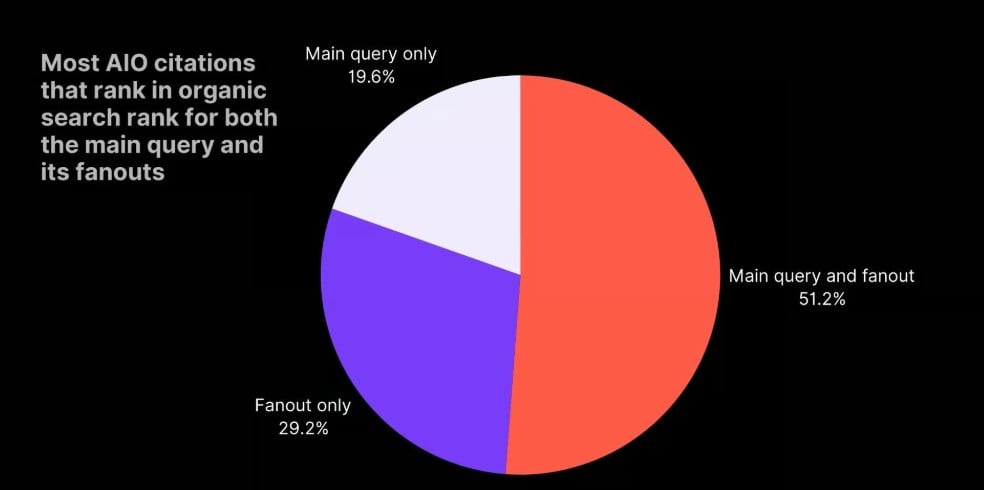
In contrast, only 19.6% of cited pages ranked solely for the main query without any fan-out coverage.
Is Ranking for Fan-Out Queries More Important Than Ranking for the Main Query?
One of the more surprising findings is that, when forced to choose, ranking for fan-out queries appears more valuable than ranking for the main keyword alone.
The study found that AI Overviews cited pages that ranked only for fan-out queries 29.2% of the time, while pages ranking only for the main query were cited just 19.6% of the time.
This means pages were 49% more likely to be cited if they ranked for fan-outs rather than the primary keyword.
This suggests AI systems prioritize topical coverage and contextual relevance over traditional single-keyword dominance.
Do Most AI Overview Citations Rank in Organic Search?
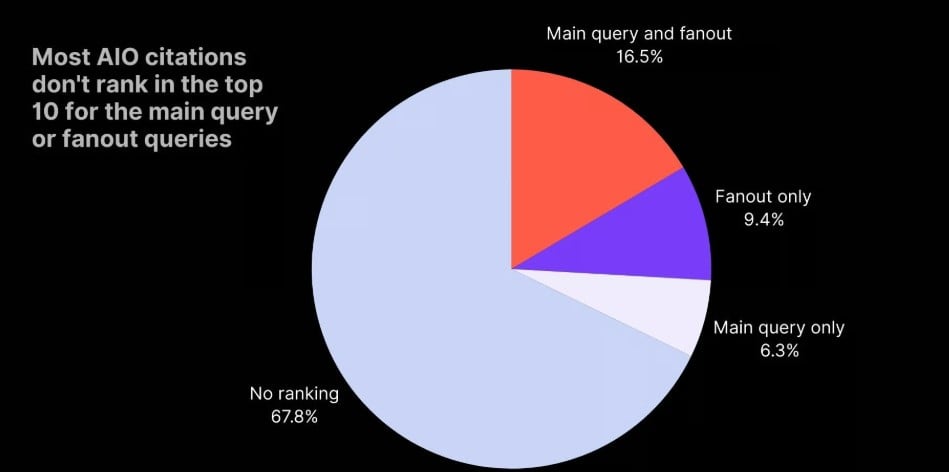
Not always. One of the most important caveats in the study is that 67.82% of AI Overview citations did not rank in the top 10 for either the main query or any fan-out query.
However, when the analysis focused only on the top three AI citations, the ones visible without clicking “Show all,” the picture changed.
In that subset, 54.14% of citations did rank in the top 10 for either the main query or its fan-outs.
The study notes two likely explanations: many cited pages may rank outside the top 10 and AI Overviews likely draw from additional sources beyond traditional blue-link results.
Does This Mean Traditional SEO No Longer Matters?
The research does not suggest abandoning traditional SEO, but it clearly indicates that rankings alone are not the full story.
While ranking for the main query and fan-outs improves citation chances, AI Overviews also reference sources that may not rank prominently in organic results.
The takeaway is that traditional SEO remains important—but it is no longer sufficient by itself to guarantee AI visibility. Content depth, AI SEO services, topical breadth, and semantic relevance play an increasingly central role.
Why Chasing Individual Fan-Out Queries Is Not a Sustainable Strategy
Despite the strong correlation, the study cautions against obsessively chasing every possible fan-out query.
Fan-outs vary based on user context, personalization, and even repeated runs of the same query.
The data shows that only about 27% of fan-out queries remain consistent across multiple searches for the same prompt.
This variability makes it difficult to build a reliable strategy based on scraping fan-outs alone.
Additionally, fan-out queries differ depending on what Google knows about the user, such as location, interests, or past behavior. This makes any static fan-out list inherently incomplete.
Why Topical Authority Emerges as the Stronger Signal
Rather than chasing individual fan-outs, the study argues for building topical authority.
Pages that comprehensively cover a topic are more likely to naturally rank for many fan-out queries, even as those queries change.
This approach allows content to remain relevant regardless of which specific fan-outs an AI system generates at any given moment.
It also aligns with broader SEO consensus, with roughly 90% of SEOs agreeing that topical authority is a key ranking factor.
By covering a topic deeply and holistically, sites increase their odds of being cited consistently across AI Overviews.
How Should Publishers Act on These Findings?
The study emphasizes a strategic shift rather than a tactical one.
Instead of targeting isolated keywords, publishers are encouraged to build structured content clusters that address the full scope of a topic.
A practical implication highlighted in the research is starting with lower-difficulty fan-out topics to build authority gradually, then expanding into more competitive areas.
This incremental approach allows sites to accumulate relevance across a growing network of related queries.
Key Takeaways
- Ranking for multiple fan-out queries has a strong correlation with AI Overview citations.
- Pages ranking for both main queries and fan-outs are 161% more likely to be cited.
- Ranking for fan-outs alone is more effective than ranking only for the main keyword.
- Most AI citations do not rank in the top 10, but top citations often do.
- Traditional SEO still matters, but it is not sufficient on its own.
- Building topical authority offers a more stable path to AI visibility than chasing individual fan-outs.

Dipti Arora
AuthorDipti Arora is a Senior Content Writer with over seven years of experience creating impactful content across Digital Marketing, SEO, technology, and business domains. She has a strong background in managing news verticals and delivering editorial excellence. Dipti has contributed to leading publications such as The Times of India and CEO News, where her research-driven storytelling and ability to simplify complex subjects have consistently stood out. She is passionate about crafting content that informs, engages, and drives meaningful results.
