
Google’s AI Overviews are designed to provide quick answers, but in some cases, they have surfaced responses that are inaccurate, misleading, or drawn from unreliable sources. Widely shared examples, such as suggestions to eat small rocks, add glue to pizza sauce, or consider the supposed benefits of running with scissors, have raised serious concerns about reliability and user trust.
Incidents like these have shown how errors can arise when the system interprets weak signals, outdated material, or satirical content that has been indexed and resurfaced as if it were factual.
When questionable inputs are elevated and presented with confidence, the resulting summaries can distort meaning, misrepresent reality, and shape perception in ways that appear authoritative even when the underlying interpretation is incorrect.
In this article, I’ll be covering how these inaccuracies emerge and how they can be corrected in a practical, structured way, so that clearer and more reliable information becomes the version that AI systems are most likely to recognize and reflect.
How AI Overviews Form Their Answers
AI Overviews are powered by generative AI models that learn patterns and relationships from large volumes of training data and then use those patterns to produce new responses.
The system synthesizes information from the sources it references, which means the quality of the output depends heavily on the clarity and accuracy of the material it draws from.
Because this technology continues to develop, it can occasionally produce inaccurate, incomplete, or insensitive statements, and errors remain possible even in seemingly simple queries.
Inaccuracies in AI Overviews often arise from three conditions:
- Ambiguous or outdated first-party content. Old blog posts, loosely phrased statements, or conditional wording can be interpreted as factual claims.
- Third-party distortions. Scraper sites, competitor pages, or historic news articles sometimes reintroduce obsolete details that the model treats as current.
- Weak machine readability. Facts buried in long narrative paragraphs are harder for systems to parse than short, declarative statements with clear structure.
The evidence suggests that AI Overviews reflect the signals they ingest rather than inventing information spontaneously. That makes diagnosis and source correction the most reliable path to change.
Finding the Root Cause of an Incorrect AI Overview
Inaccurate AI Overviews can create real-world consequences when misinformation is surfaced and repeated at scale.
A recent example involved Canadian musician Ashley MacIsaac, who was incorrectly described in a Google AI summary as a sex offender. The problem appears to have stemmed from misinterpreted web content linked to another person with the same name, leading to a cancelled concert performance and safety concerns before the summary was corrected.
Incidents like this underline why organizations and public figures need to understand where an incorrect signal originates and correct it at the source before taking any further action.
To do that effectively, you first need to trace where the inaccurate information is coming from and why the model selected it. The steps below help you diagnose the source before making any corrections.
Quick Overview of the Correction Process
| Step | Action | Goal |
| 1 | Identify the source of the inaccuracy | Find where the wrong signal originates |
| 2 | Use the direct feedback loop | Submit precise corrections to Google |
| 3 | Optimize the “source of truth” | Strengthen clarity in your own content |
| 4 | Add structured data | Help AI interpret information accurately |
| 5 | Clean up the external ecosystem | Align outside references and entities |
| 6 | Apply suppression controls (if necessary) | Prevent repeated misrepresentation |
Step 1: Identify the Source (The “Why”)
Before you attempt to fix an inaccurate AI Overview, you need to understand where the wrong information is coming from and why the model selected it.
- Trace the Links: Click the link icons or cards within the AI Overview. These are the pages the model is using as reference material. Each link represents a contributing signal.
- Check for Conflicts: Determine whether the incorrect statement comes from your own website or from an external page, such as a news article, review site, competitor page, or outdated resource that still ranks.
- Look for Ambiguity: Sometimes the AI does not invent an error. Instead, it misreads vague or loosely written language on a page that leaves room for interpretation.
Incidents reported in the media also reinforce the importance of this diagnostic step. In several public examples, the issue was not simply that the AI “made something up,” but that it interpreted outdated or non-credible references that happened to be indexed and resurfaced.
When the original signal is weak, the output becomes unreliable, which is exactly why tracing and correcting the contributing source is essential before any other action.
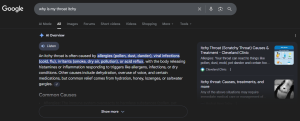
Here’s how I applied the tracing process to the query “Why is my throat itchy?”:
I opened the AI Overview and then clicked through to the Cleveland Clinic page listed in the link cards. From there, I compared each statement in the overview with the content on the source page.

Every cause mentioned in the AI Overview (allergies, viral infections, irritants, dry air or dehydration, acid reflux, and medications) appeared in the same form on the Cleveland Clinic page. The wording and meaning aligned closely with the bullet points in the “Possible Causes” section.
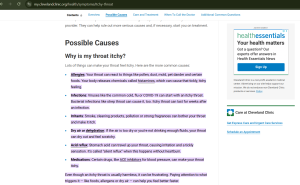
Since the statements matched the source exactly and the content was clearly structured, there was no sign of misinterpretation.
Instead of uncovering an error, this review confirmed that the AI Overview was accurately summarizing the information from a reliable medical source.
This exercise shows that tracing isn’t only useful for finding mistakes. It also helps validate when an AI Overview is grounded correctly in high-quality reference content.
Step 2: Use the Direct Feedback Loop (The Immediate Fix)
Google relies on explicit user signals to help refine AI Overviews.
The thumbs-down button allows submitters to mark an answer as inaccurate and add a short factual explanation.
The Report link is appropriate for harmful or safety-related issues. Research from SEO case studies indicates that feedback that is specific, repeatable across users, and paired with corrected content increases the likelihood of review.
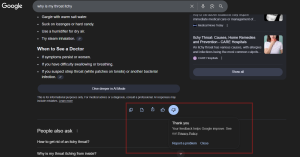
Effective submissions include:
- A concise description of the incorrect claim.
- A factual correction supported by a source URL.
- Neutral language that explains what should replace the statement, not only why it is wrong.
Step 3: Optimize the “Source of Truth”
If the AI is referencing your own site incorrectly, strengthen the content so the correct meaning becomes unmistakable.
- Declarative Sentences: Use direct “is” and “are” statements.
Example: Instead of “We aim to be recognized as a leading provider,” write “Our company is a provider of X.” - Update High-Ranking Pages: If an outdated page is feeding the error, update that specific source instead of letting legacy wording remain online.
- Clear Formatting: Use headings and bullet lists so information is easier for systems to interpret and reuse correctly.
Step 4: Leverage Structured Data
Structured data adds clarity by defining what specific information represents. The guidance highlights several valuable implementations:
- Organization schema for brand details, leadership, and services.
- Product and FAQ schema for pricing, features, and availability.
- FactCheck markup in situations where disputed or widely repeated claims require verification.
These signals help the system recognize which statements should be treated as definitive when multiple versions exist across the web.
Step 5: Clean Up the Ecosystem (The Outreach Fix)
Sometimes the error originates outside your website.
- The “Kind” Outreach: Contact the source publisher, explain the issue, and provide verified corrections. Many sites update inaccuracies to protect credibility.
- The Knowledge Graph: Update Google Business Profile, Wikipedia, and other entity hubs that serve as trusted reference points.
Aligning external signals reduces the chance of errors resurfacing.
Step 6: The “Nuclear Option” (Forcing the AI to Stop)
Some organizations may prefer to limit how their content appears in summaries. Three page-level controls can restrict reuse:
- nosnippet to block snippets across an entire page.
- data-nosnippet to exclude specific sections.
- max-snippet to limit the number of characters that can be displayed.
These controls can reduce visibility, so they are typically used only when repeated misrepresentation creates meaningful risk.
Staying Vigilant And Maintaining Accuracy Over Time
Teams that treat AI Overview corrections as ongoing quality maintenance tend to see more stable results.
Helpful habits include:
- Periodic checks of branded and topic-level queries.
- Tracking page edits so changes can be linked to shifts in summaries.
- Strengthening clarity, expertise, and trust signals across important pages so the correct version of a fact consistently outweighs weaker sources.
Over time, consistent and well-structured information reduces the likelihood that inaccuracies will reappear
The Bottom Line
Once an inaccurate AI Overview has been corrected, the real advantage comes from staying proactive rather than slipping back into a reactive mindset.
Make ongoing monitoring part of your routine by regularly searching your brand, core topics, and high-intent queries to see how your information is being represented and to catch shifts the moment they appear.
Strengthen EEAT signals across your key pages so the most accurate version of your message consistently outweighs weaker sources.
When these practices work together, they turn AI accuracy from a one-off fix into a sustained quality discipline, built on clearer data, stronger content structure, and intentional feedback that keeps guiding the system toward the truth of your brand.
Key Takeaways
- AI Overviews mirror the information they draw from, so lasting corrections begin with stronger factual signals across your content and external sources.
- Feedback is most helpful when it is specific and paired with clearly updated material.
- Direct wording, refreshed high-impact pages, and structured formatting reduce misunderstandings.
- Structured data helps systems interpret statements as definitive.
- Suppression controls can limit reuse but may also reduce visibility, so they are best reserved for exceptional cases.

Zulekha
AuthorZulekha is an emerging leader in the content marketing industry from India. She began her career in 2019 as a freelancer and, with over five years of experience, has made a significant impact in content writing. Recognized for her innovative approaches, deep knowledge of SEO, and exceptional storytelling skills, she continues to set new standards in the field. Her keen interest in news and current events, which started during an internship with The New Indian Express, further enriches her content. As an author and continuous learner, she has transformed numerous websites and digital marketing companies with customized content writing and marketing strategies.
