
Data centres now consume over 200 TWh of electricity per year globally. The hosting provider you chose for speed may be quietly torching the planet. We compared the top five.
“Every page load has a carbon cost. Most developers never think about it. We did the math — and the numbers are uncomfortable.”
When you spin up a new server or launch a website, you’re making an environmental choice — whether you realize it or not.
The global internet infrastructure emits roughly 1.5 billion tonnes of CO₂ annually, comparable to the entire aviation industry. And the lion’s share of that comes from the data centres your hosting provider quietly runs on your behalf.
Global data centre electricity consumption reached an estimated 240–340 TWh in 2022 and is projected to double by 2026 as AI workloads surge.
We dug into sustainability reports, energy disclosures, and third-party audits of the five most popular hosting and cloud providers to bring you an honest picture of what your hosting bill is really costing the atmosphere.
Our methodology draws on published Power Usage Effectiveness (PUE) scores, renewable energy certificate (REC) disclosures, and data from the Green Web Foundation‘s hosting database.
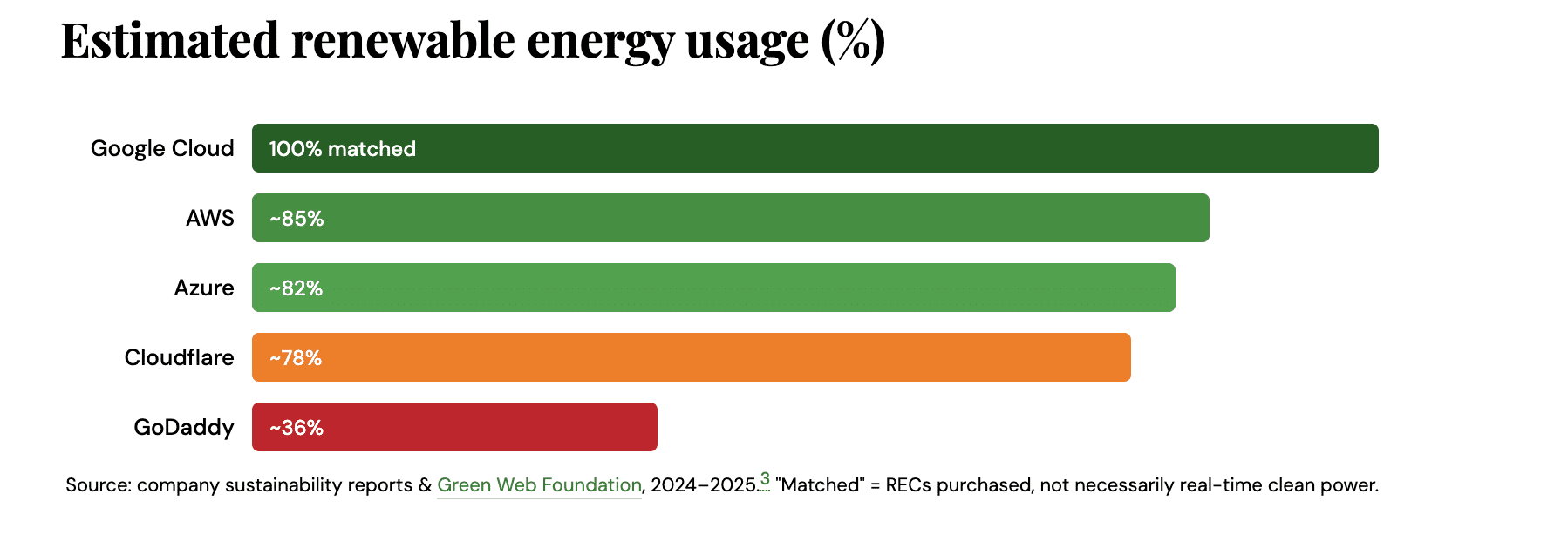
The 5 Providers Ranked on Carbon Impact
| Provider | Renewable Energy | Carbon Goal | PUE Score | Verdict |
|---|---|---|---|---|
| Google Cloud | 100% matched | Net-zero by 2030 | 1.10 | Best in class |
| Microsoft Azure | 100% by 2025 | Carbon negative 2030 | 1.18 | Strong |
| Amazon AWS | 100% by 2025 | Net-zero by 2040 | 1.20 | Improving |
| Cloudflare | Carbon neutral | No hard date | ~1.30 | Mixed |
| GoDaddy | ~36% renewable | Vague roadmap | ~1.50+ | Laggard |
PUE = Power Usage Effectiveness. A score of 1.0 is perfect; higher means more energy wasted on cooling & overhead. Google’s 1.10 is world-class; the industry average hovers around 1.58.
What the numbers actually mean
Google Cloud leads on almost every metric. It has matched 100% of its electricity consumption with renewable energy certificates since 2017 and is pushing toward 24/7 carbon-free energy — meaning clean power every hour of every day, not just annually matched. Its data centres in Finland and Iowa are cooled partly with seawater and treated wastewater. The catch: “matched” energy isn’t the same as “powered by” renewables in real time. RECs can be gamed.
Microsoft Azure has made the boldest pledge of the five: it aims to be carbon negative by 2030 — meaning it will remove more carbon than it emits — and to eliminate all historical emissions by 2050. Azure is also investing in long-duration energy storage and direct air capture. Its PUE of 1.18 is excellent. The shadow: Microsoft’s overall emissions have actually risen since 2020 due to hardware supply chains and AI compute demand.
Amazon AWS is the world’s largest cloud provider and its biggest renewable energy buyer — over 24 GW of clean energy capacity. But its net-zero target of 2040 is a decade behind Google and Microsoft. AWS also uses significantly more diesel backup generation than peers, and its scope 3 (supply chain) emissions remain poorly disclosed. Improving, but the scale of its growth makes it a genuine climate wildcard.
Cloudflare operates a massive global edge network but is more opaque about its environmental data than the hyperscalers. It’s certified carbon neutral for its operations (primarily through offset purchases), but hasn’t committed to a binding net-zero date.7 PUE data is not publicly disclosed per data centre. For a company that prides itself on transparency around performance, the environmental reporting is surprisingly thin.
GoDaddy is the weak link. With only ~36% renewable energy penetration and a PUE well above the industry wastage average, GoDaddy’s hosting is measurably more carbon-intensive per byte served than any other provider on this list. Its sustainability page is light on specifics. For a company serving 21 million customers, the absence of hard targets is damning.
Key findings at a glance
- 4× carbon difference: GoDaddy’s carbon intensity per kWh is estimated to be up to 4× higher than Google Cloud’s 1.10
- Google PUE: Against an industry average of 1.58 — saving ~100 TWh globally if all matched this
- 2030 the critical year: 3 of 5 providers have 2030 commitments. Two have no hard decarbonization deadlines
- 0 real-time clean power: No provider runs on 100% clean electricity 24/7 in every region — yet
What you can actually do
Switching providers isn’t always practical. But there are real steps developers, site owners, and businesses can take today to reduce the carbon cost of their digital presence:
- Choose a green-certified host. The Green Web Foundation’s directory offers a free check on any domain. If you can’t switch providers, at minimum choose a region powered by cleaner electricity (e.g. GCP’s Finland or Iowa regions over a coal-heavy grid region).
- Optimize for efficiency, not just speed. Smaller images, fewer third-party scripts, and static-first architecture reduce both Core Web Vitals loading times and compute emissions. The greenest request is the one that never happens. See the Sustainable Web Design guidelines.
- Use edge functions sparingly. Edge compute sounds green but cold-start overhead and geographic redundancy can multiply the compute load for lightly trafficked routes. Profile before deploying globally.
- Audit with Website Carbon Calculator. websitecarbon.com gives a per-page-view CO₂ estimate in seconds. Set a “carbon budget” for key pages like your homepage or checkout flow.
- Demand transparency from your provider. If your current provider doesn’t publish a PUE, renewable energy percentage, or a net-zero roadmap — ask them directly. Enterprise customers have leverage. Use it.

Dileep Thekkethil
AuthorDileep Thekkethil is the Director of Marketing at Stan Ventures, where he applies over 15 years of SEO and digital marketing expertise to drive growth and authority. A former journalist with six years of experience, he combines strategic storytelling with technical know-how to help brands navigate the shift toward AI-driven search and generative engines. Dileep is a strong advocate for Google’s EEAT standards, regularly sharing real-world use cases and scenarios to demystify complex marketing trends. He is an avid gardener of tropical fruits, a motor enthusiast, and a dedicated caretaker of his pair of cockatiels.
