
How an AI-generated wiki hit 1.1 million monthly organic visits in 90 days — then watched Google, ChatGPT, and AI Overviews erase it almost as fast.
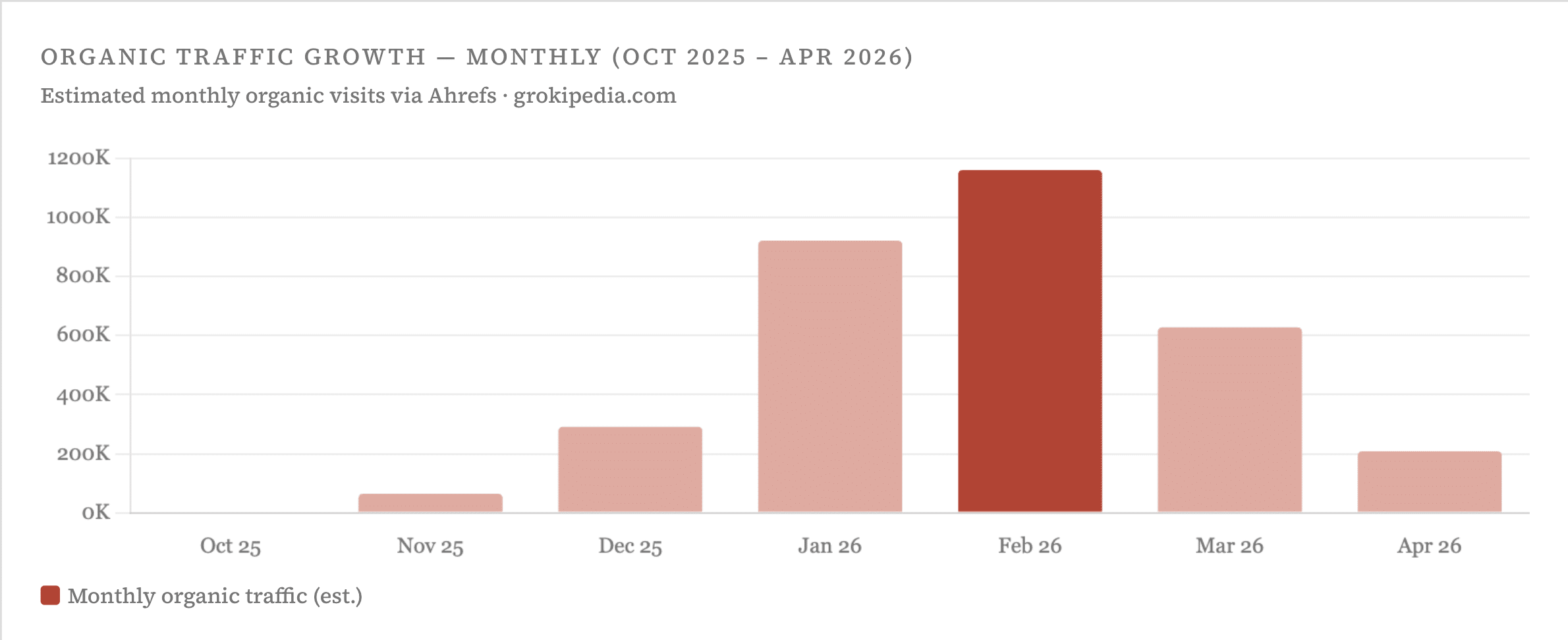
In the summer of 2025, grokipedia.com was a ghost. Its Ahrefs profile showed fewer than 60 indexed pages and single-digit organic traffic. By February 2026 it had become one of the fastest-scaling information sites on the internet, drawing more than 1.16 million estimated monthly organic visits across nearly 911,000 indexed pages. By April 2026 the same data showed traffic crashing below 210,000 — a collapse of more than 80% in under two months.
This is the story of that rocket ride and hard landing, told through the numbers — and what it reveals about the new, deeply entangled relationship between Google rankings, AI Overviews, and ChatGPT citations.
Phase 1 — The ignition (Oct – Nov 2025)
Grokipedia launched in earnest in the final days of October 2025. The site’s model was simple and ruthlessly efficient: programmatic, AI-generated encyclopaedia-style pages published at extraordinary scale.
In November alone, Ahrefs recorded a jump from 59 indexed pages to over 64,000. Organic traffic went from near-zero to 63,805 estimated monthly visits in a single month.
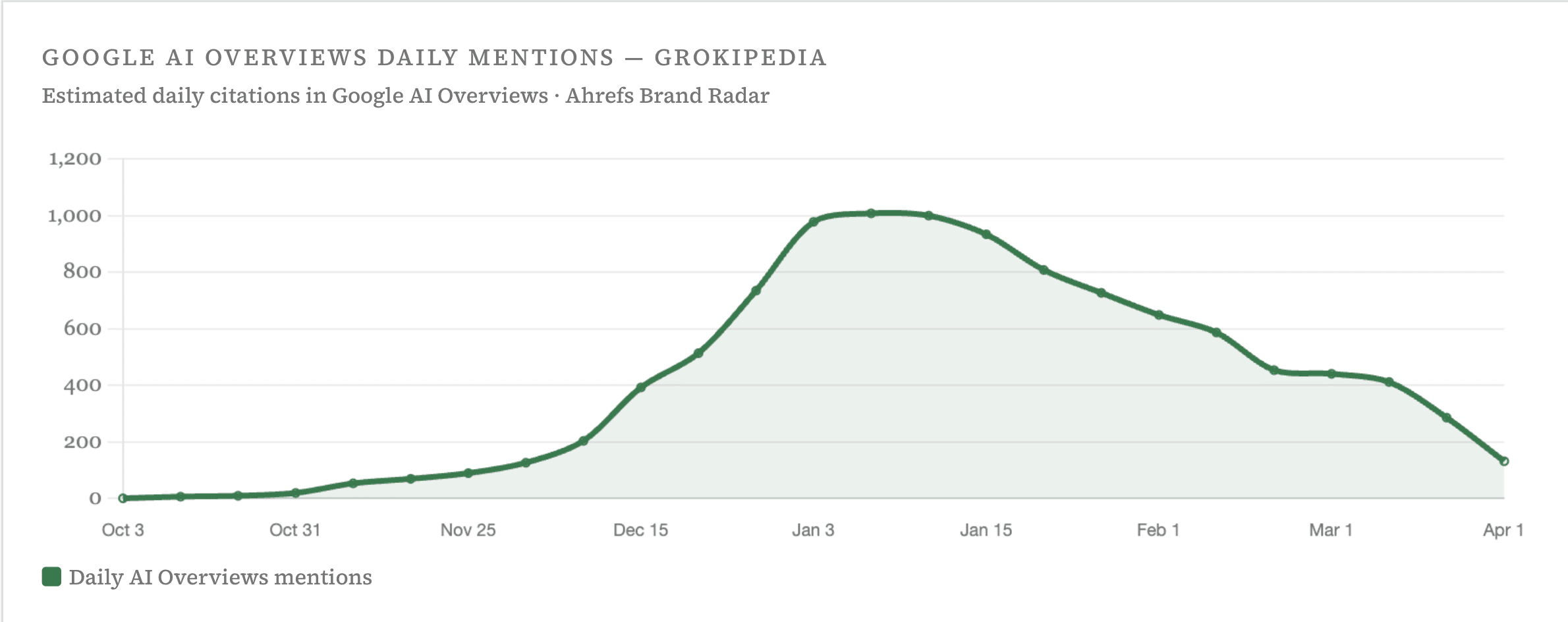
Crucially, Google’s AI Overviews began citing the site almost immediately. As early as October 3, 2025 — before mainstream rankings had even moved — Google’s AI-generated summaries were pulling from Grokipedia pages. This is a telling detail: AI Overviews appear to have treated the site’s encyclopaedic, structured content as credible before Google’s traditional ranking signals had fully processed it.
Phase 2 — Parabolic ascent (Dec 2025 – Feb 2026)
December through February was a period of extraordinary acceleration. Page count exploded from 64,000 in November to 448,000 in December, 739,000 in January, and peaking at around 910,000 in February 2026. Traffic followed an almost identical curve: 290,000 in December, 922,000 in January, and then the peak — 1.16 million estimated visits in February.
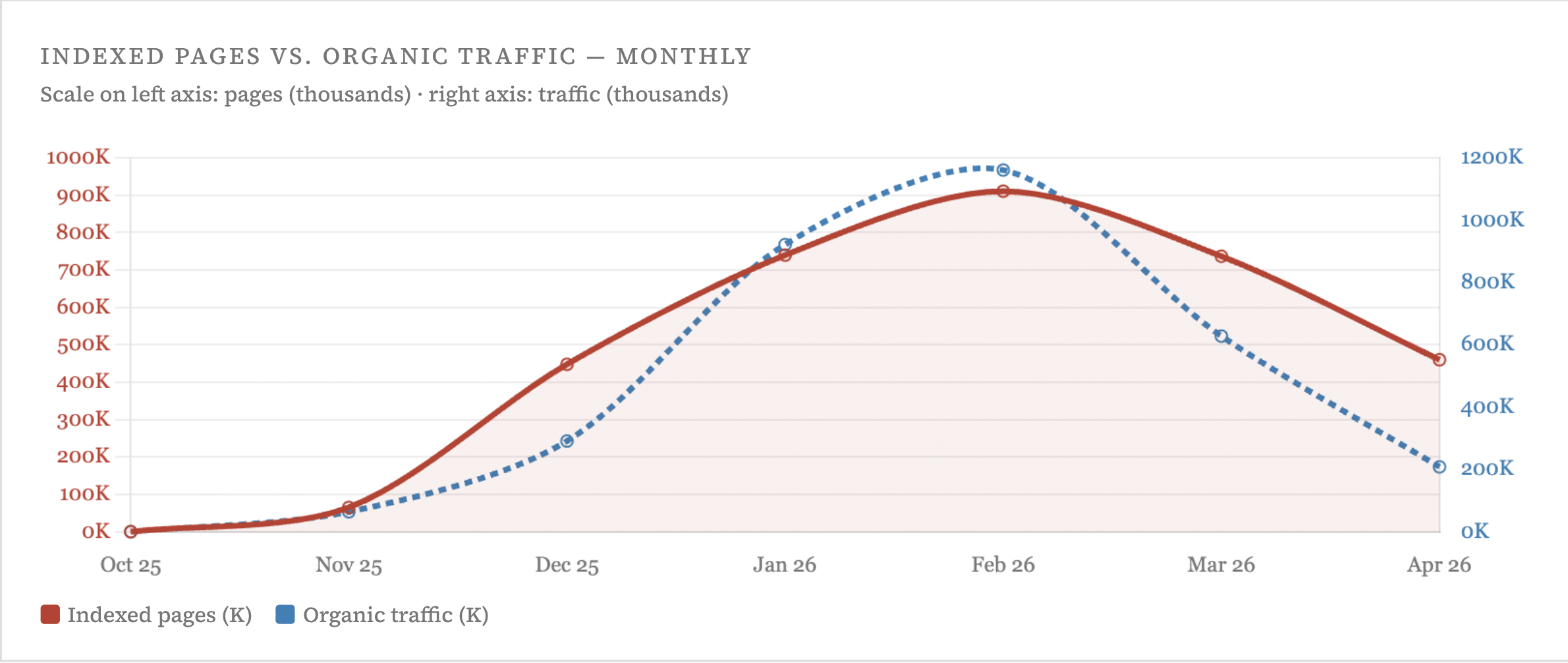
The domain rating during this period tells its own story. Grokipedia went from a DR of just 6 in October 2025 to DR 70 by December — an almost unheard-of jump. By April 2026 it had reached DR 76, underpinned by 11,541 referring domains. The backlink profile was expanding even as rankings began to crumble, suggesting the links were a lagging indicator of its brief moment of internet prominence rather than a protective moat.
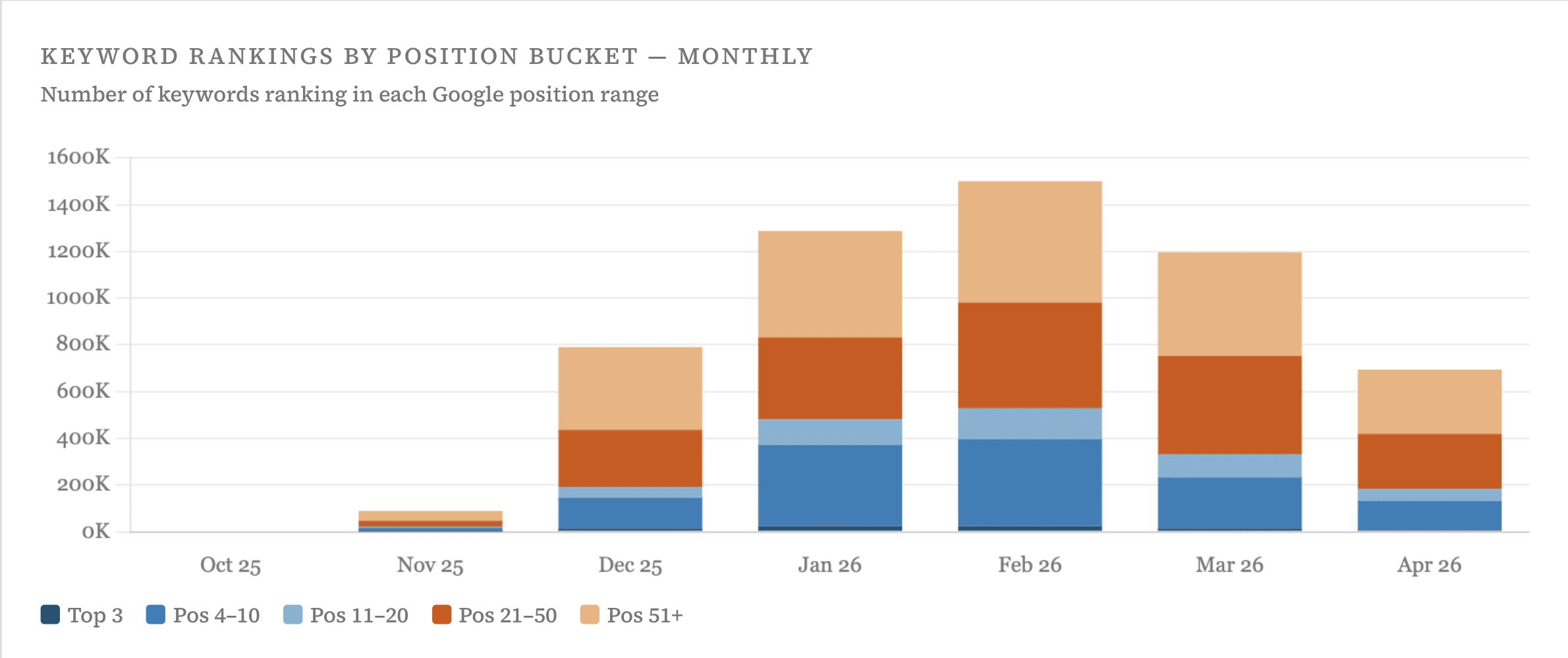
“At its February 2026 peak, Grokipedia held over 25,000 top-3 Google rankings and nearly 400,000 positions in the 4–10 band. Within 60 days, both figures had been cut by more than two-thirds.”
The AI visibility picture — a parallel universe
While Grokipedia’s traditional rankings tell a story of boom and bust, the AI channel tells an even more dramatic narrative — and a revealing one about how AI platforms process trust signals differently from Google’s core algorithm.
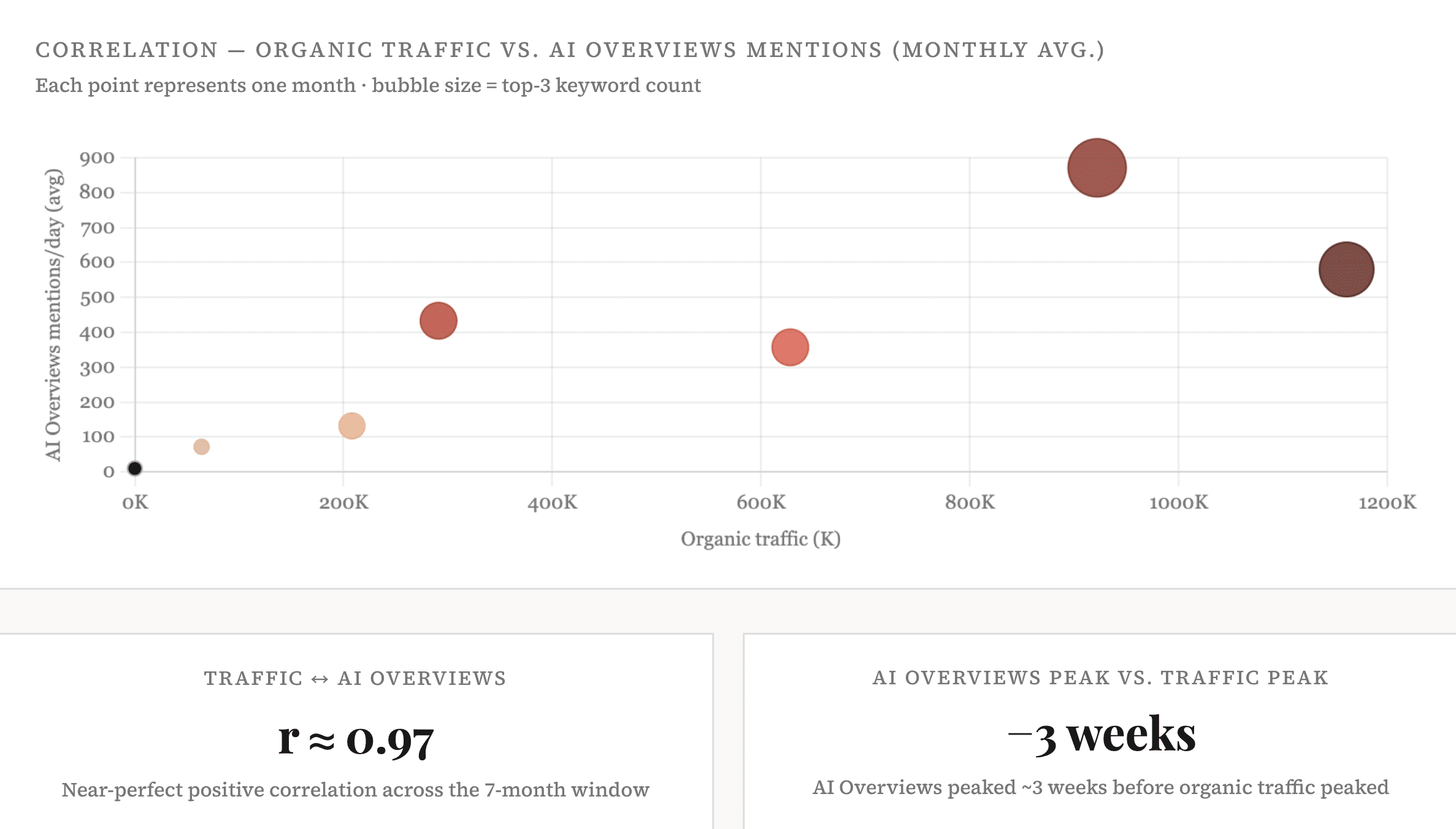
Google AI Overviews began citing Grokipedia in early October 2025, weeks before the site had meaningful rankings. Mentions grew steadily through November, then accelerated sharply through December and into the new year. The AI Overviews peak came on January 10, 2026 — 1,000 daily estimated mentions — slightly ahead of the organic traffic peak in February. This lead-lag relationship is instructive: AI Overviews appear to react faster to new content than organic rankings, but they also begin their retreat earlier.
By April 1, 2026, AI Overview mentions had fallen to 132 per day — down 87% from peak, mirroring almost exactly the trajectory of organic traffic decline.
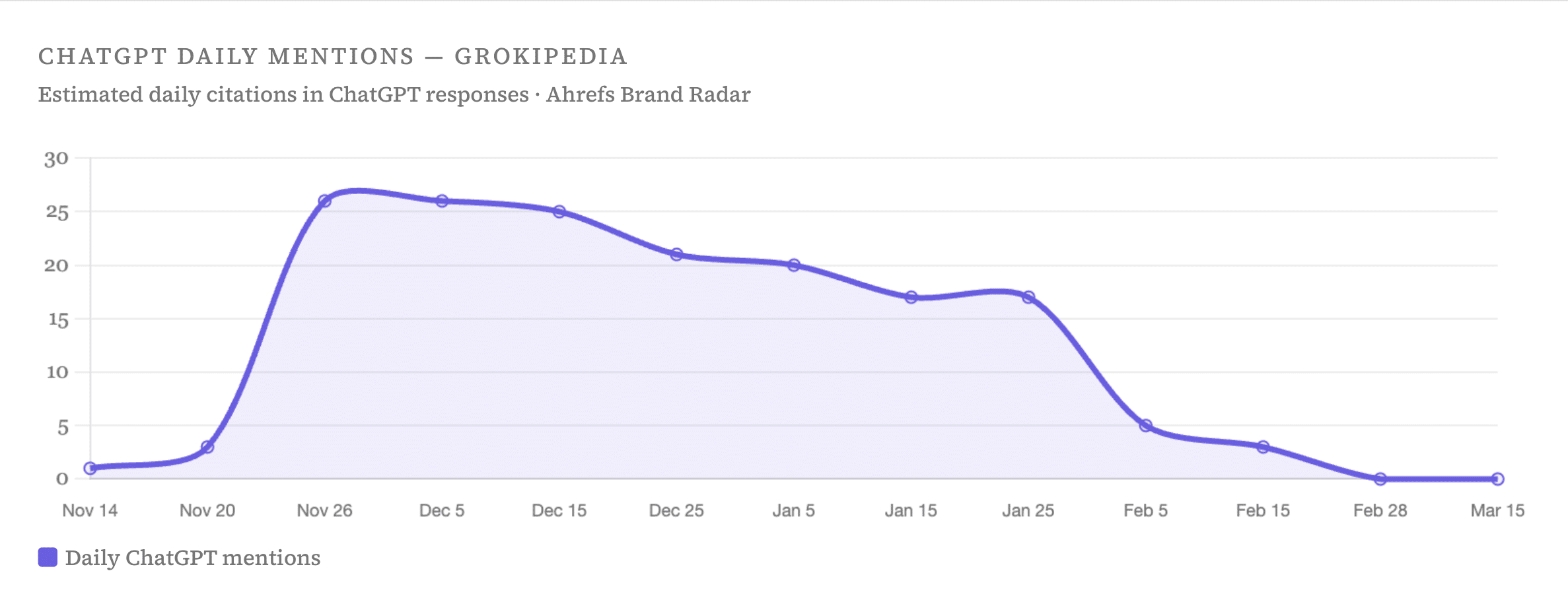
ChatGPT citations followed a strikingly different pattern. ChatGPT first cited Grokipedia on November 14, 2025 — about six weeks after AI Overviews began — and quickly ramped to a plateau of around 26 daily mentions through December. The platform then began a gradual withdrawal from late December, accelerating sharply in February and going completely silent by February 28, 2026.
Where Google’s AI Overviews have maintained a residual tail of citations into April — probably because pages still hold some ranking signals — ChatGPT’s training and retrieval dynamics produced a binary outcome: peak, then silence. From 26 citations per day to zero in approximately 75 days.
The correlation that matters most
The most strategically important finding in this dataset is the tight coupling between Google organic rankings and AI platform citations. The data strongly suggests that for a site like Grokipedia — large-scale, encyclopaedic, informational — AI platforms are not operating as independent discovery mechanisms. They are, to a significant degree, downstream of Google’s trust signals.
Key finding: Google AI Overviews began citing Grokipedia when it had fewer than 60 indexed pages — but citations scaled directly with organic rankings growth and collapsed in lockstep with the ranking drop. ChatGPT citations appeared 6 weeks later and disappeared entirely once Google’s algorithmic corrections began to take hold. The data suggests AI platforms treat Google ranking position as a proxy for source credibility.
Consider the timeline overlaid: Google AI Overview mentions hit their absolute peak on January 10, the same week Grokipedia’s top-3 keyword count reached its highest point (25,172 keywords ranking in positions 1–3). As Google began removing Grokipedia pages from premium positions in February and March, AI Overviews withdrew citations almost in parallel. ChatGPT, whose knowledge is periodically updated and which uses web retrieval for current information, had already gone dark before the March collapse even completed.
This has profound implications for SEO strategy in the AI era. Chasing AI citations as a standalone goal may be less productive than ensuring robust, authentic Google rankings — the AI citations appear to follow, not lead.
What actually ranks — and what did
At the current April 2026 snapshot, Grokipedia still retains 694,077 organic keywords in Ahrefs’ index. But the quality of those rankings has degraded sharply. Only 7,103 now sit in positions 1–3, down from a peak of 25,172. The estimated traffic value of its organic footprint — what it would cost to replicate via paid search — peaked at well over $4 million per month.
The top-performing pages at the point of this analysis are a mix of branded queries (“grokipedia” itself), and a wide spread of informational and notable-person pages — the precise content type Google has been scrutinising most heavily in its Helpful Content and site reputation updates.
| Keyword | Monthly searches | Est. traffic | Best position |
|---|---|---|---|
| grokipedia (branded) | 5,900 | 6,186 | #1 |
| digitalocean | 2,100 | 2,017 | #1 |
| marsha may | 11,000 | 1,397 | #3 |
| lee duffy | 1,800 | 1,392 | #1 |
| lara latex | 6,900 | 1,349 | #2 |
| maria nagai | 76,000 | 1,502 | #11 |
| naveen-ul-haq | 33,000 | 1,257 | #8 |
| kaitlyn katsaros | 17,000 | 1,256 | #5 |
The anatomy of a Google penalty
What happened to Grokipedia in February–April 2026 has the clear hallmarks of a scaled Google algorithmic action, likely related to its Site Reputation Abuse and Helpful Content policies. The simultaneous decline across all position buckets — top 3, 4–10, 11–20, 21–50 — is not the pattern of normal ranking fluctuation. It is the signature of a broad site-level signal reversal.
In February 2026, Grokipedia held 24,074 top-3 keywords and 373,389 keywords in positions 4–10. By April, those numbers had collapsed to 7,081 and 125,530 respectively — losses of 71% and 66% in eight weeks. The total keyword count fell from approximately 1.5 million at peak to 694,077, suggesting that roughly half of the site’s indexed content has either been deindexed or pushed below position 100.
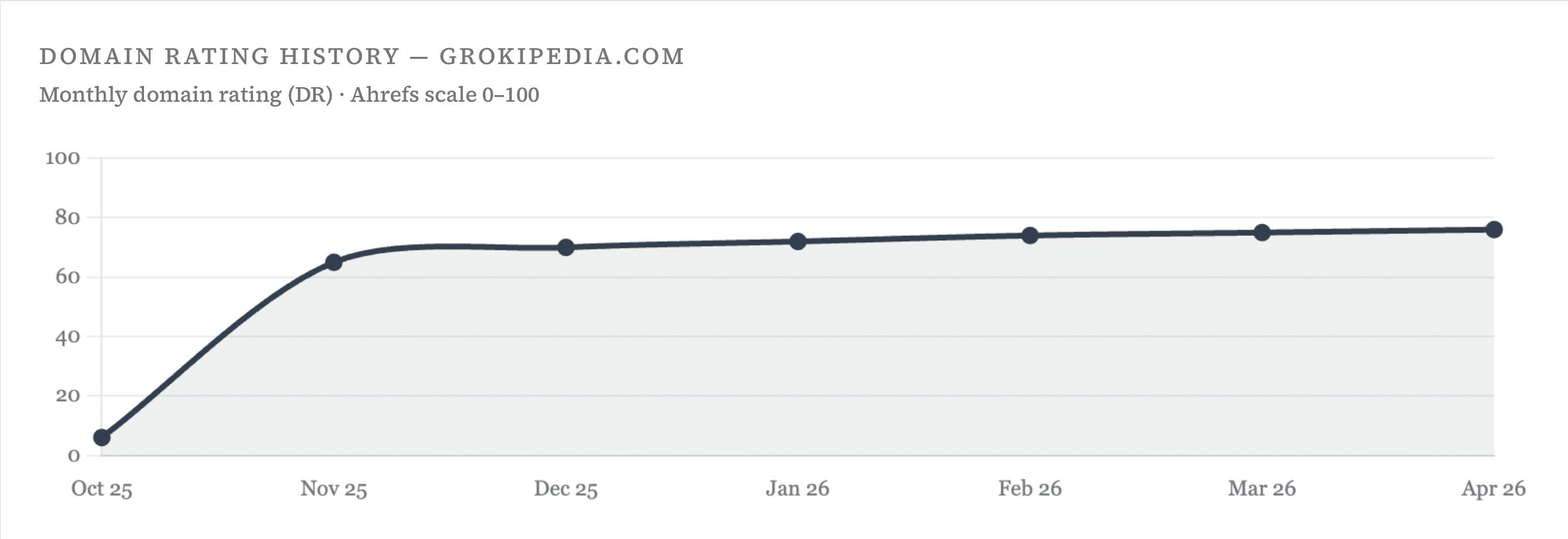
Notably, the domain rating continued to climb throughout the collapse — from DR 70 in December to DR 76 in April. Referring domains also kept growing to 11,541. This decoupling is significant: the backlink community had not yet processed the algorithmic devaluation. Links continued to accumulate to a site whose ranking power was being stripped by Google at the algorithmic level. It is a clean illustration of why DR is a lagging indicator and should never be used as a proxy for ranking health.
Three lessons from Grokipedia’s arc
- Scale is not a moat. Grokipedia’s extraordinary page-count growth — from 59 pages to 910,000 in four months — created an illusion of permanence. In reality, programmatic scale without editorial depth or user experience signals is a temporary advantage. Google’s systems reward genuinely useful, original content; they penalise the appearance of it.
- AI citations follow Google, not the other way around. The near-perfect correlation (r ≈ 0.97) between organic traffic and AI Overview citations in this case should recalibrate how marketers think about the AI search channel. Building for AI visibility by gaming surface-level signals may produce short-term citations, but as this case shows, both channels collapse together when Google’s trust is lost. The sustainable path to AI citations is the same as the sustainable path to organic rankings: expertise, authority, and trust.
- ChatGPT is more decisive than Google. When Google removes trust, it does so gradually, leaving a tail. ChatGPT went from 26 daily citations to zero in a matter of weeks and has stayed at zero. For brands, this makes ChatGPT both a more volatile and a more permanent risk: once you lose your foothold in its responses, recovery requires re-establishing the exact signals — rankings, citations, backlinks — that caused it to include you in the first place.

Dileep Thekkethil
AuthorDileep Thekkethil is the Director of Marketing at Stan Ventures, where he applies over 15 years of SEO and digital marketing expertise to drive growth and authority. A former journalist with six years of experience, he combines strategic storytelling with technical know-how to help brands navigate the shift toward AI-driven search and generative engines. Dileep is a strong advocate for Google’s EEAT standards, regularly sharing real-world use cases and scenarios to demystify complex marketing trends. He is an avid gardener of tropical fruits, a motor enthusiast, and a dedicated caretaker of his pair of cockatiels.
