Adobe has officially stepped into the future of search. In what could mark a major turning point for global brands, Adobe revealed that Adobe.com is now “Customer Zero” for Large Language Model (LLM) discoverability.
It is effectively transforming how one of the world’s most visited websites optimizes for visibility inside generative AI tools like ChatGPT and Google Gemini.
For decades, we have played by the rules of SEO such as creating metadata, backlinks and schema to rank higher on search engines.
But what happens when search itself changes? What if people stop clicking links and start conversing with AI models instead?
Let’s see how Adobe’s new initiative and its in-house LLM Optimizer is quietly becoming Generative Engine Optimization (GEO).

Why Is Adobe Focusing on LLM Discoverability Now?
Adobe’s announcement is not just another AI moment. It is a data-backed realization that user discovery habits have changed forever.
According to Adobe’s internal metrics, traffic to U.S. retail sites from LLMs surged 3,500% between mid-2024 and mid-2025, while 80% of consumers now rely on AI-written summaries for nearly half of their search activity.
Think about that for a second: your next customer might never see your website. Instead, they will read about your product in an AI-generated paragraph, sourced from the web and summarized conversationally.
For Adobe, this was not just theory, it was showing up in analytics. Their team noticed two things:
- Referral traffic from LLMs like ChatGPT and Perplexity was doubling every few months.
- “Zero-click searches” where users get answers directly without visiting a site were rising sharply.
The implications were clear: traditional SEO was no longer enough.
As Nathan Etter, Adobe’s Senior Vice President overseeing Adobe.com, put it, “We had to understand what the LLM landscape meant not just for our customers, but for Adobe itself.”
What Is Adobe’s Approach to LLM Optimization?
Adobe’s marketing team faced the same question every brand is now asking:
How do we make sure AI-generated responses talk about us accurately and favorably?
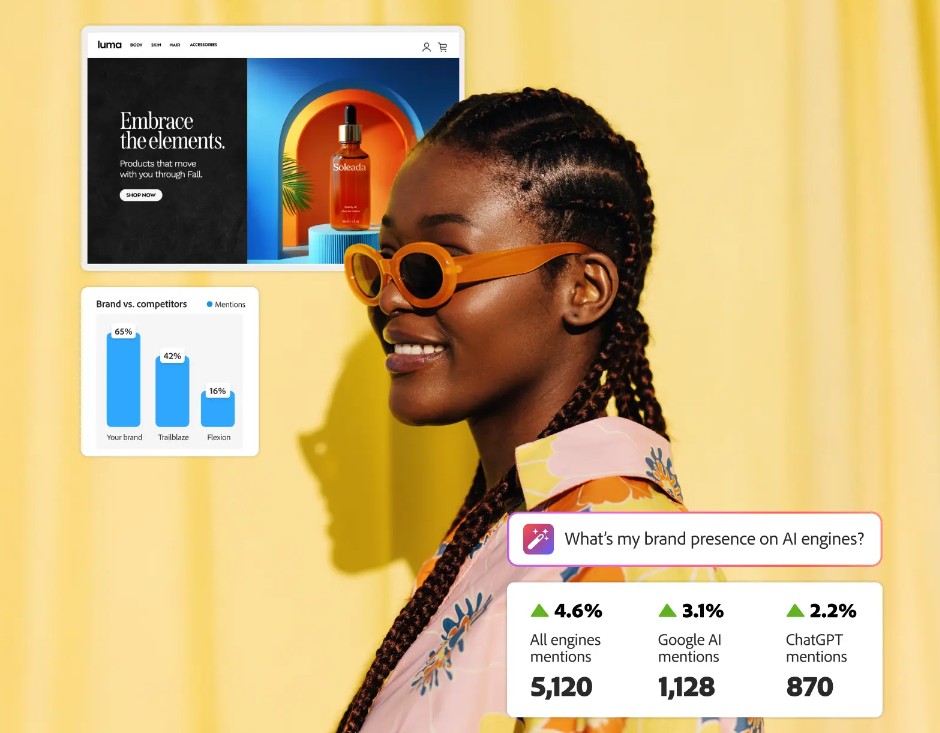
When Adobe’s CMO, Lara Balazs, posed that question internally, Etter’s team began a deep-dive into how LLMs interpret brand information.
What they discovered was fascinating: these models weren’t just reading webpages and they were synthesizing a brand’s entire online ecosystem, including:
- Social posts
- News coverage
- Product documentation
- Earned mentions in forums and tech media
So, visibility in this new world would not depend on keyword density or backlinks alone.
It would rely on how trusted and interconnected your brand’s digital footprint appeared to an AI model’s training process.
That realization led Adobe to build a dedicated framework for what it calls Generative Engine Optimization (GEO), which is a multi-channel approach to influence how LLMs “see” brands.
What Is the Adobe LLM Optimizer and How Does It Work?
To operationalize this new kind of visibility, Adobe built a proprietary tool: Adobe LLM Optimizer.
This is not a marketing dashboard or keyword tracker. It is a full-fledged system designed to analyze, measure and optimize how LLMs reference Adobe’s products across the web.
Here is how it works, simplified:
- Measure Visibility:
The Optimizer tracks how often Adobe products like Firefly or Acrobat appear in LLM-generated answers for key industry queries. It uses new metrics such as visibility score and citation frequency instead of old SEO metrics like click-through rate.
- Optimize for LLM Context:
It analyzes where and why certain pages or mentions get cited and recommends tweaks to owned, earned and social content to improve brand representation.
- Monitor Sentiment and Accuracy:
It flags how AI models describe Adobe’s offerings for instance, whether ChatGPT accurately explains Firefly’s features and suggests content adjustments to shape those narratives over time.
When Adobe tested this tool internally, the results were dramatic.
- Firefly citations across LLMs increased 5x within one week.
- Acrobat pages saw a 200% jump in visibility and 41% more referral traffic from LLM-powered sources.
In short, the LLM Optimizer didn’t just make Adobe more visible, it made the brand discoverable by machines.
How Did Adobe Optimize Content for LLMs?
The experiment revealed that discoverability now depends on three interconnected layers and each requires a distinct optimization strategy.
1. Earned Media
Adobe worked with trade publications, affiliate partners, and tech media outlets known to be indexed by LLM training datasets. The goal? To get credible, third-party mentions in places AIs “trust.”
2. Social Media Presence
Social signals are becoming secondary inputs for LLMs. Adobe amplified conversations on X, LinkedIn and community forums, ensuring the brand’s messaging stayed authoritative and current.
3. Owned Media Structure
On Adobe.com, the team restructured content to be LLM-readable which mean:
- Clear, semantically organized pages
- Accessible data (minimal script-heavy barriers)
- Context-rich product explanations designed to be summarized naturally
This blend of technical accessibility and narrative clarity made it easier for AI models to pull and cite Adobe’s web content accurately.
What Does “Customer Zero” Really Mean for Adobe?
Calling Adobe.com “Customer Zero” is more than a clever headline. It signals that Adobe is using itself as the first test case for the very problem its enterprise clients now face and LLM visibility.
With over 18 billion page views annually and content localized across 94 countries, Adobe.com is massive. That makes it the perfect sandbox to study how generative AI tools interpret multilingual, multi-product ecosystems at scale.
By becoming its own first customer, Adobe can validate its technology and offer LLM optimization solutions to other global brands turning a discovery challenge into a commercial opportunity.
Why Does This Shift Matter for the Future of Marketing?
The leap from SEO to GEO is a marketing mindset change.
Traditional SEO was about being found by humans through algorithms.
GEO is about being represented accurately by algorithms for humans.
That shift demands collaboration across departments, from PR to data science. The visibility of tomorrow’s brand will depend on how coherently those teams project identity across the internet’s conversational layers.
It also puts greater emphasis on authenticity and trust. AI-driven discovery rewards brands that maintain consistent, verified narratives across all digital touchpoints.
As Etter summarized, “For LLM visibility, you need your marketing organization acting as one every channel influencing how AI understands your brand.”
What Adobe’s Experiment Means for Everyone Else
The rise of Generative Engine Optimization could be one of the biggest transformations since the dawn of Google Search.
If the internet of the 2000s was built around hyperlinks, the internet of the 2030s will be built around machine understanding. And brands that don’t adapt risk becoming invisible in conversations their customers are already having, with AI.
Adobe’s success with the LLM Optimizer demonstrates that the path forward is clear:
- Audit how your brand is represented in AI answers.
- Develop metrics beyond traffic like citation visibility.
- Integrate SEO, PR and AI content strategy into one continuous feedback loop.

Dileep Thekkethil
AuthorDileep Thekkethil is the Director of Marketing at Stan Ventures, where he applies over 15 years of SEO and digital marketing expertise to drive growth and authority. A former journalist with six years of experience, he combines strategic storytelling with technical know-how to help brands navigate the shift toward AI-driven search and generative engines. Dileep is a strong advocate for Google’s EEAT standards, regularly sharing real-world use cases and scenarios to demystify complex marketing trends. He is an avid gardener of tropical fruits, a motor enthusiast, and a dedicated caretaker of his pair of cockatiels.