The latest episode of SEO On-Air opened with a phrase that every marketer instantly recognized: AI is not just disrupting the marketing world, it is rewriting the rules in real time.
The roundtable brought together four industry veterans, Phil Masiello (CrunchGrowth), Phillip Hill (Purebred Marketing), Parin Modi (StrategiQ), and BK (CyberMark Agency).
The conversation began with a fundamental question lurking beneath every marketer’s daily workflow.
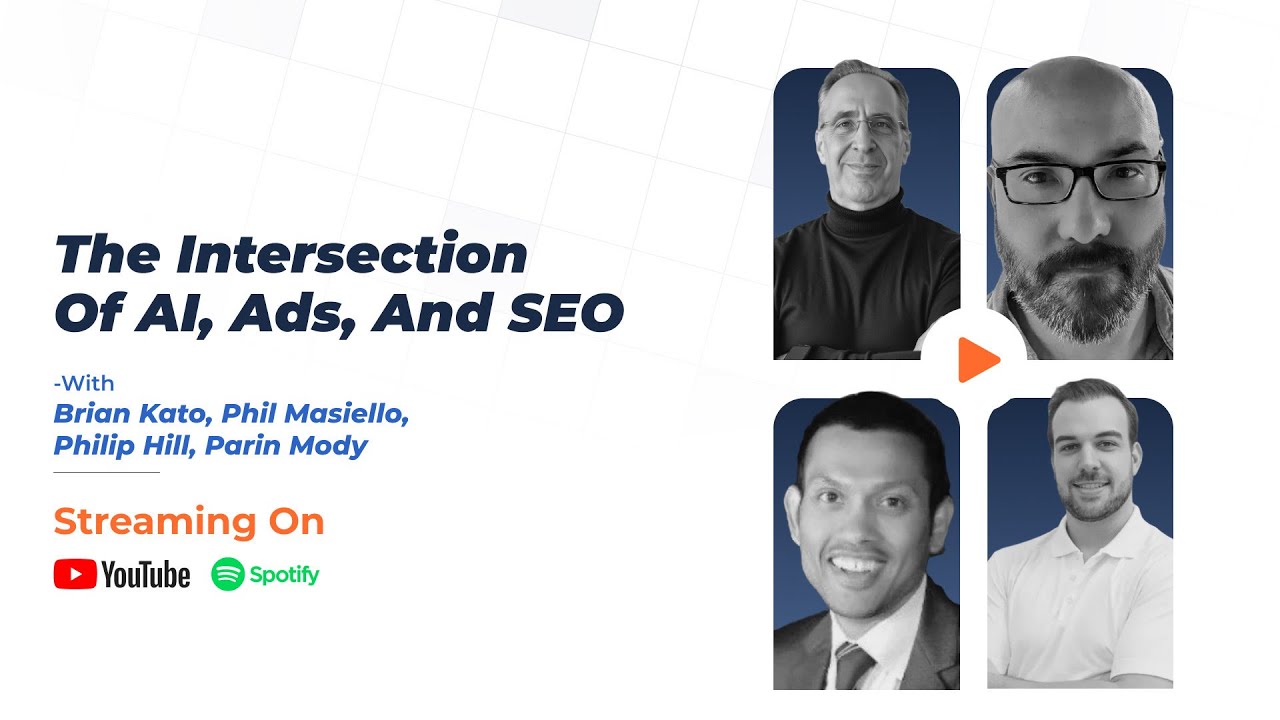
If AI-generated influencers, automated reasoning engines, and synthetic content are redefining discovery, are SEO and ads still relevant or are we clinging to outdated tools out of habit?
What followed was surprisingly insights of how AI, ads, SEO, social media, and modern consumer behavior are converging and what brands must do to survive this convergence.
Why Are Marketers Underestimating Social Media in 2025?
One of the earliest points that sparked a unanimous response: most marketers are still sleeping on social.
BK didn’t mince words. He explained that brands are still treating social media like a secondary channel when, in reality, social has become both a search engine and a discovery engine, especially for younger consumers.
This shift is not subtle. TikTok, Instagram, and YouTube Shorts have become the first stop for product research, reviews, tutorials, and trend discovery.
Meanwhile, AI-generated summaries are increasingly pulling content directly from social platforms to fuel search responses.
Yet many brands continue to rely on Google search as their main battleground.
Phil added a sobering reminder: attention on social is not just cheaper, it is profoundly more effective when brands know how to test, iterate, and deploy short-form video intelligently.
He emphasized that the formulas for high-performing UGC and social ads follow proven structures derived from decades of direct-response selling. Brands who ignore this are not just behind, they are invisible.
How Should Businesses Rethink Ads in the Age of Iteration?
The discussion around ads shifted quickly from “Do ads still work?” to “Why are brands running them wrong?”
Phillip Hill made this point sharply: ads today must be treated like modular systems, not fixed campaigns.
Every component such as creative, hook, CTA, landing page, offer structure needs its own iterative lifecycle. If one module fails, the entire system cannot perform.
Phil Masiello linked this to a deeper truth: ads alone can’t save a weak brand. If your product lacks real differentiation, no amount of creative optimization will make it profitable.
Many brands jump into paid ads before understanding their economics, customer lifetime value, retention, margins, and real acquisition thresholds.
And that’s where so many campaigns fall apart.
Phil’s anecdote about a startup deodorant brand highlighted this perfectly. A $25 product that lasts two years cannot drive sustainable paid acquisition. No creative strategy or agency magic can change the arithmetic.
Ads still work but only when the business model does.
Where Does AI Fit Into This New Marketing Ecosystem?
AI, unsurprisingly, dominated the conversation, but not from the angle many marketers expect. What stood out most: AI is no longer about retrieval, it is about reasoning.
Parin introduced the shift toward RDMa (Reasoning-Dominant Models), where AI no longer needs to store massive datasets.
Instead, it reasons through real-time information fetched from external sources. This fundamentally changes how marketers must think.
Brands can’t rely on feeding AI “static optimization signals.”
Instead, they must create content and structures that reward reasoning engines, not just keyword engines.
Phil Masiello added practical insight: his agency has seen direct purchase activity originating from ChatGPT Search, and optimizing for AI-driven search is now unavoidable.
Unlike Google, where ranking signals accumulate over time, AI search demands constant feeding, refreshing, and restructuring of information.
BK, who straddles both marketing and cybersecurity, brought a stark warning: AI search is manipulable. Extremely manipulable.
He shared that influencing AI overviews can happen in as little as six hours, making the current state of AI search similar to pre-Panda Google (when spam tactics used to dominate). This is both an opportunity and a risk, depending on the marketer.
What Happens to Authenticity in an Era of AI-Generated Creators?
One of the most heated segments came when the group tackled AI-generated influencers and UGC avatars.
Phil was direct: AI personas can’t replace real authenticity—not in consumer brands.
A single uncanny-valley mistake in an AI video can destroy trust built over months.
Phillip echoed this, explaining that trust and credibility are now make-or-break moments for consumers.
AI imitates presence, but it cannot replicate lived experience or genuine storytelling, two pillars that define modern brand loyalty.
BK, however, brought a bold counterpoint: in the AI Wild West, synthetic influencers will thrive, at least in some sectors. Faceless unboxings, AI avatars, and automated UGC workflows can drive impressions cheaply and at scale.
The problem? They may generate views, but not necessarily conversions, especially for products that require emotional connection, lifestyle aspiration, or authority.
AI will play a role but not uniformly. And certainly not without risk.
Is SEO Dead, or Just Evolving Faster Than Marketers Can Keep Up?
The question quietly shaping the entire roundtable finally came up: Is SEO still relevant?
All four experts agreed: SEO is not dead, it is transforming to AI SEO.
AI-first search does not eliminate SEO; it changes the inputs and outputs. Instead of pure keyword engineering, SEO becomes:
- A discipline of structuring information for reasoning engines
- A practice of distributing credible signals across multiple platforms
- A brand visibility exercise, not merely a ranking exercise
Phil shared a key insight: unlike Google Search, AI engines do not rely on years of accumulated ranking signals. The environment is dynamic.
Brands must update, adapt, and recontextualize content constantly to keep appearing in AI summaries.
Parin added that AI is enabling marketers to access deeper behavioral insights than ever before. This, in turn, will help brands build more strategic and data-driven funnels.
SEO isn’t dying. It’s being rewritten and the marketers who learn the new chapter early will dominate.
How Should Brands Prepare for the Next Evolution of AI Search?
The final question of the roundtable brought everything together: Where do marketers go from here?
The consensus was simple but powerful:
- Test relentlessly.
- Don’t rely on assumptions.
- Don’t chase every AI rabbit hole.
- Build foundational content and systems first.
- Use AI as a multiplier, not a substitute.
- Never ignore social media again.
And most importantly: keep evolving at the speed of the market, not the speed of your comfort zone.
Phil summed it up best: “You can’t discount anything. You have to test everything. And you must iterate without fear.”
Marketing in 2025 is about agility, clarity, differentiation, and relentless testing.
TL;DR – The Future of SEO, Ads & AI in One Snapshot
- SEO and ads are not dying, they are evolving to fit an AI-first discovery ecosystem.
- AI-driven search engines (like ChatGPT Search) now influence purchase paths, but SEO still matters for structuring clean, factual, and trustworthy content.
- Social media is massively underleveraged, it has become both a search engine and a discovery engine, especially through short-form video.
- Ads must be modular, not static. The winning brands iterate creatives, hooks, formats, and funnels rapidly.
- AI is shifting from retrieval to reasoning (RDMa), meaning content must be clear, structured, and deeply aligned with user intent.

Dipti Arora
AuthorDipti Arora is a Senior Content Writer with over seven years of experience creating impactful content across Digital Marketing, SEO, technology, and business domains. She has a strong background in managing news verticals and delivering editorial excellence. Dipti has contributed to leading publications such as The Times of India and CEO News, where her research-driven storytelling and ability to simplify complex subjects have consistently stood out. She is passionate about crafting content that informs, engages, and drives meaningful results.
