Google appears to be testing a rollback of the long-used &num=100 URL parameter that lets users show 100 search results on one page.
The change, first noticed around September 12, 2025, has produced inconsistent behavior for signed-in and signed-out users and is already affecting SEO tools and API providers.
Google Cuts Back On the 100-Result View
For years, anyone who wanted to scan beyond the first few links could tweak a setting or add &num=100 to the search URL. It was a small trick, but an important one, especially for professionals who needed to check rankings in bulk.
That shortcut, commonly referred to as the Google 100 search results parameter, now works only part of the time.
Some users still see a single page of 100 results, while others are forced back to the standard 10. The patchy rollout suggests this is a live test rather than a confirmed policy, but the ripple effects are already noticeable.
How the Change Was Spotted
The discovery started with an X post from a user who goes by SEOwner. The post included a side-by-side video showing the parameter working in one browser window and failing in another.
Google has seemingly removed the ability to do &num=100, can anyone confirm?
If you use the parameter, only 2 pages show. This “2 pages” filter has been tested for a year, but usually if you clicked to page 2 they have the rest the top 100. Now it shows nothing after page 2.
— SEOwner (@tehseowner) September 11, 2025
Why This Matters More Than it Looks
If you are an everyday searcher, you probably will not notice any change. People rarely scroll past the first handful of results, and fewer still ask to see a hundred at once. But for those who work with search data every day, the difference is huge.
SEO platforms, rank trackers, and research tools were built around the expectation that Google 100 search results could be pulled in a single sweep. Without that shortcut, the cost of collecting the same information rises, reporting cycles slow down, and long-term comparisons risk becoming messy.
In fact, many third-party tools are reporting that it now costs them ten times as much to fetch the same volume of results. Instead of one request for 100, they must issue 10 separate requests for blocks of 10 results, multiplying the strain on their infrastructure and budgets.
Early Reactions From the Industry
Reactions on X were a mix of frustration, humor, and serious concern over how dependent the SEO economy has become on the Google 100 search results setting.
Barry Schwartz of Search Engine Roundtable flagged the issue on X, warning:
Careful with the Google rank tracking tools – seems like many may be having difficulty related to this change https://t.co/Rw7baTLeoK
— Barry Schwartz (@rustybrick) September 14, 2025
His post gathered attention, drawing both concern and speculation.
Ivan Palii of Sitechecker offered three theories: that Google might be cutting infrastructure costs for non-human queries, trying to make it harder for AI systems like ChatGPT to rely on live SERPs, or simply raising the price of doing SEO.
We have this problem too at Sitechecker.
I have 3 hypotheses why Google does it:
1/ Reducing costs as much as possible on showing SERP for robots, not people.
2/ Creating difficulties for ChatGPT to use Google SERPs in its answers.
3/ Increasing the overall cost of SEO efforts,…— Ivan Palii 🇺🇦 (@IvanPalii) September 14, 2025
Others echoed the frustration. Steve Brownlie argued that Google should give occasional users some kind of fair-use option, noting that a one-off request for 100 results is not the same as automated scraping.
It kinda sucks they’re doing this broadly. They should have some kind of mechanism for fair use for logged in Google accounts. If I do this once a month because I really want to get 100 results for something just to get a feel for a set of results I’m hardly the same as OpenAI…
— Steve Brownlie (@sdbrownlie) September 15, 2025
Some responses were more lighthearted.
Still others pointed to broader implications. An account named Adguy quipped about the possibility of antitrust lawsuits from major SEO platforms. Another commenter suggested the change could trigger “an adjustment period” across the industry, hinting that providers might need to gamble on new data collection methods.
Google Search Console Data Also Looks “Off”
Many SEO professionals are also noticing oddities inside Google Search Console (GSC) itself.
Brodie Clark reported significant declines in desktop impressions, which in turn caused average position numbers to jump sharply.
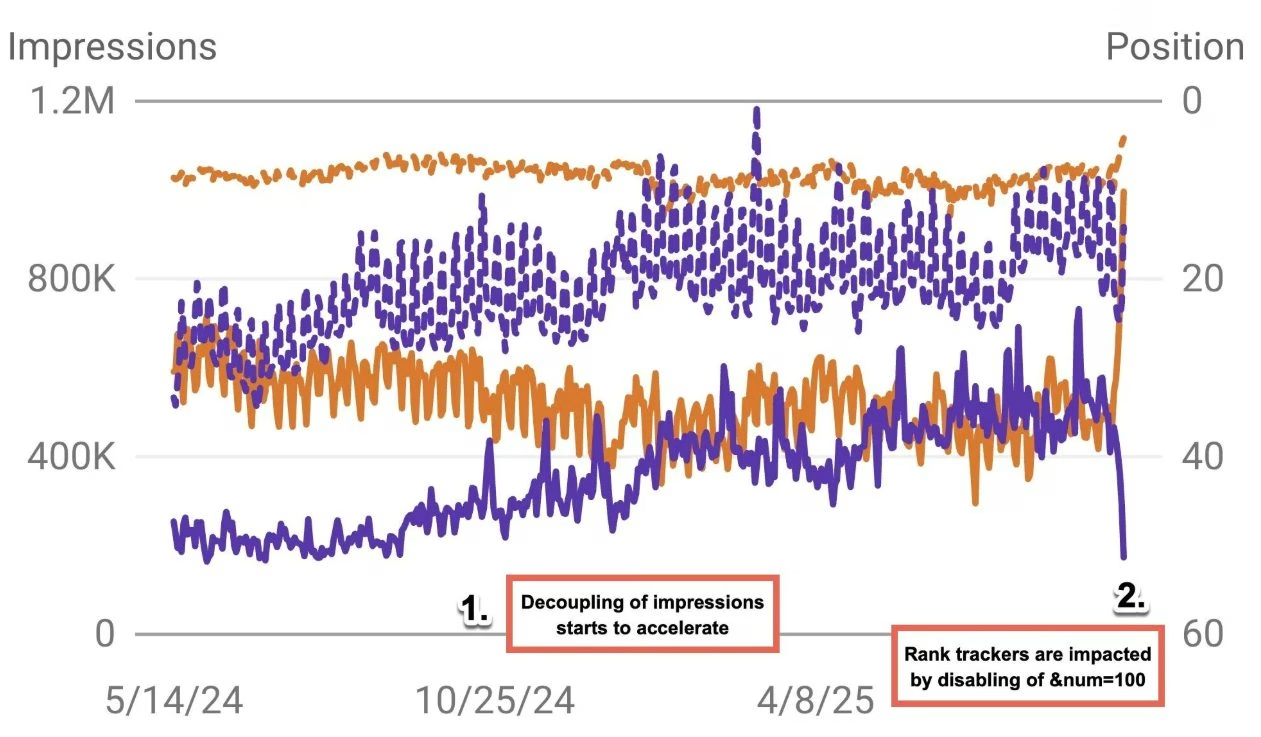
Other users echoed the same trend. This means site owners logging into GSC right now may see confusing or misleading performance metrics. The timing lines up directly with the removal of the 100 results per page option, making the connection hard to ignore.
What Actually Happens When You Ask for 100
When you request &num=100 now, some pages still return a single page with many results. In other cases, Google truncates the returned page back to the default 10 results and shows the usual pagination links.
Some vendors report that specifying num=100 returns exactly 10 results in API-style endpoints, effectively nullifying the parameter.
Why Google Might be Testing This
Google does not always explain every experiment. Still, there are sensible reasons why a company would curb single-request, bulk access.
One reason is performance. Serving giant pages with aggregated data can increase latency and system load.
Another reason is abuse control. URL parameters like &num=100 are convenient for scripts and crawlers that want to sweep a whole results set in one pass. Limiting the convenience of a single-sweep request reduces the benefit for mass scraping.
There is also a potential business angle. If third parties rely on cheap programmatic access to large swaths of search results, limiting that access can change the economics for vendors who sell search data.
Several API and analytics providers have already adjusted their systems after the change was spotted.
Who Will Be Affected First
- Rank tracking platforms that generated reports by requesting 100 results at once will see mismatches in historical comparison.
- Competitive intelligence tools that scrape SERPs for many keywords will see higher costs or slower refresh cycles.
- SEO teams that relied on quick manual checks using &num=100 will need new shortcuts or browser extensions.
- Researchers, journalists and power users who rely on one-page scanning will lose convenience.
If you run one of these operations, you should plan for temporary noise in ranking reports and test your fetch logic now rather than waiting for client complaints.
Fixes and Workarounds You Can Use Today
I did deep research and reviewed vendor notes while compiling these tips. Here are practical steps you can implement now.
- Use pagination explicitly. Request results with start=0, start=10, start=20 and so on to assemble the top 100. That matches how Google naturally serves pages and avoids relying on num. This approach is slower but reliable.
- Update your API usage. Some providers have already changed defaults and pricing. Check your vendor notices because requests that used to return 100 results may now return 10 or bill differently. DataForSEO and others announced immediate adjustments. Budget for more requests.
- Rethink sampling. Do you need the full top-100 for every keyword? For many campaigns, the most meaningful data sits in the top 20. If you can reduce depth, you lower cost and complexity. Vendors point out that CTR and click behavior tend to concentrate at shallower ranks.
- Consider browser automation when legal and permitted. For internal research, headless browsing or authenticated requests that mimic human behavior can return fuller results. This still carries proxy and maintenance costs.
- Communicate with clients up front. If you report rankings, explain that a platform-level experiment might cause small ranking shifts and give clients an accurate timeline for when fetch logic will stabilize. Several vendors reported temporary ranking noise after the change was observed.
Signals So You Can Monitor This Change
If you want to watch whether the test becomes permanent, these are sensible checks.
- Track &num=100 behavior on both signed-in and signed-out sessions. Some observers reported that the parameter failed only when logged in, or only when logged out. That difference suggests Google is testing user-state-dependent behavior.
- Watch vendor status pages and API blogs. DataForSEO, SerpApi and other providers issued early updates when the change appeared. Those posts normally show how vendors will adapt.
- Look for changes in pagination at the bottom of the SERP. Sites that reduce num usage will show the usual page links instead of a long single page. Several commentators posted side-by-side videos demonstrating that behavior.
The Larger Picture
Search is both a user-facing product and a platform with a thriving ecosystem built on programmatic access. Small changes to how results are delivered ripple outward.
When one parameter becomes unreliable, the costs of collecting data rise or the speed of insights slows. That matters for businesses that run millions of keyword checks every month.
It also changes the incentives for third parties who package search data for advertisers, journalists and research institutions. We are at a moment where how search is packaged looks like it might shift, slowly or quickly.
What I will Be Watching
I will keep an eye on vendor status pages, developer blogs and Google’s announcements for any formal confirmation. If Google confirms a permanent policy change, the next phase will be a scramble to rearchitect systems to accommodate pagination and higher request counts. Until there is an official statement, treat this as a test and plan for both temporary and long-term adaptations.
Key Takeaways
- Google is testing or has restricted the &num=100 parameter, causing it to return fewer results or behave inconsistently.
- The change surfaced in mid September 2025 and was documented by Search Engine Roundtable and posts on X.
- SEO tools and API providers are already adapting by adding pagination and adjusting pricing or defaults.
- Workarounds include explicit pagination with start=, revised API calls and tighter sampling. Expect higher costs for bulk scraping.
- For most searchers the experience will not change, but for anyone who depends on large-volume SERP access this is a meaningful operational shift.

Dileep Thekkethil
AuthorDileep Thekkethil is the Director of Marketing at Stan Ventures, where he applies over 15 years of SEO and digital marketing expertise to drive growth and authority. A former journalist with six years of experience, he combines strategic storytelling with technical know-how to help brands navigate the shift toward AI-driven search and generative engines. Dileep is a strong advocate for Google’s EEAT standards, regularly sharing real-world use cases and scenarios to demystify complex marketing trends. He is an avid gardener of tropical fruits, a motor enthusiast, and a dedicated caretaker of his pair of cockatiels.