Google and Bing have issued fresh warnings about the growing use of markdown files on websites, stating that they add technical clutter, increase crawl load, and offer no ranking advantage. Both companies stress that search systems continue to prioritize what users actually see on webpages, not simplified files created for bots or AI systems.
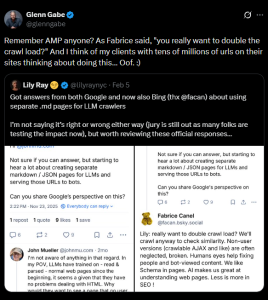
The topic resurfaced after SEO analyst Lily Ray raised a series of public questions about the growing use of markdown files on websites.
Her concerns focused on whether these files could be exploited for spam, how search engines handle differences between markdown and live pages, and whether crawling such files means they are actually being used.
Those questions prompted responses from senior figures at both Google and Bing, offering rare clarity on how search engines view markdown files today.
Search Engines Say Markdown Creates A Mess, Not Clarity
Responding on social platforms, John Mueller of Google acknowledged that the web is already difficult to manage at scale. Search systems must constantly filter broken pages, low-quality content, and abuse.
The web’s messy on its own; these services all have to filter out things that don’t work. Of course they’ll also filter out things (and sites) that are purposely abusive. Even basic SEO tool metrics like DA do that.
— John Mueller (@johnmu.com) February 14, 2026 at 1:04 PM
From Google’s perspective, markdown files are harder to audit, harder to debug, and more likely to contain errors. When those files exist mainly to influence bots instead of users, they become easy candidates for filtering or ignoring entirely.
Bing made the same point, using more direct language.
Fabrice Canel questioned who would maintain markdown files when they break or fall out of sync with the real webpage. He emphasized that modern search systems already understand full HTML pages extremely well and do not need simplified alternatives.
💯 Lily. How will you know when .md transform is half-broken on a page? Who will fix? In the AI era we understand webpages perfectly, no need for sub-standard. Think: we rank based on what customers see. As crawlable ajax, anything not real or not well managed by SEOs will die!
— Fabrice Canel (@facan) February 14, 2026
Bing ranks pages based on the experience shown to users. Anything artificial, incomplete, or poorly managed is unlikely to hold value over time.
Crawling Does Not Mean Content Is Being Used
One of the most important clarifications to emerge from this discussion is the difference between crawling and usage. Just because a search engine or AI system crawls a markdown file does not mean it is trusted, ranked, or used to generate answers.
Publishers often assume that bot activity equals approval. Google and Bing are pushing back on that idea. Systems may crawl markdown files, then discard them entirely if they offer no user value or introduce inconsistencies.
This becomes even more critical when markdown files show content that differs from what users see on the actual webpage. Any mismatch raises quality concerns and can weaken overall trust signals.
Concerns About Spam And Manipulation
The discussion also touched on a larger issue facing AI-driven systems.
As more content is created specifically to influence machine responses, search engines expect to see rising attempts at manipulation.
Markdown files aimed only at bots are an obvious target for spam filtering. If those files are used to present exaggerated, optimized, or misleading versions of content, they may be removed from consideration before they influence search or AI outputs at all.
Comparisons To Amp Miss A Key Difference
Some industry voices have compared markdown experimentation to the early days of AMP. The comparison falls apart quickly.
AMP came with clear incentives, including speed benefits and visibility advantages. Markdown files come with no confirmed rewards. They increase crawl demand, add maintenance overhead, and introduce risk without offering measurable gains.
What Publishers Should Do Instead
Many companies run into markdown decisions while redesigning a site, changing platforms, or testing ways to improve how their content appears in search and AI tools. These choices are often made quickly, without a clear sense of how search engines will treat the added files.
Google and Bing are warning that this approach can backfire.
Adding extra file formats increases the number of URLs search engines must process, makes sites harder to maintain, and raises the risk of content drifting out of sync. These problems usually surface later, when traffic dips or crawling issues appear.
This is often where professional SEO services prove useful. Instead of chasing untested ideas, experienced teams help businesses pressure-test technical changes before they go live. With markdown files in particular, the safer move is often deciding not to add another layer at all.
What search engines are emphasizing is that pages built for users are easier to crawl and more likely to perform well over time.
Key Takeaways
- Google and Bing have made it clear that publishing .md files offers no SEO advantage.
- Public markdown files add more URLs for search engines to process. This increases crawl demand without improving content quality or visibility.
- A markdown file being crawled does not mean it is trusted, ranked, or used in search or AI responses. Many of these files may be filtered out entirely.
- When markdown content does not exactly match the visible webpage, it raises quality and trust concerns that can weaken overall site signals.
- Both Google and Bing emphasized that their systems can fully process and rank standard HTML pages, making simplified or bot-focused versions unnecessary.

Zulekha
AuthorZulekha is an emerging leader in the content marketing industry from India. She began her career in 2019 as a freelancer and, with over five years of experience, has made a significant impact in content writing. Recognized for her innovative approaches, deep knowledge of SEO, and exceptional storytelling skills, she continues to set new standards in the field. Her keen interest in news and current events, which started during an internship with The New Indian Express, further enriches her content. As an author and continuous learner, she has transformed numerous websites and digital marketing companies with customized content writing and marketing strategies.
