Google has once again clarified that changes in crawling patterns are not tied to major algorithm updates.
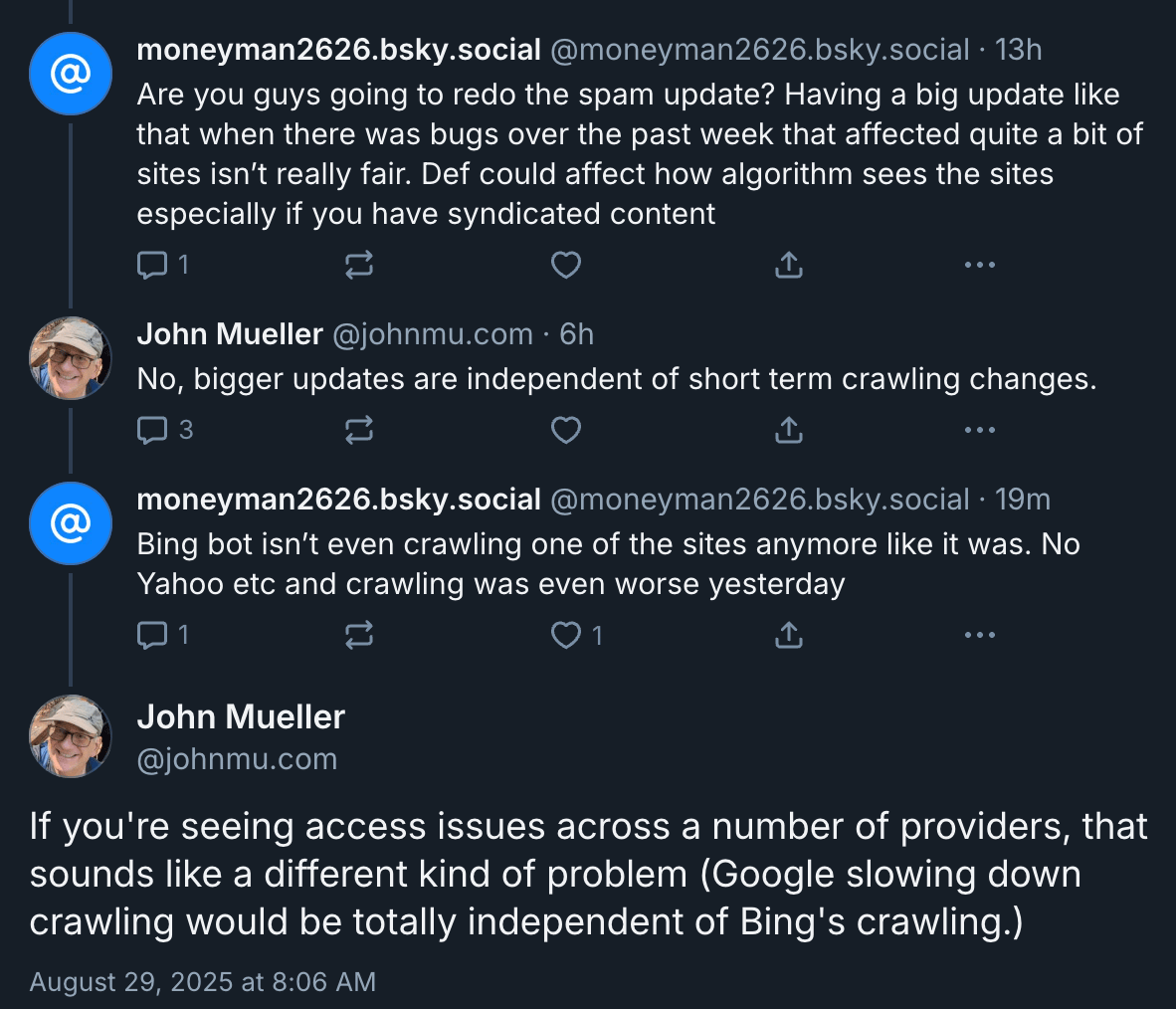
The latest statement came from John Mueller, Google Search Advocate, who responded to a query on Bluesky. His words were definitive:
“No, bigger updates are independent of short term crawling changes.”
The comment may sound routine, but it addresses one of the most persistent SEO debates: do spikes or drops in crawl rates signal that a major Google update is underway?
According to Mueller, as Google has said for nearly a decade, the answer is no.
If Google has said this so many times before, why does the rumor resurface every few months? Why do so many SEOs remain convinced that crawl rate fluctuations are early signs of an update?
Why Do SEOs Believe Crawl Rate Spikes Signal Updates?
For years, site owners and SEOs have noticed sudden surges or declines in Googlebot activity just before confirmed updates.
To them, the pattern feels obvious: more crawling must mean Google is preparing to recalculate rankings.
In reality, Googlebot’s crawl activity is largely about maintaining index freshness, testing new URLs and ensuring site accessibility. Changes in crawl rate can be triggered by server performance, site structure changes or even just shifts in how Google prioritizes certain pages.
Yet the belief persists, because in SEO, timing coincidences often get mistaken for causal links. When traffic drops and crawl spikes overlap with an algorithm update, it is easy to assume one caused the other.
What Has Google Said About This in the Past?
This is not the first time Google has addressed the myth.
- In 2016, Gary Illyes of Google explicitly said it was a “myth” that crawl spikes relate to algorithm updates.
- In 2019, John Mueller reiterated that crawling activity is not a precursor to updates.
- Over the years, both Mueller and other Googlers have repeatedly said the same thing: crawling and ranking systems are separate.
The latest clarification on Bluesky is just one more entry in this long history. Mueller even added a side note: Google has no control over Bing’s crawling, and Bing has no influence over Google’s. For anyone hoping that competing crawlers “signal” updates in tandem, the answer is a clear no.
How Does Crawling Actually Work at Google?
To understand why crawling is separate from updates, it helps to look at how Googlebot works.
Crawling is Google’s way of discovering and refreshing content on the web. It decides what to crawl based on factors like:
- Page importance: internal linking, external backlinks, sitemap inclusion.
- Crawl budget: how many resources Google allocates crawl budget to a site without overloading servers.
- Freshness signals: how often a page changes or whether new URLs have been discovered.
This process runs continuously. Updates, on the other hand, are algorithmic recalibrations of how results are ranked. They involve processing and re-weighting signals in the index, not changing how pages are fetched.
In other words, crawling fills the library with books, while ranking updates decide which books go on the front shelf.
Why Does Google Keep Repeating This?
If Google has explained this so many times, why keep repeating it? The answer lies in SEO culture.
Every time a broad core update or spam update rolls out, SEO forums light up with speculation. Someone inevitably notices unusual crawl logs, and the theory that crawling signals updates resurfaces.
It becomes a cycle: Google denies it, SEOs remain skeptical, and the conversation repeats with every update.
Part of the skepticism comes from distrust. Many SEOs feel Google is not always transparent about updates, so they search for indirect clues. Crawl rate seems like one of those “tells,” even if Google insists it isn’t.
Do Crawl Spikes Have Any SEO Meaning at All?
This is where nuance is important. While crawl changes are not tied to updates, they can still be meaningful for site owners.
A sudden crawl spike might indicate that Google discovered a new section of your site, such as a blog archive or updated product catalog. A drop might suggest that Google is deprioritizing certain content or that your server is slowing responses.
In those cases, crawl activity is about your site, not about Google’s updates. Monitoring logs remains valuable, but interpreting them as “Google is updating” is misguided.
Can Crawling Patterns Predict Indexing or Ranking Changes?
Not directly. A crawl spike does not mean your rankings are about to change. However, crawling is the first step in getting indexed. If Google crawls new content, it may soon appear in search results.
For example, if you publish a major news story and see Googlebot hit the page within minutes, that is a sign it is eligible to surface quickly in results. But that is about content freshness, not a sign of a global algorithm update.
Similarly, if you launch thousands of new product pages and see a gradual crawl increase, that signals Googlebot is working through them. Again, that’s about site-specific discovery, not core ranking shifts.
What About Bing and Other Crawlers?
Mueller’s aside about Bing is worth noting. Sometimes, SEOs speculate that both Google and Bing’s crawling patterns line up before updates. Mueller made it clear: there is no connection. Each search engine runs its own crawl infrastructure, independent of the others.
This matters because the myth of “cross-crawler correlation” has also circulated in forums. If you see both bots increase activity, it likely means your site triggered more interest, not that both engines are synchronizing updates.
How Should SEOs Monitor Crawl Logs in 2025?
Despite the myth-busting, crawl log monitoring remains a valuable SEO practice. It helps diagnose:
- Indexing issues: Are important pages being crawled regularly?
- Crawl budget usage: Are low-value pages wasting resources?
- Server health: Are spikes overwhelming your server capacity?
For instance, e-commerce sites with millions of SKUs often track crawl patterns to ensure product pages are discovered. Publishers monitor crawl rates on breaking news to confirm rapid indexing.
But what SEOs should not do is interpret crawl fluctuations as “Google update signals.” The logs tell you about how Google sees your site, not about the global state of search.
What Does This Mean for SEO Strategy?
The takeaway is simple, but it matters. Algorithm updates and crawl behavior are separate systems. Treating crawl patterns as “update early warnings” is a distraction.
Instead, SEOs should focus on fundamentals: improving site performance, ensuring crawlable architecture, publishing high-quality content, and aligning with Google’s spam and core update guidelines.
Watching crawl logs still matters, but as a site health metric, not an update predictor.

Dileep Thekkethil
AuthorDileep Thekkethil is the Director of Marketing at Stan Ventures, where he applies over 15 years of SEO and digital marketing expertise to drive growth and authority. A former journalist with six years of experience, he combines strategic storytelling with technical know-how to help brands navigate the shift toward AI-driven search and generative engines. Dileep is a strong advocate for Google’s EEAT standards, regularly sharing real-world use cases and scenarios to demystify complex marketing trends. He is an avid gardener of tropical fruits, a motor enthusiast, and a dedicated caretaker of his pair of cockatiels.
