Google has confirmed that its search systems do not penalize or restrict pages simply because of poorly written or frequently changed title tags, addressing concerns raised by site owners who noticed title updates not appearing in Google Search.
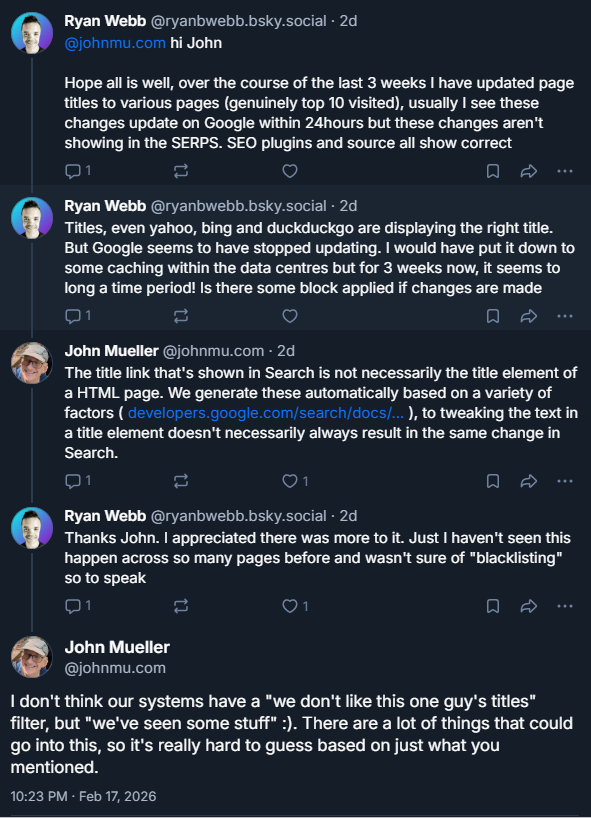
Ryan Webb reported that after updating title tags on several of his highest-traffic pages, Google did not reflect those changes in search results for more than three weeks. This behavior was unusual, as previous title updates typically appeared within 24 hours.
The issue stood out because the updated titles were visible in page source code, SEO plugins, and other search engines, including Bing, Yahoo, and DuckDuckGo. Google alone continued to show older titles.
This led to a specific concern. Was Google applying some form of restriction because titles were changed too often or across many pages?
Google’s Position Is Explicit
John Mueller, Google Search Advocate, responded on Bluesky and rejected that idea directly.
Google does not operate a system that suppresses pages or sites because of “bad” title tags. There is no blacklist, no site-level filter, and no mechanism that limits visibility based solely on title quality or frequency of edits.
Mueller stated that Google’s systems do not include a rule equivalent to “we don’t like this site’s titles.”
Why Google May Ignore the HTML Title Tag
Mueller also clarified that the title shown in Google Search is not always taken from the HTML title element.
Google generates what it calls a “title link.” This is created automatically using multiple signals. As a result, changing the title tag does not guarantee that Google will display the same text in search results.
This behavior is expected and does not indicate indexing problems or penalties.
What a Missing Title Update Actually Means
When Google continues to show an older title, it does not mean a change was blocked or rejected.
It means Google’s systems determined that another version better represents the page based on available signals. Mueller noted that many factors can influence this outcome, making it difficult to diagnose from limited information.
What he ruled out clearly is intentional suppression tied to title edits.
Implications for Site Owners and SEO Teams
This clarification removes a common fear. Updating titles does not carry an inherent risk, even when changes are made across many pages.
However, relevance still matters. If a title does not clearly match the page content, Google may choose an alternative for search results.
This is a representation decision, not an enforcement action.
Practical Guidance for Handling Title Updates
When updated titles do not appear in Google Search, the next steps should focus on clarity rather than concern.
Here are the actions site owners should prioritize.
- Check that the title clearly reflects the page’s main topic and visible content.
- Align the title tag closely with the primary on-page heading.
- Avoid vague, generic, or repeated titles across multiple pages.
- Allow adequate time for Google to recrawl and reassess before making further changes.
- Compare Google’s displayed title with your own to see which better summarizes the page.
On larger sites or where title changes happen frequently, professional SEO services can help review updates at scale and assess alignment between page content and search presentation.
Key Takeaways
- Google does not suppress pages because of poor or changing titles.
- There is no system that limits visibility based on title quality alone.
- Search result titles are generated independently of the HTML title tag.
- A title not updating does not indicate a penalty or block.
- Alignment between title text and page content drives how titles are shown.

Zulekha
AuthorZulekha is an emerging leader in the content marketing industry from India. She began her career in 2019 as a freelancer and, with over five years of experience, has made a significant impact in content writing. Recognized for her innovative approaches, deep knowledge of SEO, and exceptional storytelling skills, she continues to set new standards in the field. Her keen interest in news and current events, which started during an internship with The New Indian Express, further enriches her content. As an author and continuous learner, she has transformed numerous websites and digital marketing companies with customized content writing and marketing strategies.

