New data shows that the decline in organic search traffic is being driven less by AI features alone and more by a rapid expansion of paid placements, fundamentally reshaping how clicks are distributed on Google search results.
Organic search traffic has been under pressure for some time, and many marketers have pointed to AI Overviews as the primary reason.
While AI-driven results are becoming more visible, new evidence suggests they are only part of a broader transformation. Paid placements, particularly text ads, are absorbing a growing share of user clicks across multiple industries.
Using Similarweb data, Aleyda Solis analyzed Google search results from January 2025 to January 2026 across four major US verticals: headphones, jeans, online games, and greeting cards and e-cards.
Thousands of high-volume queries were examined to understand how clicks are now distributed among classic organic listings, paid ads, product listing ads, SERP features, zero-click results, and AI Overviews.
The pattern is consistent across all categories.
Traditional organic listings are losing visibility, paid results are expanding rapidly, and search performance is becoming more closely tied to advertising investment.
Organic Click Share Is Falling Across Every Category
Every vertical studied experienced a noticeable decline in the share of clicks going to classic organic results.
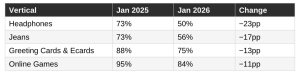
In the headphones category, organic click share fell from 73% to 50% within a single year. Jeans followed a similar trajectory, dropping from 73% to 56%. Even online games, long considered one of the most organic-friendly categories, saw organic clicks decline from 95% to 84%.
This matters because it shows that organic traffic loss is not confined to specific niches. It is happening across commerce, content, and entertainment searches alike.
In some cases, the challenge is intensified by shrinking total click volume. For headphones and jeans, overall clicks across top queries declined year over year, meaning organic sites are competing for fewer opportunities while paid placements multiply.
Text Ads Are Taking the Largest Share of Growth
While AI Overviews often dominate conversations, the data shows that text ads are the biggest winners in terms of click share.
Across every vertical, text ads grew sharply.
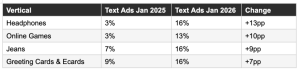
In headphones, text ads increased from 3% to 16% of total clicks. Online games saw text ads jump from 3% to 13%, a striking change for a category that historically had minimal advertising. Jeans and greeting cards followed the same upward trend.
In product-focused categories, the impact is even stronger when text ads are combined with product listing ads. Paid results now capture more than one-third of all clicks in both headphones and jeans, compared to less than one-fifth just a year earlier.
This helps explain why many brands report declining organic performance even when rankings appear unchanged. The space surrounding those rankings has become increasingly dominated by paid placements that intercept clicks first.
AI Overviews Are Expanding, but Unevenly
AI Overviews are appearing on far more search results than before, though their growth varies widely by category.
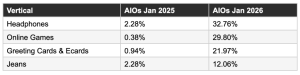
In headphones and online games, AI Overviews appeared on nearly one-third of search results by January 2026. Jeans showed more moderate growth, reaching just over 12%, while greeting cards fell between these ranges.
It is important to note that this data tracks how often AI Overviews appear, not how many clicks they receive. While they may reduce the need for some users to click, the data clearly shows that ads are capturing a larger share of the clicks that still occur.
Zero-Click Searches Remain High
Zero-click searches continue to account for a large portion of user behavior, typically ranging between 50% and 65% across the categories studied.
With the exception of online games, where zero-click activity increased more noticeably, these rates remained largely stable year over year. This suggests the core issue is not fewer clicks overall, but rather where those clicks are being directed.
When users do click, a growing proportion of those clicks now go to paid results instead of organic listings.
Brands Are Buying Their Way Back Into Visibility
One of the clearest signals in the data is how brands are responding to declining organic reach.
Companies losing organic clicks are often the same ones increasing paid investment. Large retailers, marketplaces, and direct-to-consumer brands are spending more aggressively on search ads to maintain visibility.
In several verticals, brands appeared among the top paid advertisers without appearing in the organic top results at all. This reflects a growing willingness to rely on paid exposure rather than compete for shrinking organic real estate.
At the same time, competition for paid clicks is intensifying. Lower-paid positions now generate significantly more clicks than they did a year ago, indicating that more advertisers are crowding into the same spaces.
Social and Video Platforms Are Gaining Organic Ground
While many publishers and brand websites lost organic traffic, certain platforms consistently gained ground.
YouTube increased organic clicks across multiple categories. Reddit showed strong growth in online games. Instagram gained traction in the jeans category. These platforms are capturing attention as traditional sites lose visibility.
This pattern suggests that Google is increasingly rewarding content formats centered on video, community interaction, and visual discovery. For brands, relying only on their own websites is becoming less effective than maintaining visibility across multiple ecosystems.
What This Means for Search Strategy
The data makes it clear that organic traffic decline should not be treated as an AI-only issue. Paid placements are playing a larger and more measurable role in reshaping search outcomes. As a result, businesses can no longer rely on isolated tactics and increasingly turn to professional SEO services to understand how ads, AI features, and evolving SERP structures affect real click behavior.
Search strategies based on assumptions from even a year ago may no longer hold. Understanding who is buying clicks, how results pages are structured, and where attention flows is now just as important as tracking rankings.
For many businesses, this requires rethinking budget allocation, content formats, and success metrics. Rankings alone no longer tell the full story.
How to Respond Moving Forward
Here are practical steps businesses and marketers can take to adjust to the changing structure of Google search and protect visibility in an increasingly paid-heavy environment:
- Analyze your actual search results, not just rankings. Review how many ads appear for your priority keywords, where they sit on the page, and how much screen space organic results realistically occupy.
- Reassess paid search strategy using current click distribution. In many verticals, the balance between organic and paid traffic has shifted far more quickly than expected, making older budget assumptions unreliable.
- Expand content efforts beyond traditional web pages. Video platforms, social communities, and visual discovery channels are playing a growing role in organic visibility and should be treated as core assets, not side projects.
- Track performance using real click behavior and SERP composition. Measuring positions alone no longer reflects search reality, as ads, SERP features, and zero-click elements increasingly shape outcomes.
Key Takeaways
- Organic click share is declining across every major category studied.
- Text ads are capturing the largest share of redirected clicks.
- Paid results now dominate a growing portion of high-intent searches.
- AI features are expanding, but their influence varies by industry.
- Search visibility is increasingly linked to advertising investment.

Zulekha
AuthorZulekha is an emerging leader in the content marketing industry from India. She began her career in 2019 as a freelancer and, with over five years of experience, has made a significant impact in content writing. Recognized for her innovative approaches, deep knowledge of SEO, and exceptional storytelling skills, she continues to set new standards in the field. Her keen interest in news and current events, which started during an internship with The New Indian Express, further enriches her content. As an author and continuous learner, she has transformed numerous websites and digital marketing companies with customized content writing and marketing strategies.
