
Large language models are changing how content is discovered, evaluated, and cited online. A new technical guide by Pedro Dias explains in detail how retrieval-augmented generation (RAG) systems retrieve, rank, and cite content.
In his study he mentioned why traditional SEO signals alone are no longer sufficient for visibility in generative search experiences.
This outlines how modern AI systems move beyond keyword matching and link building authority, instead selecting sources based on semantic relevance, information gain, and reasoning-based validation.
How Does LLM Retrieval Differ From Traditional Search?
Traditional search engines retrieve documents by matching query terms to indexed pages using lexical signals such as TF-IDF or BM25, combined with authority metrics like PageRank.
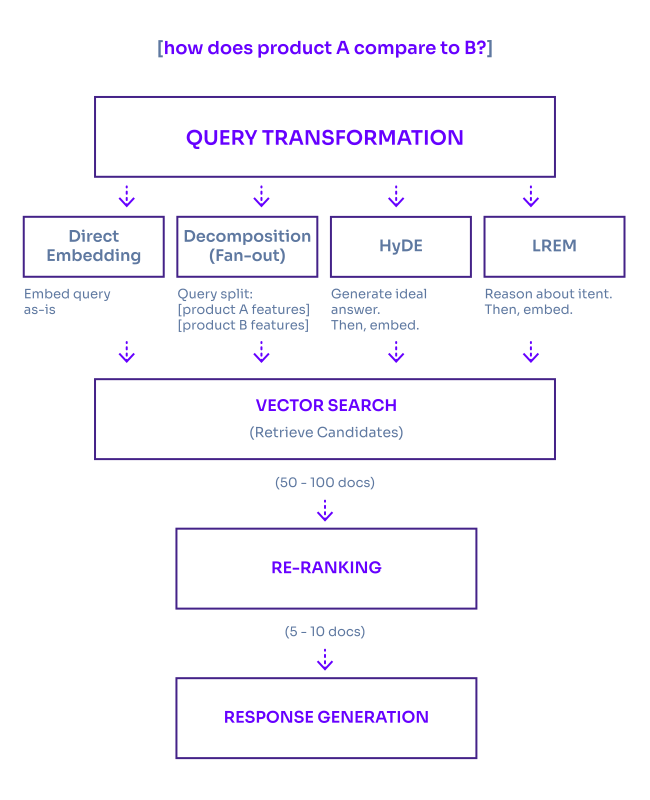
In contrast, LLM-driven retrieval evaluates content by meaning rather than exact wording.
RAG systems encode both queries and documents into high-dimensional vector representations.
Retrieval then becomes a geometric problem: documents closest to the query in semantic space are selected.
This allows AI systems to surface relevant content even when vocabulary differs, solving the long-standing “vocabulary mismatch” problem common in keyword search.
Traditional Search vs LLM + RAG Systems
| Aspect | Traditional Search Engines | LLM + RAG Systems |
| Retrieval Method | Keyword-based (BM25, TF-IDF) | Semantic vector embeddings |
| Query Matching | Exact or partial keyword matches | Meaning-based similarity |
| Ranking Signal | Links, authority, relevance | Semantic relevance + reasoning |
| Content Unit | Full web pages | Extracted passages or chunks |
| Re-ranking | Based on static ranking factors | Query-document relevance scoring |
| Selection Logic | Rank-first, then display | Retrieve → filter → reason → select |
| Citation Criteria | Page-level authority | Evidence-level support |
| Redundancy Handling | Multiple similar results shown | Redundant content filtered out |
| Information Gain | Not explicitly measured | Actively optimized |
| Attribution | Manual user click | Automated citation attachment |
| Traffic Outcome | Click-driven discovery | Answer-driven consumption |
| Visibility Metric | Rankings & CTR | Selection rate & citation frequency |
Why Have RAG Systems Moved From Keywords to Vectors?
Vector embeddings allow content with similar meaning to cluster together, regardless of phrasing.
For example, a query about resetting login credentials can retrieve content discussing password recovery, even if the exact terms do not match.
However, this shift introduces new limitations.
Embeddings reflect relationships learned during model training, meaning unfamiliar concepts or poorly represented entities may not retrieve effectively.
Additionally, searching large vector spaces is computationally expensive, so production systems rely on approximate nearest neighbor algorithms.
This creates non-determinism, where the closest match may occasionally be missed, one reason AI visibility tracking remains imperfect.
Why Do RAG Systems Use Hybrid Retrieval Instead of Pure Semantic Search?
Semantic search alone struggles with precise identifiers such as brand names, product models, or technical specifications.
To address this, RAG systems combine semantic retrieval with traditional keyword search.
Most production systems run two searches in parallel:
- Semantic search to identify meaningfully related content
- Keyword search to capture exact terms
Results are merged using reciprocal rank fusion, prioritizing documents that perform well in both lists.
This explains why exact terminology still matters in AI search environments, even as semantic relevance dominates.
How Do RAG Systems Transform Queries Before Retrieval?
Raw user queries are often ambiguous or incomplete. RAG architectures address this through query transformation, improving retrieval accuracy before embedding occurs.
The guide outlines three common approaches.
- Query decomposition splits complex questions into simpler sub-queries.
- Hypothetical document embeddings generate an idealized answer first and use that as the retrieval query.
- Reasoning-then-embedding expands the query by explicitly articulating user intent before embedding.
These transformations are applied selectively, with systems first classifying whether a query requires additional processing.
This reduces computational cost while improving relevance for complex searches.
What Happens During Re-Ranking After Initial Retrieval?
Initial retrieval is designed for speed, often returning dozens of candidate documents. Re-ranking then acts as a second, more precise filter.
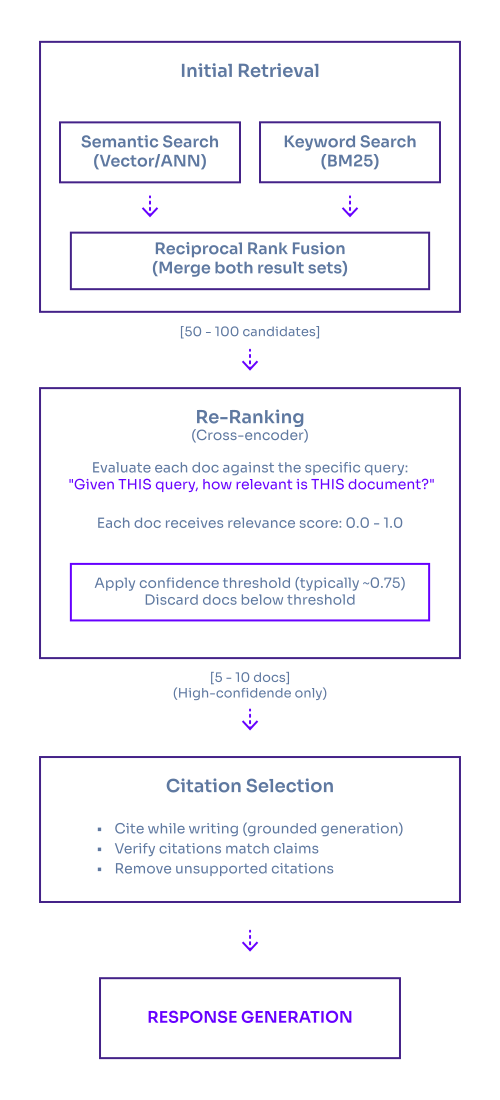
During re-ranking, the system evaluates each document in direct relation to the query, assigning a relevance score.
Documents below a confidence threshold are discarded entirely.
Rather than passing full pages to the language model, the system extracts targeted excerpts, assembling only the most relevant passages into a compact context.
This stage rewards content that answers specific questions directly. Broad but unfocused pages may pass initial retrieval yet fail during re-ranking due to lack of topical precision.
Why Are RAG Systems Moving Beyond Ranking to Rationale-Based Selection?
Newer systems no longer rely solely on similarity scores. Instead, they generate a rationale, a description of what evidence is required to answer the query correctly before selecting sources.
Retrieved content is evaluated against this rationale, not just against the query itself.
Research cited in the guide shows that this approach reduces the amount of content retrieved while improving answer accuracy by more than 33%.
Selection is driven by whether a source genuinely supports the needed claims, not whether it simply appears relevant.
How Do Citations Get Attached in AI-Generated Responses?
Citation mechanisms vary across systems.
Some models generate answers first and attach citations afterward, increasing the risk of weak or mismatched attribution.
Others cite while writing, only making claims that can be immediately grounded in retrieved sources.
Some platforms add a verification step after generation, checking whether cited sources actually support the claims made.
If evidence is insufficient, claims may be rewritten or removed. In stricter systems, the model may return no answer at all rather than risk unsupported output.
Importantly, being retrieved does not guarantee being cited. Content may rank highly during retrieval yet be discarded during re-ranking or verification.
How LLMs and RAG Systems Retrieve, Rank, and Cite Content 🤖 A must read A technical guide by @pedrodias to understanding retrieval-augmented generation architecture and its implications for content visibility in generative search:
* How does LLM retrieval differ from… pic.twitter.com/3MjFRMieCO
— Aleyda Solis 🕊️ (@aleyda) December 19, 2025
Why Is Information Gain a Critical Selection Signal?
The guide highlights information gain as a key factor in source selection. AI systems aim to synthesize complete answers, prioritizing sources that contribute new or complementary information.
If multiple documents repeat the same consensus points, they become redundant in vector space and are filtered out.
Sources offering examples, statistics, edge cases, or advanced nuance are more likely to be selected.
This enhances differentiation as a primary visibility signal in generative search.
What Role Do Structured Data and Entities Play in RAG Systems?
Structured data has clear benefits in traditional search, but its role in RAG systems is less definitive.
What is clear is that clean, well-structured HTML is easier for systems to parse accurately.
Entity recognition plays a more significant role. Content associated with recognized entities, brands, products, people, may receive trust signals through knowledge graph alignment.
However, evidence that schema markup directly improves RAG retrieval or citation remains inconclusive.
The conservative recommendation is to implement structured data for traditional SEO benefits, not as a primary AI visibility lever.
How Is This Changing Traffic and Visibility Patterns?
The deployment of AI-mediated retrieval has already altered user behavior.
Research cited in the guide shows that when AI Overviews are present, users click on citations less than 1% of the time.
Users are also significantly more likely to end their search session after reading an AI summary.
This represents a structural shift rather than a temporary fluctuation.
Generative systems evaluate content at the passage level using embeddings and information gain, not at the page level using link authority.
As a result, traditional ranking positions and click-through rates provide incomplete visibility signals.
Key Takeaways
- LLM retrieval prioritizes semantic meaning over keyword matching
- Hybrid retrieval still rewards exact terminology for entities and identifiers
- Re-ranking and rationale-based selection favor precise, question-focused content
- Citations depend on evidence support, not retrieval alone
- Information gain differentiates content in AI responses
- Visibility is increasingly decoupled from traffic in generative search

Dipti Arora
AuthorDipti Arora is a Senior Content Writer with over seven years of experience creating impactful content across Digital Marketing, SEO, technology, and business domains. She has a strong background in managing news verticals and delivering editorial excellence. Dipti has contributed to leading publications such as The Times of India and CEO News, where her research-driven storytelling and ability to simplify complex subjects have consistently stood out. She is passionate about crafting content that informs, engages, and drives meaningful results.
