
Apple’s latest Safari update finally gives website owners a clear view of how their sites perform for Apple users, addressing a long-standing gap in real user performance data.
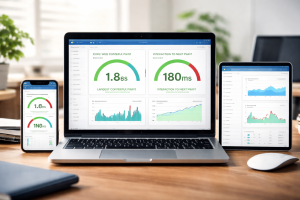
Apple has rolled out Safari 26.2 with a change that matters significantly to publishers, e-commerce teams, and performance-focused marketers.
For the first time, Safari now supports direct measurement of two Core Web Vitals metrics, Largest Contentful Paint and Interaction to Next Paint, through the browser’s Performance API
The change allows websites to collect real-world performance data from Safari users on iPhone, iPad, and Mac using their own analytics and monitoring tools.
What Safari Is Now Measuring
The update introduces two APIs that directly impact performance reporting.
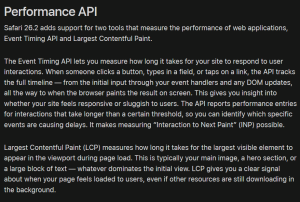
Largest Contentful Paint tracks how long it takes for the most visually dominant element on a page to appear. This could be a hero image, a headline, or a major content block. LCP helps answer a simple question users care about. Does the page feel loaded yet?
The Event Timing API enables measurement of Interaction to Next Paint. INP captures the delay between a user action, such as a tap or click, and the moment the browser updates the screen. It reports the slowest interaction during a session, which makes it especially useful for spotting moments when a page feels unresponsive or stuck.
Here’s the screenshot taken from Apple’s official documentation:
Why This Fills an Important Gap
LCP is a Core Web Vitals ranking signal, and INP is a key measure of responsiveness.
While Google evaluates rankings using Chrome-based data, site owners still need a complete picture of how real users experience their pages.
Safari users have long been underrepresented in field performance reports. That made it harder to diagnose issues that only appeared on Apple devices or under Safari’s rendering behavior. With this update, those blind spots begin to disappear.
Fast interactions matter as much as fast loads. A page that loads quickly but responds slowly to taps or clicks still feels broken. INP helps surface those problems in a way older metrics could not.
What This Update Does Not Change
This change does not affect public tools such as PageSpeed Insights or the Chrome User Experience Report. Those tools remain Chrome-based and will continue to show Chrome-only data.
The impact is limited to first-party measurement. Safari users can now be included in performance data collected through analytics and real user monitoring platforms, as long as site owners have configured those tools correctly.
Analytics and Monitoring Tools That Benefit
Safari’s new support allows performance data to flow into widely used platforms such as Google Analytics 4, Adobe Analytics, Matomo, Amplitude, Mixpanel, and custom in-house systems.
Real User Monitoring platforms can also surface this data, including Cloudflare Web Analytics, Datadog RUM, New Relic Browser, SpeedCurve, Sentry Performance, and others.
For teams already tracking performance trends, Safari traffic no longer needs to be treated as a question mark.
How Teams Can Use This Data Effectively
Site owners should first confirm that their analytics or RUM setup is collecting Performance API data from Safari browsers.
From there, teams can compare Safari behavior with Chrome data to identify browser-specific issues. INP data can highlight slow JavaScript handlers or delayed visual updates, while LCP can reveal loading problems tied to images, fonts, or layout decisions.
Why This Matters Beyond Metrics
Safari 26.2 does not change how Google ranks pages, but it does change how clearly site owners can understand user experience across devices.
With Apple traffic finally visible in Core Web Vitals reporting, teams can make decisions based on real behavior rather than assumptions. That leads to faster interactions, fewer frustrating delays, and a more consistent experience for users browsing on Apple devices.
Key Takeaways
- Safari 26.2 now supports direct measurement of Largest Contentful Paint and Interaction to Next Paint using the browser’s Performance API.
- Site owners can finally collect real user performance data from Safari visitors on Apple devices.
- The update helps identify responsiveness and loading issues that previously went unseen in Safari traffic.
- Public tools like PageSpeed Insights remain unchanged because they rely on Chrome-based data.
- With Safari metrics available, teams can make performance decisions based on a more complete view of user experience.

Zulekha
AuthorZulekha is an emerging leader in the content marketing industry from India. She began her career in 2019 as a freelancer and, with over five years of experience, has made a significant impact in content writing. Recognized for her innovative approaches, deep knowledge of SEO, and exceptional storytelling skills, she continues to set new standards in the field. Her keen interest in news and current events, which started during an internship with The New Indian Express, further enriches her content. As an author and continuous learner, she has transformed numerous websites and digital marketing companies with customized content writing and marketing strategies.
