Google has been struggling with a big question for years: Should website owners be able to control how Google’s AI uses, scrapes, or displays their content?
The newly surfaced court documents from the U.S. Department of Justice’s monopoly case against Google reveal a behind-the-scenes debate inside the company.
The document, posted on X by Nate Hake, shows Google evaluated six different options, ranging from doing nothing… to giving publishers deep control over indexing, training, grounding, and AI Overviews (previously called SGE).
The surprising part? Google appears to have chosen the option its own team labeled “likely unstable.”
This alone raises important questions: Why was it chosen? What does it say about Google’s stance on publisher autonomy? Let’s find out.
Google won’t even let website owners **choose** if AI Mode scrapes our content
Court docs show Google debated it internally but drew a “hard red line” against giving publishers choice https://t.co/VzhutjVX7Y pic.twitter.com/7aBaPU9Cyx
— Nate Hake (@natejhake) November 19, 2025
What Does the Newly Released Court Document Reveal?
The internal Google slide is titled: “Recap of options: How granular should the control functionality on Search be for publishers?”
This single sentence captures a complex debate. Behind it lies the tension between two competing needs:
- Google’s need for large volumes of high-quality internet content to train AI
- Publishers’ growing desire to maintain control, prevent over-scraping, and protect revenue
The slide outlines six internal options, each representing a different level of publisher control. Some options introduce granular opt-outs, while others maintain the status quo.
But the key phrase that caught everyone’s attention was “hard red line”, a point beyond which Google internally decided it would not allow publisher control.
According to Nate Hake’s post, Google “drew a hard red line against giving publishers a choice” over whether AI Mode could scrape their content. And that is where this becomes a bigger story than one internal meeting.
Which Option Did Google Appear to Choose and Why Does It Matter?
Google seems to have moved forward with Option #2, the one labeled internally as “likely unstable.”
This option does not introduce new controls. Instead, it reframes an existing one: the nosnippet tag.
Under this approach, Google repositions nosnippet as a tool for limiting the content used not only for display but also for grounding AI-generated answers.
In simpler terms
Publishers don’t get a new tool.
Google simply reinterprets an old one.
This is why many publishers see the move as insufficient and why the internal label “likely unstable” now makes sense.
The approach does not meaningfully address the industry’s concerns.
Instead, it uses messaging to shift expectations without changing the underlying power structure.
What Were the Six Options Google Discussed Internally?
While the list contains six options, they sit along a spectrum from maintaining Google’s existing AI privileges to offering partial opt-outs to more granular, content-level controls.
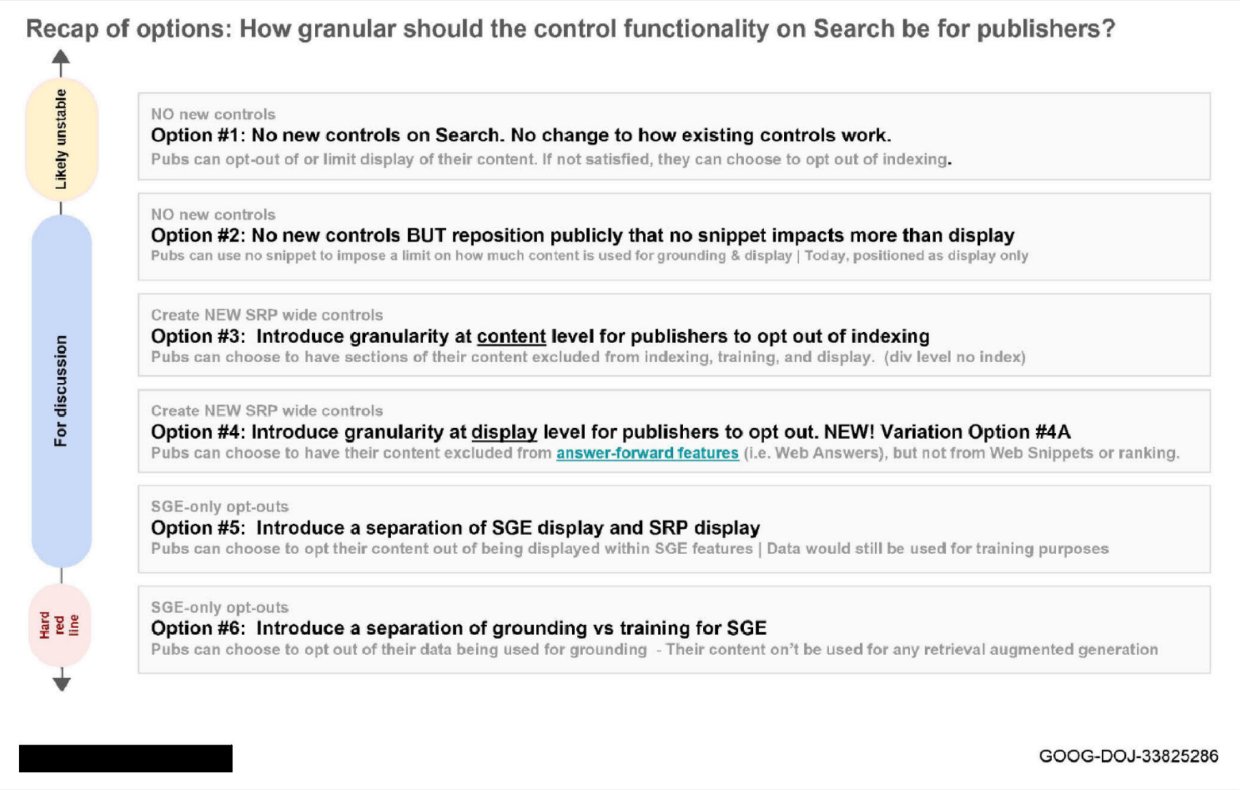
But each comes with different implications for publishers, AI training and Google’s search ecosystem.
Option #1: Status Quo, No New Controls
Under this approach, Google makes no changes and keeps existing controls such as noindex and nosnippet. If publishers are unhappy, they can opt out of indexing completely, even though doing so damages visibility and traffic.
Option #2: No New Controls, But Reposition Public Messaging
This is the path Google seems to have chosen. The controls stay the same, but Google emphasizes that nosnippet can limit how much content is used for grounding (not just display)
Option #3: Granular Content-Level Opt-Outs (Div-Level Noindex)
This would allow publishers to exclude specific sections of their pages from indexing or training, a more nuanced approach than all or nothing. This would have been a win for publishers but crosses Google’s internal “red line.”
Option #4 / 4A: Opt Out of Answer-Forward Features
This option allows publishers to block their content from appearing in answer-style features (like AI-powered Web Answers) while still participating in ranking or snippets. A “4A” variation expands this to other display elements.
Option #5: Separate AI Overviews (SGE) From Search Results Pages (SRP)
This option lets publishers opt out of AI Overviews specifically while remaining visible in normal search results. It offers a softer compromise but still allows Google to use the data for AI training, even if not displaying it in AI Overviews.
Option #6: Separate Grounding From Training
This would let publishers block Google from using their content for retrieval-augmented generation (RAG) grounding, even if training still occurs.
This is the closest to offering meaningful AI autonomy but also one of the options Google considered “new” and difficult to implement.
Does Google’s Current Solution Truly Address Publisher Concerns?
Most publishers would say no.
The main issue remains: publishers want clear, explicit, enforceable control over how AI accesses and uses their content.
Without that, concerns about content scraping, data extraction, copyright bypassing, and revenue loss remain.
Google’s current approach, allowing nosnippet to function as a partial limiter, creates more questions than answers. Does this fully block content from AI grounding?
Does it prevent training? Does it reduce visibility? Should publishers sacrifice search exposure to protect AI rights?
Why Does This Matter for the Future of Publishing?
Because we are entering a phase where: AI overviews generate answers directly with AI SEO.
- Traffic may shift away from websites
- Models depend heavily on publisher data
- Original content creators risk losing visibility or value
- Publishers are not merely asking for fairness, they are asking for survival.
Publishers are not merely asking for fairness, they are asking for survival.
When Google internally categorizes “publisher choice” as a hard red line, it signals that the company views unrestricted access to online content as essential to its AI ecosystem. And that is where the conflict deepens.
TL;DR – Key Takeaways
- Court documents reveal Google discussed six internal options for publisher AI control.
- Google appears to have chosen Option #2, which offers no new controls, only revised messaging.
- Google drew an internal “hard red line” against giving publishers full choice over AI scraping.
- The current system still relies on nosnippet and noindex, leaving publishers with limited real control.

Dipti Arora
AuthorDipti Arora is a Senior Content Writer with over seven years of experience creating impactful content across Digital Marketing, SEO, technology, and business domains. She has a strong background in managing news verticals and delivering editorial excellence. Dipti has contributed to leading publications such as The Times of India and CEO News, where her research-driven storytelling and ability to simplify complex subjects have consistently stood out. She is passionate about crafting content that informs, engages, and drives meaningful results.
