
A new study analyzing five million AI-cited URLs shows that technical SEO still plays a role in AI search visibility, but mostly as a foundation rather than a direct ranking signal. Pages cited by AI systems tend to share clear structural and technical traits, even though those traits do not work in the same way they do in traditional search.
As AI-powered discovery tools such as ChatGPT Search and Google AI Mode become part of how people find information, many teams assume that technical SEO factors carry over automatically. The research suggests that the assumption is only partly correct.
The study examined five million URLs cited by ChatGPT Search and Google AI Mode to understand which technical signals appear most often alongside AI citations.
The results show consistent correlations, but they also highlight an important distinction. Technical SEO does not function as a direct lever for AI citations.
Instead, it creates conditions that make content easier for AI systems to access, interpret, and reference.
Search Discovery Is Splitting Across Platforms
Search behavior is no longer concentrated in one place. Google still holds the largest share of traditional search, with roughly 90.06%, though that share is gradually declining. At the same time, AI-driven discovery is growing into its own category.
Within AI platforms, ChatGPT accounts for about 80%of usage, followed by Perplexity at roughly 11% and Microsoft Copilot at around 5%. Other tools make up the remaining 4%. This means that relying only on Google rankings no longer captures the full picture of how users discover brands and content.
This fragmentation changes how SEO teams approach forecasting and measurement. Visibility now depends on how content performs across both traditional search engines and AI-powered systems.
AI Visibility Emerges as a New KPI
AI visibility has been part of digital discussions for a while, but it is now receiving more structured attention as AI-driven discovery grows.
It refers to how often a brand or page appears in AI-generated responses and how frequently those systems cite it as a source.
Teams are placing greater emphasis on whether their brand appears in category-level queries, how reliably AI platforms reference their content, and what kind of traffic follows those mentions.
What was once tracked informally is increasingly being folded into regular performance measurement.
User Engagement Shows a Strong Correlation

One of the clearest findings is that AI-cited pages tend to perform better on user engagement metrics.
URLs cited in higher positions, particularly positions one through five, show higher visit volumes, longer session durations, more pages per visit, and stronger conversion rates.
Google AI Mode shows an even stronger preference for pages with higher engagement metrics than ChatGPT Search, especially for page views and purchases per visit.
While engagement occurs after a user clicks, and therefore cannot directly influence AI citation decisions, it likely reflects deeper signals such as content usefulness, clarity, and trust.
Pages that consistently satisfy users tend to share technical qualities that also make them easier for AI systems to evaluate and reference.
URL Structure Patterns in AI Citations
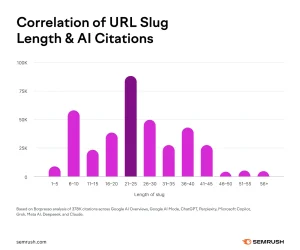
The study found a clear pattern in URL slug length. URLs with slugs between 21 and 25 characters received the highest number of citations, at roughly 87,000.
Slugs in the 6 to 10 character range followed with about 57,000 citations.
Overall, URLs with slug lengths between 17 and 40 characters performed best across AI platforms.
Very short slugs, often tied to homepages or broad category pages, and very long slugs, often deeply nested or overloaded with keywords, appeared less frequently among cited URLs.
These findings suggest that AI systems tend to surface URLs that are descriptive without being excessive, helping clarify page intent at a glance.
Structured Data Appears Frequently on Cited Pages
Structured data showed a strong association with AI citations. Pages cited by AI platforms are more likely to implement certain schema types, particularly Organization, Article, and Breadcrumb.
Among cited pages, the Organization schema appeared on about 25% of ChatGPT-cited URLs and 34% of Google AI Mode citations. Article schema appeared in 20% of ChatGPT citations and 26% of AI Mode citations. Breadcrumb schema appeared on 15 percent and 20%, respectively.
Other schema types, such as FAQ, SiteLinks Search Box, LocalBusiness, Product, ReviewSnippet, and Video, appeared less frequently but were still more common on AI-cited pages than on average web pages.
Open Graph markup appeared on roughly 60% of AI Mode citations and about 40% of ChatGPT citations.
Twitter Cards appeared on around 50% of AI Mode citations and 30% of ChatGPT citations. Schema.org JSON-LD appeared on roughly 40% of AI Mode citations and 30% of ChatGPT citations.
These figures suggest that AI systems can extract meaning from multiple structured data formats. While schema does not guarantee citations, it appears to help provide clearer context and reduce ambiguity.
The Role of Crawlability and Rendering
The study highlights the growing presence of AI crawlers, including OpenAI’s crawler, in server logs.
Increased crawler activity places greater importance on crawlability and reliable access to content.
Sites built heavily around client-side JavaScript can create challenges for AI systems. Clean HTML, server-side rendering, and clear heading structures make it easier for content to be accessed, interpreted, and parsed consistently.
Understanding the “Educated Click”
Although not directly measured, the research notes a behavioral pattern referred to as the educated click.
Users arriving from AI platforms often come with prior context from the AI response. As a result, they tend to engage more deeply, bounce less, and convert faster.
This pattern helps explain why AI-cited pages show strong engagement metrics even though engagement itself does not guide citation decisions.
Practical Actions Based on the Findings
Teams looking to improve AI visibility should focus on fundamentals rather than chasing new technical shortcuts.
Ensure important content is rendered server-side and accessible to AI crawlers. Maintain clear URL structures with descriptive slugs between 17 and 40 characters.
Prioritize core schema types such as Organization, Article, and Breadcrumb, then test additional schema where relevant.
Monitor crawl logs to understand how AI bots interact with the site. Improve technical elements that support user engagement, including page speed, mobile usability, and site architecture.
What the Study Ultimately Shows
The research shows that technical SEO still matters in AI-driven discovery, though it no longer functions as a direct ranking signal. Technical elements play a supporting role, creating the conditions that allow content to be accessed and interpreted when other signals align.
User engagement metrics appear to reflect underlying content quality rather than influencing AI systems directly. Clear URL structures and structured data serve a similar purpose, helping reduce ambiguity and clarify meaning rather than forcing visibility.
This context helps explain the growing interest in AI SEO within broader optimization programs. Strong technical foundations remain essential, and many teams continue to rely on professional SEO services to maintain that baseline while evaluating how AI platforms surface and cite content.
Taken together, the findings point to a more measured approach to technical SEO for AI search, one centered on clarity, accessibility, and consistency.
Key Takeaways
- Strong technical SEO supports AI visibility, even if it does not directly drive citations.
- User engagement reflects deeper quality signals that AI-cited pages tend to share.
- URL clarity matters more than extreme brevity or excessive length.
- Structured data improves context and citation accuracy for AI systems.
- AI discovery rewards foundations, not shortcuts.

Zulekha
AuthorZulekha is an emerging leader in the content marketing industry from India. She began her career in 2019 as a freelancer and, with over five years of experience, has made a significant impact in content writing. Recognized for her innovative approaches, deep knowledge of SEO, and exceptional storytelling skills, she continues to set new standards in the field. Her keen interest in news and current events, which started during an internship with The New Indian Express, further enriches her content. As an author and continuous learner, she has transformed numerous websites and digital marketing companies with customized content writing and marketing strategies.
