
In a recent Search Off the Record episode, John Mueller and Martin Splitt said the quiet part out loud: SEO doesn’t survive being added at the end. Not on AI-built sites, not anywhere.
Their pitch is simple. When you tell Lovable or Cursor or Replit to build you a site, the SEO has to be in the brief on day one. Canonical tags. A real sitemap. Semantic HTML. Mueller and Splitt compared bolting it on later to asking a developer to “sprinkle some SEO on it” once the site is shipped. That doesn’t work for human developers. It really doesn’t work for AI ones.
And they’re right. Here’s the proof.
The Bento Grid Receipt
October 2025. A developer vibe-codes a Bento Grid Generator in two days, ships it to Product Hunt, gets 90+ upvotes in two hours. Real product, real users, real momentum.
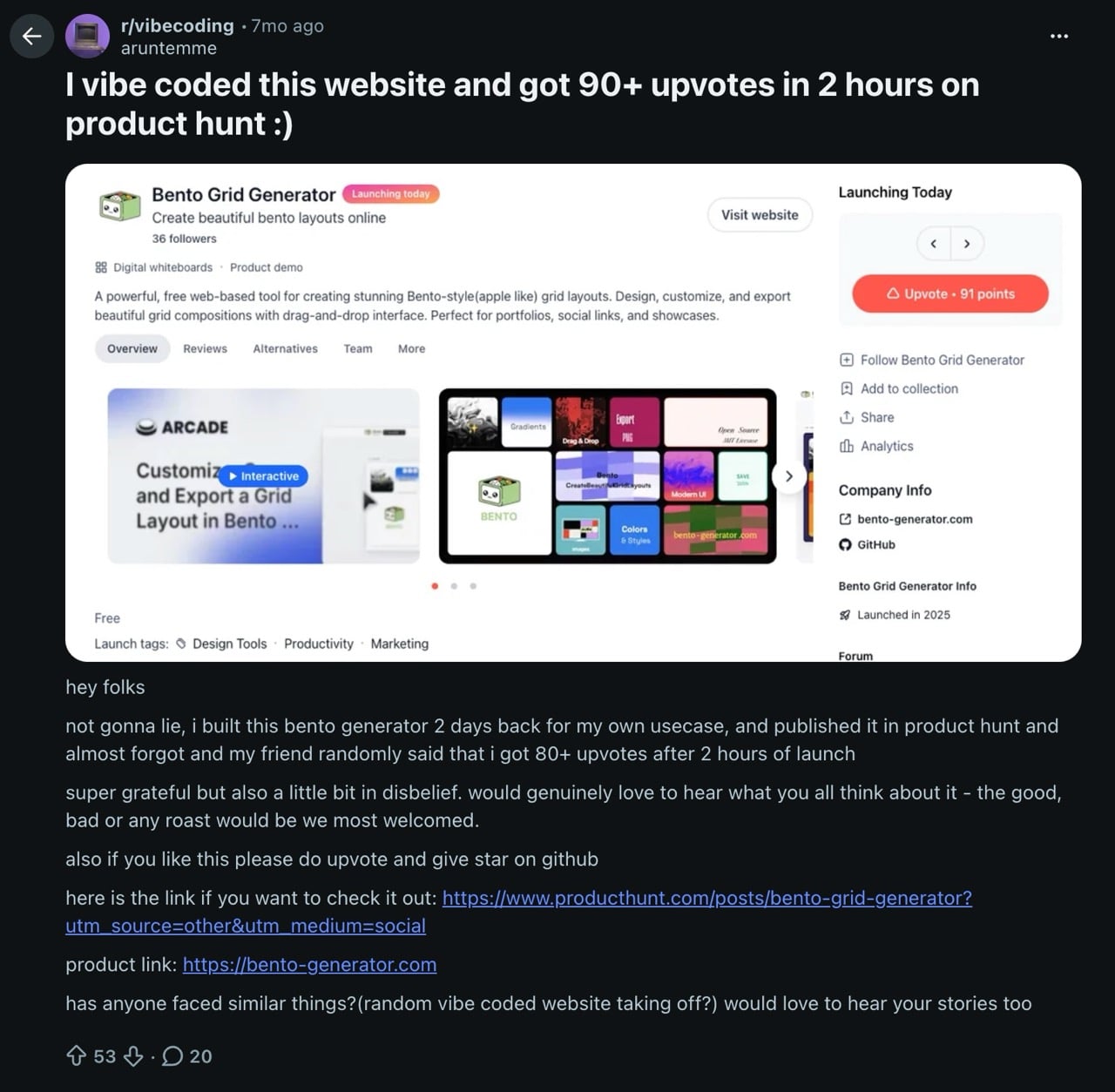
Then John Mueller shows up in the Reddit thread and rattles off a list of things the site is doing wrong from a search perspective. Key content stored in a llms.txt JavaScript file Google doesn’t read. Obsolete meta tags. Broken hreflang. Structured data issues. None of it affecting users. All of it invisible to Googlebot.
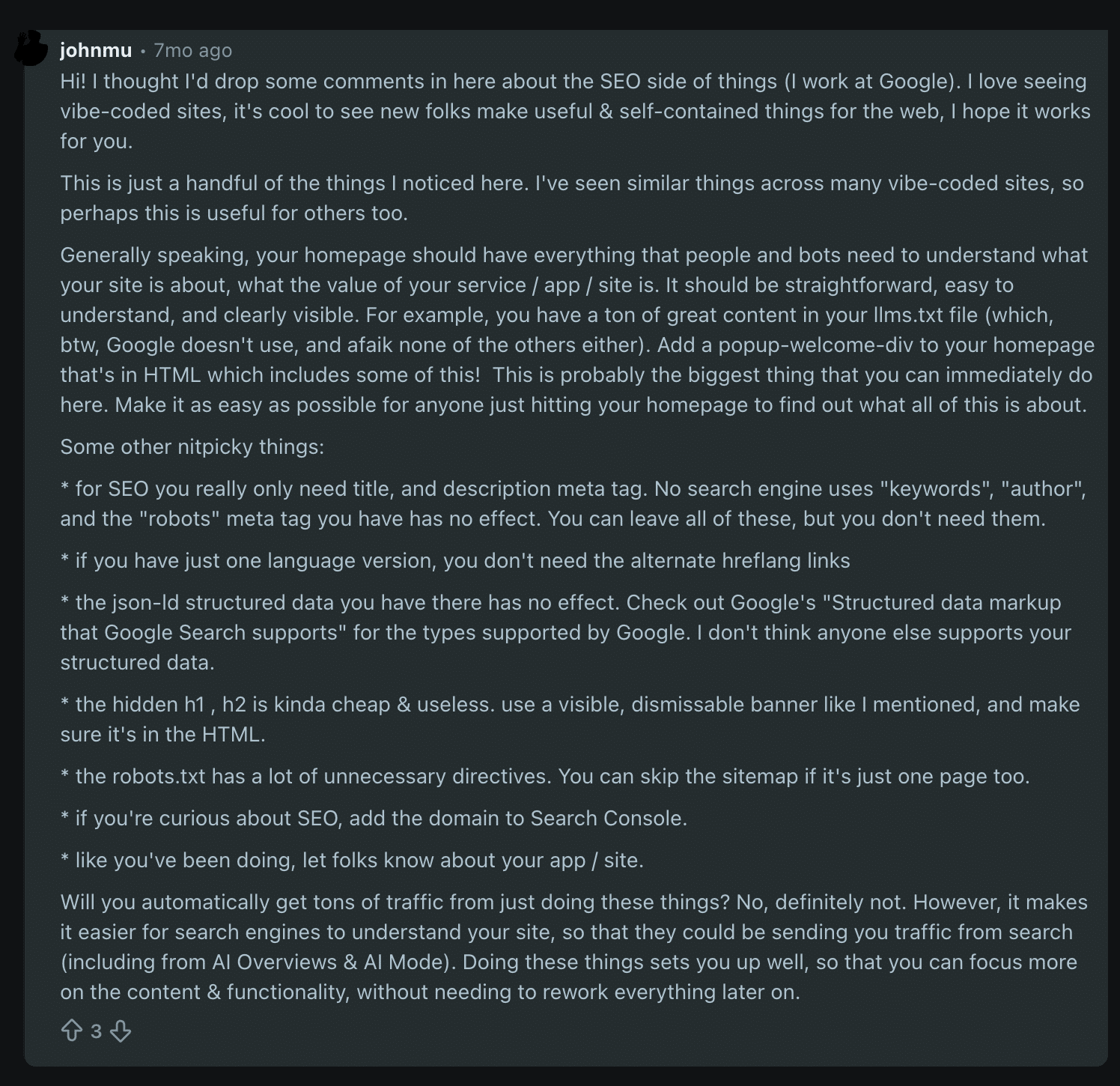
Mueller’s framing was generous: he loves seeing vibe-coded sites, this is just a handful of issues he sees across many of them. But read between the lines and the message is harsher than it sounds. The site shipped. Users showed up. Search visibility was just… absent. And nobody on the build side noticed because the AI never asked.
That’s the gap.
Why “ask the AI to add SEO later” Fails
Two reasons, one technical, one structural.
The technical one: SEO isn’t a layer. It’s not paint. Canonicals, hreflang, internal linking, sitemap structure, semantic HTML, render strategy, these are decisions that ripple through every page template. Trying to add them after the fact means rewriting components, refactoring routes, sometimes redoing the whole information architecture. AI tools will happily do that work. They’ll also happily break six other things while they do it. Our technical SEO checklist covers what should be in place before a single line of code gets written.
The structural one is worse. Most people prompting Lovable or Cursor don’t know what to ask for. They don’t know that “make this a service page” leaves out canonical tags. They don’t know “build a blog” doesn’t get them a sitemap. They don’t know to ask for <article> instead of <div>. The AI builds exactly what you describe. If you don’t describe SEO, you don’t get SEO.
That’s the “you don’t know what you don’t know” problem, and it’s quietly killing thousands of vibe-coded sites right now.
What to Actually Put in the Prompt
Mueller and Splitt’s list, canonicals, sitemaps, semantic HTML, is the floor, not the ceiling. Here’s what I’d hand a client building anything with AI tools.
On the architecture prompt itself, day one:
- Use semantic HTML5 elements (<header>, <main>, <article>, <nav>, <footer>)
- Generate a clean URL structure with no trailing parameters or session IDs
- Build a working sitemap.xml and reference it in robots.txt
- Add rel=”canonical” to every page, self-referencing by default (Google’s own docs explain why this matters even when you only have one version of a page)
- Add unique <title> and <meta description> per page, no duplicates
- Server-render or statically generate content. No client-side-only rendering for primary content.
- Use one H1 per page, with logical H2/H3 hierarchy below it
- Open Graph and Twitter Card meta tags for every page
- Schema markup matching the page type (Article, Product, LocalBusiness, etc.)
On the content prompt:
- Write the homepage like a human will read it. Don’t bury value props three scrolls down or hide them in animated reveal blocks AI loves to add.
- Internal linking between related pages, not just nav links
- Image alt attributes that describe the image, not stuff keywords
- Avoid llms.txt as a primary content store. Mueller has said directly Google doesn’t use it.
On the QA prompt before you ship:
- Run Lighthouse and fix anything below 90 on SEO and Best Practices
- View source on three random pages. If you can’t read the content as plain HTML, neither can Googlebot.
- Submit the sitemap to Search Console and watch what gets indexed in week one
That last one matters more than people think. Indexation lag is the first sign your AI built you a pretty site Google can’t read. And if your site’s primary traffic ambition includes showing up in AI search, the same foundations apply, just with even less margin for error.
The Honest Take for Agencies
If you sell SEO services, vibe-coded sites are about to be a major chunk of your audit pipeline. Founders are spinning these up in afternoons. The sites look polished. They convert fine for paid traffic. Then six months in, organic is flat and the founder calls you wondering why.
You’ll open the site and find no canonical tags, a sitemap that 404s, and content rendered entirely by client-side JavaScript that bots see as a blank div.
Two ways to handle that conversation. You can rebuild the site, which is expensive and the founder doesn’t want to hear it. Or you can write them a prompt template, yours, branded, opinionated, that they paste into their AI tool before building anything. The fix is upstream. The audit is downstream. Sell both. (This is also why agentic commerce is moving in the same direction: machine-readable foundations or you don’t exist.)
Key Takeaway
Mueller and Splitt aren’t saying anything new technically. Canonicals have mattered for fifteen years. What’s new is the audience. A whole generation of site builders is shipping production sites without a developer in the loop, which means without a developer’s instinct for any of this. Of all the SEO trends shaping 2026, this one is hiding in plain sight.
So the SEO knowledge has to move into the prompt. Into the brief. Into the system message you give the AI before you ask it for a homepage.
Sprinkling SEO on at the end was always inefficient. With AI builders, it’s just impossible.

Dileep Thekkethil
AuthorDileep Thekkethil is the Director of Marketing at Stan Ventures, where he applies over 15 years of SEO and digital marketing expertise to drive growth and authority. A former journalist with six years of experience, he combines strategic storytelling with technical know-how to help brands navigate the shift toward AI-driven search and generative engines. Dileep is a strong advocate for Google’s EEAT standards, regularly sharing real-world use cases and scenarios to demystify complex marketing trends. He is an avid gardener of tropical fruits, a motor enthusiast, and a dedicated caretaker of his pair of cockatiels.
