
Search is no longer just answering questions.
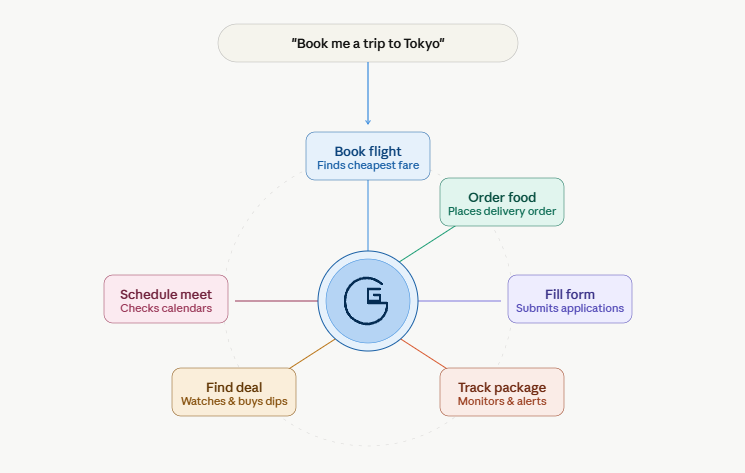
It is doing things on your behalf.
Google has rolled out three new task-based features inside AI Mode this week, and each one moves search further away from the ten blue links model that agencies have built strategies around for two decades.
The three new features are hotel price tracking at the individual property level, agentic calling where Google’s AI contacts local stores on your behalf to check stock and availability, and a Canvas trip planning tool that builds structured travel itineraries inside AI Mode itself.
These are not isolated experiments.
They are part of a deliberate product direction that has been building for over a year, and they mark a clear turning point in how Google defines what search is supposed to do.
From Finding to Doing
The most significant of the three new features is agentic calling.
When a user searches for a product nearby and does not know which local store has it in stock, Google’s AI will now call those stores directly and report back.
The user searches.
The AI does the legwork.
This capability has technically existed inside Google Search since late 2025, but bringing it fully into AI Mode puts it in front of far more users and gives it a cleaner, more accessible interface.
The hotel price tracking feature is similarly significant.
Instead of presenting a list of hotels and asking users to compare prices across multiple platforms, Google now monitors prices at the individual property level and alerts users when the right conditions are met.
The Canvas trip planning tool rounds out this shift by letting users build structured travel plans entirely within AI Mode, without ever visiting a third-party site.
Taken together, these three features tell a single story.
Google’s agents are already out there, reading your pages, checking your inventory, calling your stores, and deciding whether your business is worth surfacing to a user who never sees the results page at all.
What This Means for Your Website
The SEO implications here are direct and immediate.
Structured data is no longer a technical checkbox.
It is the difference between being used by Google’s agents or being skipped entirely.
Schema markup, consistent local listings, updated pricing, and accurate inventory information are now the signals that determine whether an AI agent includes your business in its response or moves on to a competitor who has their data in better shape.
Pages that are technically clean, machine-readable, and well-structured are the ones that AI agents can act on.
Pages that are not will become increasingly invisible regardless of how well they rank in traditional results.
This is a fundamental shift in what technical SEO is for.
It has always been about helping Google understand your content.
Now it is also about enabling Google’s agents to take action on your behalf.
If your clients are in hospitality, retail, local services, or any industry where users make reservations, check availability, or compare prices, this update is directly relevant to their visibility right now.
The Bigger Picture for SEO Strategy
Google CEO Sundar Pichai has stated publicly that the future of search is agentic.
What this week’s features confirm is that the future is already here.
Search is becoming a layer through which AI agents navigate the world on behalf of users.
The businesses that structure their data accordingly are the ones that will stay visible inside it.
The ones that do not will find themselves increasingly bypassed by agents that simply move on to better-prepared competitors.
For SEO agencies, this reinforces something that the best practitioners have understood for a while.
Technical excellence and content quality are not separate disciplines.
A technically perfect page with thin content can underperform.
A well-written page delivered through a poor technical structure can underperform just as badly.
Durable visibility in an agentic search environment needs both.
Staying current with the AI era SEO trends reshaping how Google surfaces and acts on content is now a baseline requirement, not a competitive advantage.
What Agencies Should Do Right Now
The first priority is a structured data audit across your clients’ most important pages.
Identify where schema markup is missing, inconsistent, or outdated.
Pay particular attention to local business data, product information, pricing, and availability signals.
These are the inputs that Google’s agents rely on to complete tasks accurately.
The second priority is ensuring technical accessibility.
Pages that are slow to load, difficult to crawl, or inconsistently structured are harder for AI agents to process and act on.
Core Web Vitals, mobile optimization, and clean internal architecture all contribute to whether your content is agent-ready.
The third priority is rethinking how you measure success.
Traditional rank tracking captures less and less of the visibility picture as agentic search expands.
Agencies need to monitor how often their clients’ businesses are surfaced inside AI responses, task completions, and agentic interactions, not just where they rank for a given keyword.
Understanding zero-click SEO and how to measure brand value in an environment where users increasingly never click at all is now one of the most important skills an agency can develop.
The ten blue links are not disappearing overnight.
But the direction is clear, and the agencies that adapt their technical and strategic frameworks now will be significantly better positioned when agentic search becomes the dominant mode of discovery.
Google completing tasks for users is the headline.
The real story is that link building strategies and technical SEO are converging into a single discipline built around one question: is your content structured well enough for an AI agent to trust, read, and act on it?

Deepan Paul
AuthorDeepan Paul is a Team Lead of the Internal Marketing Department at Stan Ventures, with four years of experience helping brands recover, grow, and hold on to organic traffic across global B2B, B2C, and D2C markets. He's known as a ranking revival expert. When traffic drops, pages fall out of the index, or visibility disappears after an update, he finds the cause and fixes it. Today he runs Stan Ventures' own organic presence, and that goes well past Google. He tracks and grows how the brand shows up in AI Overviews and across AI tools like ChatGPT, Perplexity, and Gemini, where citations decide who gets mentioned and who doesn't. His work covers technical SEO, content strategy, indexing, and building growth systems that hold up when algorithms shift. He has managed international clients and led cross-functional teams, keeping every SEO decision tied to what the business actually needs. Outside of client work, Deepan trains SEO professionals, speaks at industry events, and contributes insights to digital marketing publications. His approach is simple: build systems that keep working, instead of chasing quick wins.
