
ChatGPT just became a performance marketing channel, and the implications for SEO agencies are bigger than most people realize.
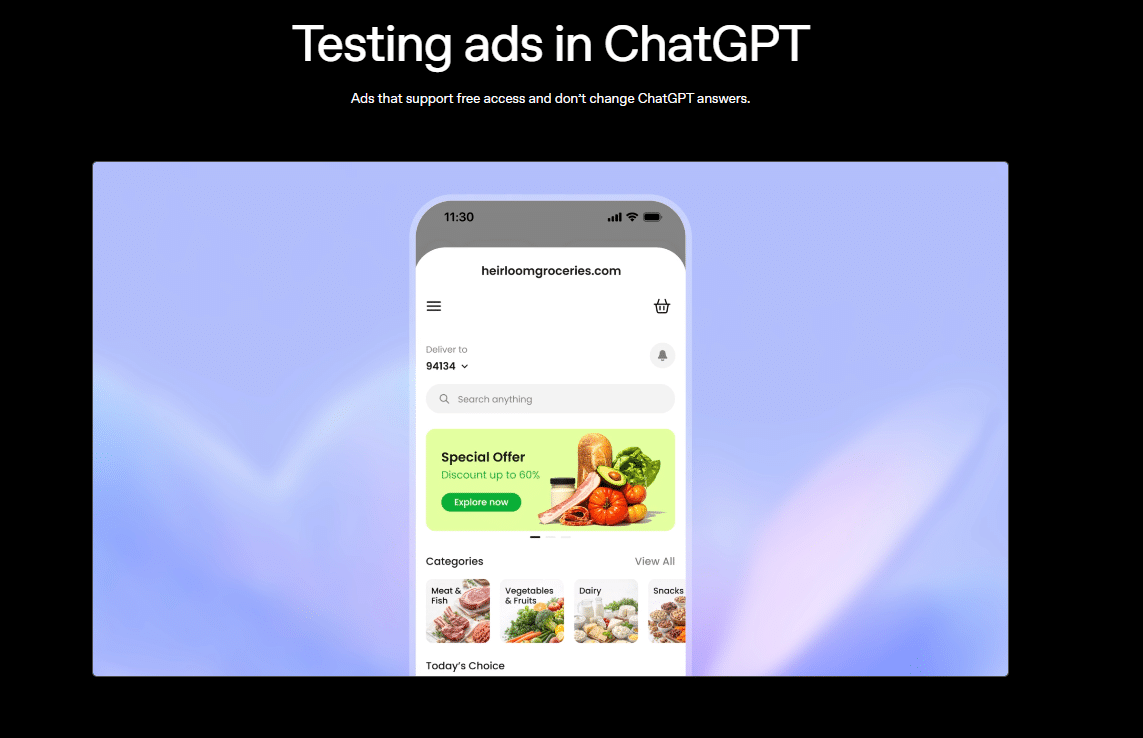
On April 22, OpenAI confirmed it has started testing cost-per-click ads inside ChatGPT.
Instead of charging advertisers for every thousand impressions shown, the new model lets brands pay only when a user actually clicks.
Early reports show clicks are being priced between $3 and $5, rolling out through a limited ads manager that runs alongside the existing CPM-based system.
This is not just an advertising story. It is a signal about where search budgets, user behavior, and organic visibility are all heading at the same time.
Why OpenAI Made This Move
The financial pressure behind this decision is straightforward. ChatGPT’s ad CPMs have already dropped significantly since launch, falling from around $60 per thousand impressions to closer to $25 in some cases.
When impression revenue declines that sharply in a short period, the platform needs a new way to grow ad revenue without relying on holding CPMs up.
Cost-per-click solves that problem by tying revenue directly to outcomes.
Advertisers only pay when something happens. That makes the platform easier to justify internally, easier to compare against Google benchmarks, and easier to scale when the self-serve tools open up to a wider advertiser base later this month.
OpenAI is also hunting for its first advertising marketing science leader, which tells you this is not an experiment.
It is the beginning of a full advertising operation built to compete with the most established platforms in digital marketing.
What This Means for SEO Agencies
Here is the part that matters most for agencies managing organic search strategies.
ChatGPT now has roughly 800 million weekly active users.
It is the fourth most visited website in the world. And it is about to become a direct competitor for the same performance budgets that Google Search has owned for the past two decades.
Advertisers will soon be comparing ChatGPT clicks against Google Search clicks side by side.
That conversation immediately brings in questions about organic presence inside ChatGPT, citation rates, brand authority, and how often a client’s content appears in AI-generated answers without any paid spend at all.
The brands that show up organically inside ChatGPT responses — because their content is well-structured, authoritative, and frequently cited, will have a compounding advantage.
Their organic presence reduces the cost of paid visibility on the same platform. Their authority signals carry weight in both the paid and organic layers simultaneously.
This convergence of paid and organic AI visibility is new territory, but the underlying mechanics are familiar.
Authority, trust, and structured content have always been the foundation of sustainable search visibility. The platforms have changed. The principles have not.
The Organic Angle Most Agencies Are Missing
While the ad side of this story is getting most of the attention, the more strategically important question is how your clients show up inside ChatGPT answers without paying for placement.
ChatGPT cites sources in roughly 87% of responses. But it only mentions brand names in around 20% of answers, meaning it often uses your content without crediting your brand by name.
That gap between being used as a source and being recognized as a brand is one of the biggest opportunities in AI search right now.
Brands that build consistent entity signals across the web — through editorial backlinks, authoritative brand mentions for SEO and AI visibility, structured content, and topical depth, are the ones that AI systems return to repeatedly.
Over time, that consistency compounds into a default authority that is very difficult for competitors to displace.
Understanding the full scope of AI SEO backlinks is no longer a supplementary strategy.
For agencies that want to future-proof client visibility across Google, ChatGPT, Perplexity, and every AI surface that follows, it is the core strategy.
What Your Clients Should Do Right Now
The first step is a content audit focused on AI citability.
Does your client’s content contain original data, direct answers, clear structure, and specific facts that an AI system can extract and attribute? If not, that is the gap to close before optimizing for anything else.
The second step is building authority signals at scale.
Editorial backlinks from relevant, high-authority sites remain the strongest trust signal both Google and AI systems use to evaluate whether a source is worth citing.
Consistent brand mentions across trusted platforms reinforce entity recognition in ways that paid placements cannot replicate.
The third step is tracking the right metrics. Rankings alone no longer tell the full story.
Agencies need to monitor AI citation rates, branded search volume trends, and organic visibility across AI-driven platforms.
Understanding zero-click SEO and how to measure brand value beyond traditional clicks is now an essential skill for every agency managing clients in 2026.
ChatGPT becoming a performance ad platform is the headline. But for SEO agencies, the real story is that organic AI visibility just became one of the most valuable assets a client can own.

Deepan Paul
AuthorDeepan Paul is a Team Lead of the Internal Marketing Department at Stan Ventures, with four years of experience helping brands recover, grow, and hold on to organic traffic across global B2B, B2C, and D2C markets. He's known as a ranking revival expert. When traffic drops, pages fall out of the index, or visibility disappears after an update, he finds the cause and fixes it. Today he runs Stan Ventures' own organic presence, and that goes well past Google. He tracks and grows how the brand shows up in AI Overviews and across AI tools like ChatGPT, Perplexity, and Gemini, where citations decide who gets mentioned and who doesn't. His work covers technical SEO, content strategy, indexing, and building growth systems that hold up when algorithms shift. He has managed international clients and led cross-functional teams, keeping every SEO decision tied to what the business actually needs. Outside of client work, Deepan trains SEO professionals, speaks at industry events, and contributes insights to digital marketing publications. His approach is simple: build systems that keep working, instead of chasing quick wins.
