
The world of search is shifting dramatically as Google’s AI Overviews begin reshaping how users access information.
SEO professionals and businesses are bracing for impact as new research reveals surprising insights into how AIOs appear, their impact on rankings, and what the future may hold.

AI Overviews Expand, But Not Everywhere
Despite fears of AIOs dominating search, new data suggests that they are far from universal.
Research shows that AIOs appear for only 29.9% of keywords and just 11.5% of total search volume.
Interestingly, they are more common for mid-volume searches (501-2,400 monthly searches) rather than high-volume queries.
Industries Most Affected by AI Overviews
Not all industries are experiencing the same level of disruption. Here’s where AIOs are most and least common:
- Telecoms: Highest AIO presence (56% of keywords)
- Business Services: Strong AIO presence (41%)
- Beauty & Cosmetics: Lowest AIO presence (14%)
Industries that involve complex purchasing decisions or require detailed information see more AIOs, while simpler products, like cosmetics, are less affected.
User Intent: The Hidden Factor Driving AIOs
Google appears to be prioritizing certain types of searches when triggering AI Overviews. Research categorizes searches by intent and finds:
- Problem-Solving & Specific Questions: AIOs dominate (74% and 69%, respectively)
- Navigational Queries: No AIOs appear
- Topic Research Queries: Rare AIO appearances (3.37%)
- Product & Service Searches: AIOs appear 10.8% of the time
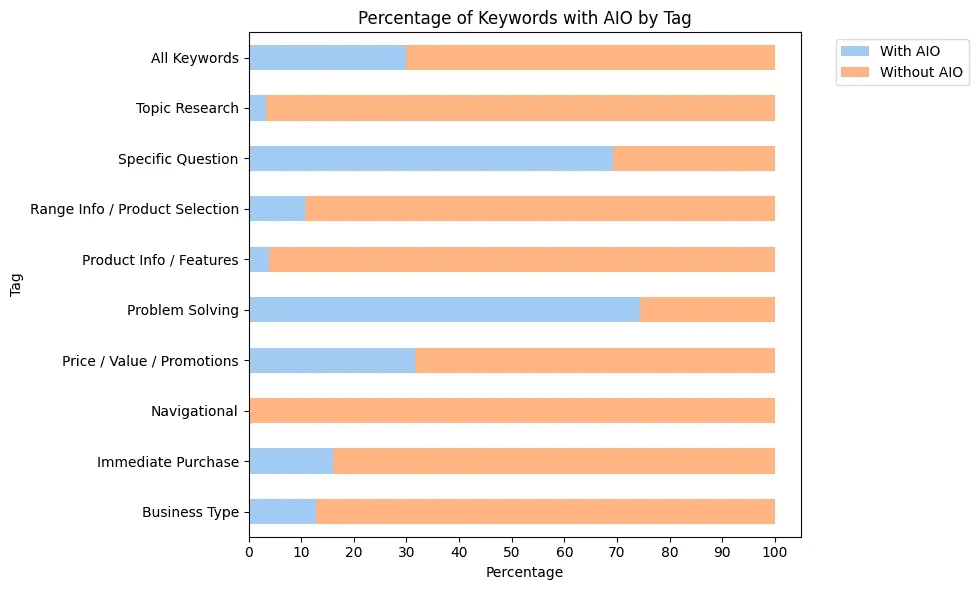
For brands, this means answering common customer questions is more important than ever to get featured in AIOs.
Brand Searches vs. Generic Queries
AIOs appear more frequently for non-brand keywords (33.3%) than for brand-specific searches (19.6%).
However, for informational brand searches, AIOs appear 69.8% of the time, giving businesses a golden opportunity to influence how their brand is portrayed in search results.
AI Overviews Are Pushing Traditional Rankings Down
Perhaps the biggest concern is how AIOs impact organic search rankings. The research reveals:
- Before expanding an AIO, only 2-3 organic results are visible on the first screen.
- After clicking “Show More,” organic results drop by 220 pixels, pushing them further down.
- On mobile, expanding an AIO can push all organic results off-screen.
For businesses, this means a new approach to SEO is essential—simply ranking high is no longer enough.
What’s Next? Volatility and Future Trends
The next big question is whether AIOs behave like traditional rankings or if they fluctuate independently.
Researchers are currently studying how often AIOs change and what influences these shifts. As AI-driven search evolves, businesses must stay informed and flexible.
What Can You Do Now?
To stay ahead in this new landscape, businesses should:
Target Mid-Volume Keywords: High-volume terms aren’t triggering AIOs as often.
Focus on Problem-Solving Content: Answer user questions to increase visibility.
Track AIO Volatility: Monitor when and how often AIOs appear.
Optimize Brand Content: Ensure Google presents accurate, positive brand information.
Adapt to SERP Layout Changes: Expect AIOs to push organic rankings lower and plan accordingly.
Key Takeaways
- AIOs appear in only 29.9% of searches, mostly for mid-range search volume keywords, not high-volume queries.
- Telecoms (56%) and Business Services (41%) see more AIOs, while Beauty & Cosmetics (14%) see fewer.
- Problem-solving and specific question searches (74% and 69%) trigger AIOs the most, while navigational searches don’t trigger them at all.
- Expanding an AIO can significantly reduce the visibility of organic results, especially on mobile.
- Businesses should focus on optimizing for problem-solving content, tracking AIO volatility, and adapting to changes in SERP layouts.

Dileep Thekkethil
AuthorDileep Thekkethil is the Director of Marketing at Stan Ventures, where he applies over 15 years of SEO and digital marketing expertise to drive growth and authority. A former journalist with six years of experience, he combines strategic storytelling with technical know-how to help brands navigate the shift toward AI-driven search and generative engines. Dileep is a strong advocate for Google’s EEAT standards, regularly sharing real-world use cases and scenarios to demystify complex marketing trends. He is an avid gardener of tropical fruits, a motor enthusiast, and a dedicated caretaker of his pair of cockatiels.
