
Google has just updated its guidelines on crawl budgets, and it’s an important one for large websites, especially those that keep separate mobile and desktop versions.
If you’re not ensuring the same links are accessible on both versions, you may risk slower page discovery—and in turn, less visibility in search results.
Let’s break down what these changes mean, why they’re important, and how you can optimize your website to stay ahead.
What Does “Crawl Budget” Mean?
First, let’s tackle what a crawl budget actually is. Think of it as Google’s limited time spent on your website. With every visit, Googlebot, Google’s web-crawling “robot,” uses this time (or budget) to index as many pages as possible.
This budget isn’t usually an issue for small websites—Google can crawl and index all pages pretty quickly. But for larger sites, it’s a different story.
The bigger your site, the more careful you need to be about the crawl budget because it directly impacts your visibility on Google Search.
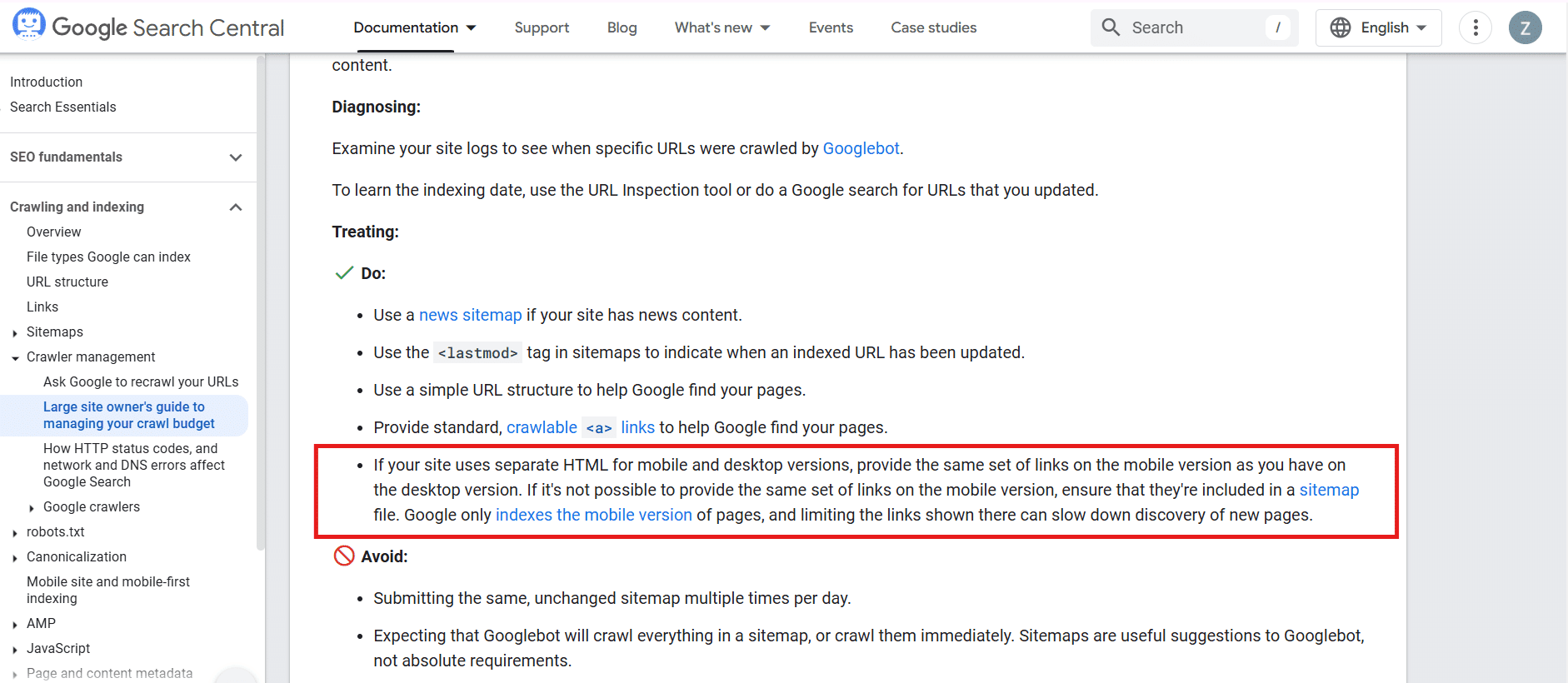
Google’s new guidelines urge sites to maintain consistent link structures on mobile and desktop. This means that if your desktop site has a certain set of links, your mobile site should ideally have the same ones.
If matching all links isn’t possible, Google recommends including those links in a sitemap file.
Why This Change Matters
Google has taken a “mobile-first” approach to indexing for a while now, meaning it primarily uses the mobile version of content when evaluating and ranking sites. This update reflects the ongoing focus on mobile indexing, making it clear that a well-optimized mobile site is more critical than ever.
For sites with thousands or even millions of pages, missing links on mobile versions means Google could skip over important content, leading to gaps in the indexed pages and potentially missing out on new or updated pages.
Who’s Affected Most?
This crawl budget update affects a specific group of websites, primarily large or high-traffic sites, such as:
Sites with 1 million+ pages: Those that regularly update content, like news outlets, e-commerce platforms, or large content libraries.
Medium-sized sites (10,000+ pages): These are sites that update daily, where fresh content is vital to SEO, as Google’s priority is to surface the most current information.
Sites with URLs marked “Discovered – not indexed”: If Search Console shows many of your URLs as “Discovered – currently not indexed,” it’s a red flag that Google’s having trouble finding your pages.
If your website falls into one of these categories, this update is particularly relevant to you.
How This Impacts SEO
For websites impacted by this change, the result could be slower page discovery and indexing. This delay affects visibility because unindexed pages are essentially invisible on Google’s search results.
Fewer pages crawled mean less exposure, which could lead to a decline in traffic—especially for content that relies heavily on freshness, like news articles or product updates.
If your mobile site has fewer links than your desktop version, Google might not find new content, which can hurt your SEO performance. In competitive industries, where every second matters, any slow-down in indexing is a problem.
Practical Tips to Optimize Your Site
So, what can you do to ensure your website follows these new guidelines and gets the maximum crawl budget?
Here are a few actionable steps:
Audit Your Link Structure: Compare your mobile and desktop versions to ensure all essential links are present. This might involve running a website crawler or manually checking navigation paths.
Update Your Sitemap: If matching links isn’t possible, ensure that your sitemap has a complete list of URLs. This way, Googlebot can still access and index these pages.
Check Your Crawl Stats: Use Google Search Console to monitor how well Google is crawling your site. Look out for the “Discovered – currently not indexed” status—it could be a clue that you need to adjust link structures.
Optimize Navigation Paths: Simplify navigation on mobile. A clean, easy-to-follow structure helps Googlebot (and your users) navigate efficiently, leading to quicker indexing of new pages.
Track Changes Over Time: Regularly monitor your site’s indexing and make adjustments as needed. Just because your site is optimized now doesn’t mean it will be next month.
Predicting the Future of SEO for Large Sites
Looking ahead, it’s clear Google will continue to refine its guidelines as it learns more about mobile-first indexing. This means that large websites should expect more specific recommendations around crawl efficiency, potentially with additional rules for certain types of content or industries.
For now, keeping links consistent between mobile and desktop is the primary takeaway, but in the future, we may see more detailed guidelines that prioritize different types of content based on user demand or the type of device.
The Bottom Line
These changes make sense, and while it’s an extra step for large sites, it’s ultimately beneficial.
Think of this as a way for Google to help users find content faster by streamlining how websites work across devices.
By focusing on link parity, Google is pushing webmasters to create more unified, efficient experiences for both mobile and desktop users.
And while some might view this as an added burden, it’s more about keeping up with an evolving digital landscape where mobile access is now the default. Having a fully optimized mobile site isn’t just smart for SEO; it’s good for user experience.
Key Takeaways
- Google recommends keeping links consistent across mobile and desktop versions.
- If identical links aren’t feasible, include all important URLs in the sitemap.
- Regularly check both mobile and desktop versions to ensure all critical links are accessible.

Dileep Thekkethil
AuthorDileep Thekkethil is the Director of Marketing at Stan Ventures, where he applies over 15 years of SEO and digital marketing expertise to drive growth and authority. A former journalist with six years of experience, he combines strategic storytelling with technical know-how to help brands navigate the shift toward AI-driven search and generative engines. Dileep is a strong advocate for Google’s EEAT standards, regularly sharing real-world use cases and scenarios to demystify complex marketing trends. He is an avid gardener of tropical fruits, a motor enthusiast, and a dedicated caretaker of his pair of cockatiels.
