
You’ve probably heard that building backlinks is important for SEO.
But here’s a question most people don’t ask — does the speed at which you build them matter?
The answer is yes. And getting it wrong can quietly hurt your rankings even if your links are high quality.
That’s what link velocity is about.
The Simple Definition
Link velocity is the rate at which your website gains new backlinks over time.
It’s usually measured in new links or referring domains per month.
A site picking up 5 new backlinks this month and 6 next month has a slow, steady velocity.
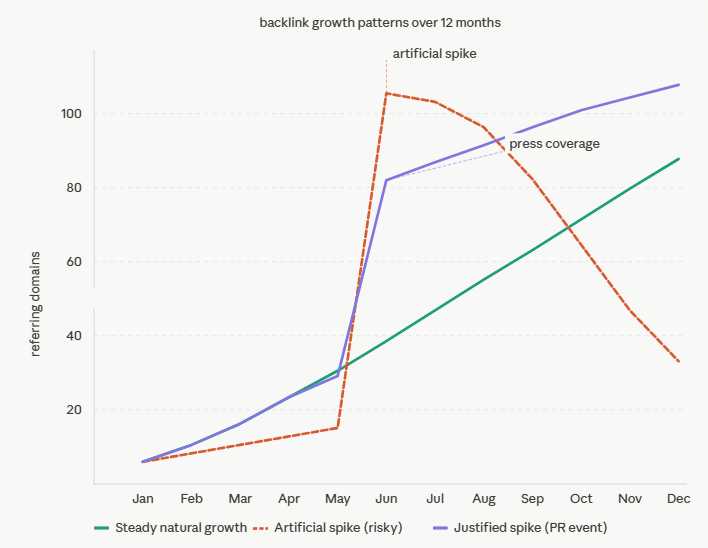
A site that goes from 5 to 500 in a single week has a spike — and that’s where things get risky.
Why Google Pays Attention to It
Google doesn’t just look at how many backlinks you have.
It looks at how naturally your profile is growing.
An older Google patent flagged this directly — a sudden spike in backlink growth could signal an attempt to manipulate rankings, and in response, Google may actually lower a page’s score.
In 2019, Google’s Search Advocate John Mueller added more context.
He said it’s not really about how many links you get in a given period — it’s whether those links look unnatural or problematic.
So the issue isn’t speed alone. It’s whether the speed makes sense given your site’s size, age, and content activity.
What Natural Velocity Looks Like
Natural link growth mirrors what’s actually happening with your content and brand.
A startup that just got covered in TechCrunch can legitimately earn 300 links in a week.
A local plumbing company that suddenly gets 500 links from unrelated blogs cannot.
Context is everything.
According to data analyzed by Ahrefs, top-ranking pages for competitive keywords tend to gain followed backlinks from new referring domains at a pace of roughly 5% to 14.5% per month.
So a page with 100 referring domains would naturally gain around 5 to 15 new links per month.
That’s a useful benchmark when planning your outreach pace.
What Triggers a Red Flag
Google’s systems are built to detect patterns that don’t match real-world behaviour.
A few things that raise concern:
Sudden spikes with no explanation. If you haven’t published anything new or run any PR activity, a flood of new links looks suspicious regardless of their quality.
Links from unrelated niches. Getting 50 backlinks from cooking blogs when your site is about SEO tells Google something is off.
Same anchor text repeated across many links. Natural link profiles have variety. A wave of identical exact-match anchors looks engineered.
All links pointing to one page. Real backlink growth spreads across multiple pages. Concentrating everything on a single URL is a pattern Google notices.
How Fast Is Too Fast?
There’s no universal number — it depends on your site.
A brand-new site with 10 existing backlinks building 50 links in a month looks very different from an established site with 2,000 backlinks doing the same.
A practical approach used by experienced link builders is to look at your current baseline and scale gradually. If you’re earning one link per month organically, starting your outreach at two or three links per month makes sense. If you’re already at a hundred per month, ramping to 30 or 40 and building from there is reasonable.
The goal is steady, explainable growth — not hitting a number.
Spikes Are Fine When They’re Earned
One important nuance: fast velocity isn’t always bad.
If your content goes viral, gets picked up by a major publication, or your brand lands a big press mention, a sudden spike in links is completely natural.
Google is looking for growth that can’t be explained by real activity.
When the explanation exists — a product launch, a data study, a trending article — the spike is a signal of authority, not manipulation.
The problem is manufacturing that spike artificially when nothing has actually happened.
What to Do in Practice
Match your pace to your site’s current profile. Look at how many referring domains you currently have and grow at a rate that fits your baseline.
Spread links across multiple pages. Don’t funnel everything into one URL. A natural profile links to blog posts, service pages, and your homepage.
Diversify your link types. Guest posts, niche edits, digital PR, citations, and community mentions all signal a real, active brand.
Don’t stop between campaigns. A flat line followed by a sudden burst looks worse than a consistent slow build. Keep activity running month to month, even at a low volume.
Monitor your profile regularly. Tools like Ahrefs and Semrush let you track your referring domain growth over time and spot unusual patterns before they become problems.
If you’re working with a white label link building partner, make sure they understand your current baseline and build at a pace that matches your site’s history — not just a flat monthly quota.
The Takeaway
Link velocity isn’t a direct ranking factor on its own.
But an unnatural growth pattern is one of the clearest signals Google uses to identify manipulative link building.
Build consistently.
Build at a pace that matches your site’s authority and content activity.
And if you earn a natural spike from real coverage or a viral piece of content, don’t worry about it — that’s exactly how it’s supposed to work.
The sites that win long-term aren’t the ones that built the most links the fastest.
They’re the ones that built them in a way Google had no reason to question.

Deepan Paul
AuthorDeepan Paul is a Team Lead of the Internal Marketing Department at Stan Ventures, with four years of experience helping brands recover, grow, and hold on to organic traffic across global B2B, B2C, and D2C markets. He's known as a ranking revival expert. When traffic drops, pages fall out of the index, or visibility disappears after an update, he finds the cause and fixes it. Today he runs Stan Ventures' own organic presence, and that goes well past Google. He tracks and grows how the brand shows up in AI Overviews and across AI tools like ChatGPT, Perplexity, and Gemini, where citations decide who gets mentioned and who doesn't. His work covers technical SEO, content strategy, indexing, and building growth systems that hold up when algorithms shift. He has managed international clients and led cross-functional teams, keeping every SEO decision tied to what the business actually needs. Outside of client work, Deepan trains SEO professionals, speaks at industry events, and contributes insights to digital marketing publications. His approach is simple: build systems that keep working, instead of chasing quick wins.
