
Google’s John Mueller cautions SaaS companies against rushing into multiple country-code domains for international expansion, noting that splitting content across separate domains slows progress and increases SEO complexity.
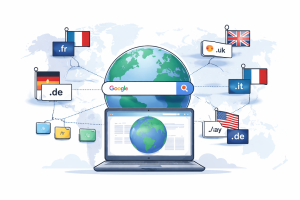
Google Search advocate John Mueller has reiterated that using multiple country-code top-level domains for international expansion can work, but it often makes SEO slower and harder.
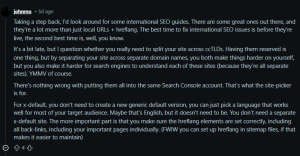
His comments surfaced after a SaaS company said it purchased several ccTLDs for different countries and translated pages for each site.
The exchange happened on Reddit and has since prompted renewed debate among global-growth teams about how Google actually interprets international site structures and what configuration offers the strongest long-term momentum for rankings and maintenance efficiency.
Why Does This Question Keep Coming Up
As more SaaS companies expand into new countries, many teams feel tempted to secure .fr, .it, or .co.uk domains early.
Owning country-specific domains can look strategic and future-ready, but it can also commit a business to a structure that demands far more effort than expected.
John Mueller’s comments carry weight because they reflect how Google interprets real websites in practice, not just theory, and they help separate what is technically possible from what is genuinely sustainable.
Who John Mueller Is and Why His Perspective Matters
John Mueller works closely with Google Search Central and routinely answers technical SEO issues raised by developers, publishers, and product teams.
His role gives him direct visibility into how Google evaluates site structures at scale.
When he comments on ccTLDs, he is not speaking in hypotheticals. He is explaining how different setups are interpreted by search systems and why some choices create unnecessary friction even if they appear attractive at first glance.
Cctlds Make SEO Harder, Even Though They Can Work
Mueller explains that every ccTLD is treated as a separate website.
Once a company spreads content across several domains, it divides authority, increases crawling and indexing complexity, and multiplies ongoing SEO effort.
Link signals do not naturally reinforce one another.
Content updates and technical fixes must be repeated for each market.
None of this makes success impossible, but it raises the cost of progress and slows momentum at stages when teams usually need efficiency the most.
What He Is Really Comparing: CcTLDs vs Subdirectories
Country-code domains provide a strong regional signal. That benefit comes with a tradeoff: every domain must earn trust independently.
By contrast, language or country subdirectories on a single domain allow Google to recognize relationships between versions more easily.
Signals build faster because authority remains unified. There are still scenarios where ccTLDs can be justified, such as legal requirements, regulated sectors, or cases where a visible local presence improves user confidence.
Even then, the decision should be intentional and supported by resources, not driven by habit or fear of missing out.
Google Search Console: Myths vs Reality
Some teams worry that managing multiple ccTLDs in the same Google Search Console account could confuse Google. Mueller clarifies that this is not a problem.
What matters is how properties are configured and monitored, not whether they sit under one account.
The site picker inside the interface does not influence crawling or rankings.
This removes a common misunderstanding and reinforces that tool organization should never dictate structural choices.
Hreflang Is Essential, but It Is Not a Rescue Button
Hreflang remains important for serving the right version to the right audience. Still, it cannot overcome the authority split created by separate domains.
Mueller stresses accurate reciprocal references and coverage across key pages rather than limiting hreflang to homepages.
Managing hreflang through sitemaps can simplify upkeep, yet even perfect implementation does not change the fact that each ccTLD must stand on its own.
The x-Default Question and Mueller’s Clear Clarification
Teams sometimes assume they need a separate “global” domain for x-default. Mueller explains that this is unnecessary.
x-default can simply point to the primary language version, which is often English or whichever variant serves the widest audience.
Creating an extra domain purely to satisfy x-default logic adds complexity without delivering meaningful value.
The Hidden Cost He Is Warning About
Running several domains spreads every growth activity across multiple fronts. Link acquisition must be repeated.
Content updates take longer to coordinate.
Technical SEO fixes require duplication.
For lean SaaS teams, this delays traction in new markets and diverts energy away from improving product-market fit, support content, and localization quality. The risk is not failure. It is slower progress where speed matters most.
What Mueller Would Likely Recommend if You Have Not Launched Yet
If international rollout has not begun, start with one strong domain and organize pages into language or country subdirectories. Validate demand, build authority, and scale gradually. You can still reserve ccTLDs for brand protection without activating them immediately. This approach keeps options open while preserving momentum and making learning cycles faster.
International SEO on “Hard Mode”
Mueller is not saying ccTLDs are wrong. He is saying they come with higher effort, slower consolidation of trust, and greater ongoing maintenance.
Choosing them should be a deliberate tradeoff with clear justification.
For most growing SaaS companies, a single domain with structured subdirectories delivers faster results, clearer signals, and a smoother path to scaling across markets.
Practical Advice
Here are actionable steps teams can take to apply John Mueller’s guidance in real-world international SEO decisions.
- Prefer one domain with country or language subdirectories unless regulation, trust, or brand positioning clearly requires multiple domains.
- If ccTLDs are already active, invest in consistent content quality, full hreflang coverage, and dedicated resources for each market.
- Treat Search Console as a monitoring tool, not a structural decision driver.
- Use x-default without creating extra domains.
- Focus saved time and budget on localization depth, support documentation, and market research.
Key Takeaways
- Every ccTLD functions as an independent site with isolated authority.
- Subdirectories help signals consolidate and reduce maintenance overhead.
- Hreflang improves targeting but cannot offset fragmentation.
- x-default does not require a separate domain.
- Choose ccTLDs only when the strategic benefit outweighs the extra effort.

Zulekha
AuthorZulekha is an emerging leader in the content marketing industry from India. She began her career in 2019 as a freelancer and, with over five years of experience, has made a significant impact in content writing. Recognized for her innovative approaches, deep knowledge of SEO, and exceptional storytelling skills, she continues to set new standards in the field. Her keen interest in news and current events, which started during an internship with The New Indian Express, further enriches her content. As an author and continuous learner, she has transformed numerous websites and digital marketing companies with customized content writing and marketing strategies.
