Peter Steinberger, the Austrian developer behind the fast-rising AI assistant OpenClaw, has joined OpenAI, marking a notable step in the evolution of task-driven personal AI agents.
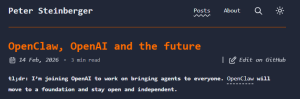
Steinberger, who built OpenClaw as an assistant designed to actively carry out tasks rather than simply respond to prompts, confirmed the move in a blog post.
OpenAI CEO Sam Altman also publicly welcomed him, stating that Steinberger will help shape the next generation of personal agents at the company.
Peter Steinberger is joining OpenAI to drive the next generation of personal agents. He is a genius with a lot of amazing ideas about the future of very smart agents interacting with each other to do very useful things for people. We expect this will quickly become core to our…
— Sam Altman (@sama) February 15, 2026
While Steinberger transitions into his new role, OpenClaw itself will continue as an open-source project under a foundation, with ongoing support from OpenAI.
From Experiment to Viral Assistant
OpenClaw gained attention over the past few weeks by positioning itself as an AI that could actually get things done.
Instead of stopping at conversation, it demonstrated the ability to manage calendars, book flights, and interact with a network of other AI agents. That practical focus helped it spread quickly across social platforms and developer communities.
The project went through multiple name changes along the way. It was initially known as Clawdbot, then Moltbot, before settling on OpenClaw.
One change followed legal pressure from Anthropic over similarities to its Claude branding, while the final name was a personal choice by Steinberger.
Despite the rebrands, interest in the assistant continued to build as users focused on what it could do rather than what it was called.
Choosing Impact Over Independence
In his announcement, Steinberger acknowledged that OpenClaw could have been developed into a standalone company.
However, he explained that building a large business was not what motivated him. His goal, he said, was to create meaningful change, and he viewed joining OpenAI as the fastest way to bring capable personal AI agents to a broader audience.
That reasoning aligns closely with OpenAI’s current direction. As large language models become more capable, attention is shifting toward agents that can plan actions, execute tasks, and interact with real systems on a user’s behalf. Steinberger’s work on OpenClaw fits naturally into that vision.
What OpenClaw’s Future Looks Like
Rather than being absorbed or shut down, OpenClaw will continue as an open-source project. According to Altman, it will be housed within a foundation, ensuring that developers can still explore, modify, and build on the assistant.
OpenAI’s commitment to supporting the project suggests that the company sees long-term value in keeping parts of this work accessible to the wider community.
This approach allows Steinberger to focus on advancing agent capabilities at OpenAI while preserving OpenClaw as a living example of how such systems can function in real-world scenarios.
Why This Move Matters
Steinberger’s move points to how AI products are beginning to change in practice. Attention is shifting away from chat tools that stop at conversation and toward systems built to complete tasks across multiple services without constant oversight.
Developers and businesses are already feeling the impact of that change. AI tools are starting to fit directly into daily workflows, handling scheduling, coordinating tools, and carrying out defined actions rather than offering suggestions alone. That shift places more weight on reliability and real integration than on novelty.
OpenClaw remaining open source adds further context to this transition.
Developers can examine how task-driven agents function in real situations and contribute improvements, rather than working only with closed systems. OpenAI’s decision to support that model suggests it sees long-term value in shared experimentation alongside internal development.
Personal AI agents are still early, but Steinberger’s move from independent builder to OpenAI contributor already hints at a broader pattern. Smaller projects that prove their usefulness are increasingly being pulled into larger platforms that have the resources to expand them at scale.
Key Takeaways
Peter Steinberger, the creator of OpenClaw, has joined OpenAI to work on personal AI agents
OpenClaw gained attention by performing real tasks such as scheduling, booking flights, and interacting with other AI agents.
OpenAI confirmed that OpenClaw will remain an open-source project under a foundation with continued support.
Steinberger chose to join OpenAI instead of building a standalone company to expand the reach of his work faster.
The hire signals OpenAI’s intent to invest more directly in task-focused AI systems rather than chat-only tools.

Zulekha
AuthorZulekha is an emerging leader in the content marketing industry from India. She began her career in 2019 as a freelancer and, with over five years of experience, has made a significant impact in content writing. Recognized for her innovative approaches, deep knowledge of SEO, and exceptional storytelling skills, she continues to set new standards in the field. Her keen interest in news and current events, which started during an internship with The New Indian Express, further enriches her content. As an author and continuous learner, she has transformed numerous websites and digital marketing companies with customized content writing and marketing strategies.
