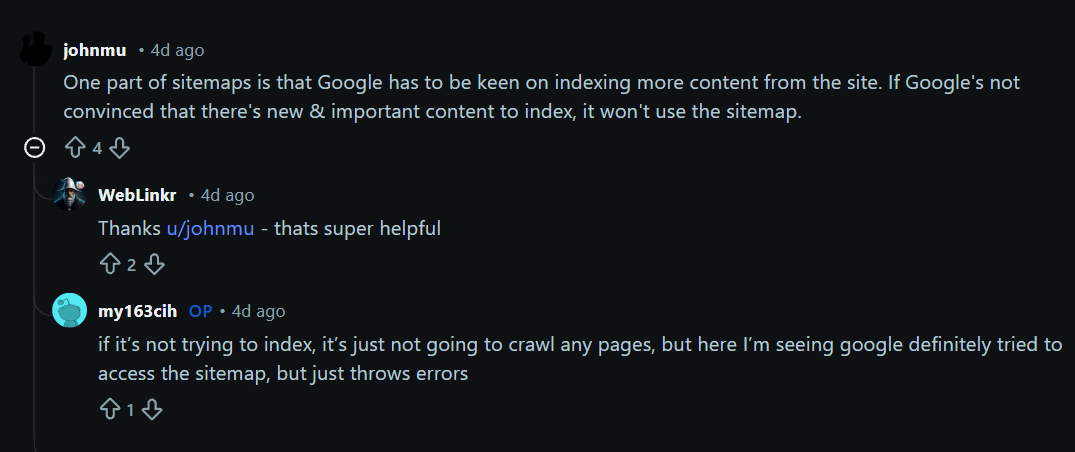
Google has reaffirmed that sitemap files do not influence indexing unless its systems believe a site offers genuinely new or important content. Without that confidence, a sitemap can be present, valid, and still unused.
In a recent Reddit discussion, John Mueller addressed a belief that still persists across SEO teams and site owners. The assumption is simple but flawed. If a sitemap exists, Google will crawl and index what is listed.
Google Search Console: Sitemap could not be read
by
u/my163cih in
SEO
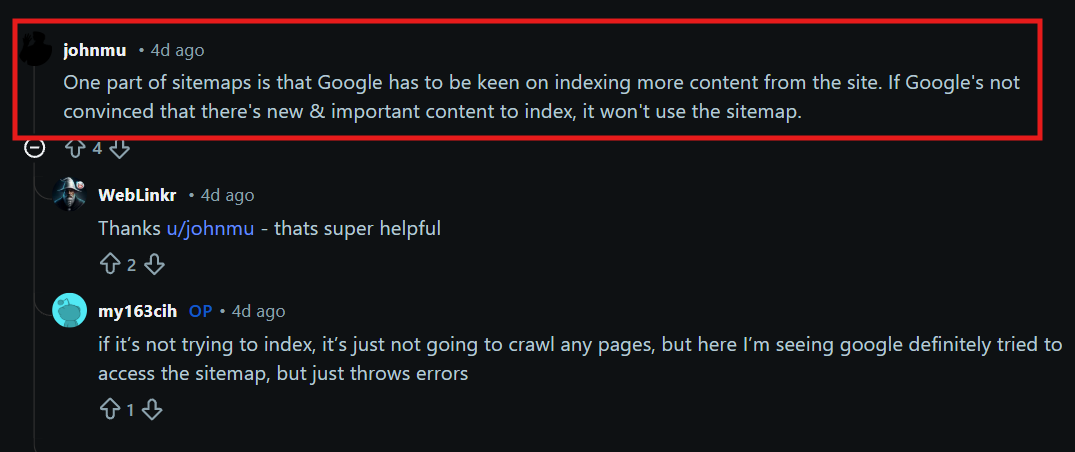
Mueller said that Google only leans on sitemap files when it sees a reason to explore more pages from a site. If its systems are not convinced that new or meaningful content is being added, the sitemap does not change that decision.
What Google Is Actually Deciding Before It Crawls
Google does not treat crawling as an automatic entitlement. Every site is evaluated based on signals that suggest whether additional crawling effort is worthwhile.
Those signals include how often a site publishes content that adds information, how distinct pages are from one another, and whether updates reflect real change or surface-level edits. When those signals are weak, Google may reduce crawl activity regardless of how complete the sitemap looks.
In that context, a sitemap becomes a reference tool rather than a trigger.
Why Many Valid Pages Never Make It Into the Index
It is common for site owners to see large gaps between submitted URLs and indexed pages. This often causes concern, but it reflects how Google prioritizes.
Most websites do not have full index coverage. Blogs accumulate dated posts, e-commerce sites generate filter and variant URLs, and publishers reuse formats across hundreds of pages. Google may crawl these pages once, recognize limited value, and decide not to index them.
The presence of a sitemap does not override that assessment.
The Real Role Sitemaps Play Today
Sitemaps still matter, but their role is narrower than many expect.
They help Google discover URLs that are hard to reach through links. They provide hints about canonical structure. They help surface pages faster when a site already demonstrates consistent value.
What they do not do is persuade Google to index pages it would otherwise ignore.
Seen this way, sitemaps support strong sites. They do not rescue weak ones.
Signals That Matter More Than Submission
If Google is unconvinced, the solution is rarely technical. The more effective levers are editorial and structural.
Pages that overlap heavily in purpose reduce confidence. Thin updates signal low priority. Important content buried deep in navigation sends mixed signals about relevance.
On the other hand, clear internal linking, purposeful updates, and visible differentiation between pages increase the likelihood that Google will revisit and expand indexing.
When those signals improve, sitemap usage often follows naturally.
Practical Steps That Align With How Google Thinks
Here are steps site owners can take to increase the likelihood that Google treats new content as worth crawling and indexing:
- Audit content in groups rather than page by page and identify repetition that can be merged or removed.
- Consolidate similar pages and strengthen internal links to the URLs that truly matter instead of spreading signals across many near-identical pages.
- Treat updates as opportunities to add clarity, context, or new information, not as light rewrites done for freshness alone.
- Give important pages clear prominence through navigation and linking so Google can understand their priority.
- Use the sitemap to reflect genuine intent and structure, not as a substitute for trust or quality signals.
Key Takeaways
- A sitemap only tells Google which URLs exist, not which ones deserve to be indexed.
- Google increases crawling when it expects to find meaningful content, not simply because more pages are submitted.
- Large numbers of unindexed pages usually reflect content quality or duplication issues rather than technical errors.
- Consistent, differentiated updates build crawl interest more effectively than publishing at scale.
- Sitemaps support sites that have earned trust but rarely change outcomes for sites that have not.

Zulekha
AuthorZulekha is an emerging leader in the content marketing industry from India. She began her career in 2019 as a freelancer and, with over five years of experience, has made a significant impact in content writing. Recognized for her innovative approaches, deep knowledge of SEO, and exceptional storytelling skills, she continues to set new standards in the field. Her keen interest in news and current events, which started during an internship with The New Indian Express, further enriches her content. As an author and continuous learner, she has transformed numerous websites and digital marketing companies with customized content writing and marketing strategies.