Key Takeaways
- Define the role and budget before posting: Misaligned salary expectations are the most avoidable cause of failed SEO hires.Setting the level accurately before outreach prevents wasted screening time on both sides.
- Resume screening alone will not surface the right candidate: SEO specialist skills are difficult to verify from a CV. Project-based interview questions, technical diagnostic exercises, and structured reference checks are the only reliable way to confirm real-world capability before a commitment is made.
- Technical SEO skills are a baseline requirement, not a bonus: Any candidate who cannot answer crawl budget, Core Web Vitals, or redirect questions with specificity is not ready for agency work, regardless of how strong their content or link-building background appears on paper.
- Use the contract-to-hire model to reduce risk: A 30/60/90-day performance framework defined before day one turns the probationary period into a structured evaluation rather than an awkward waiting period. Early-career professionals with strong potential consistently outperform expensive hires given the right structure and mentorship.
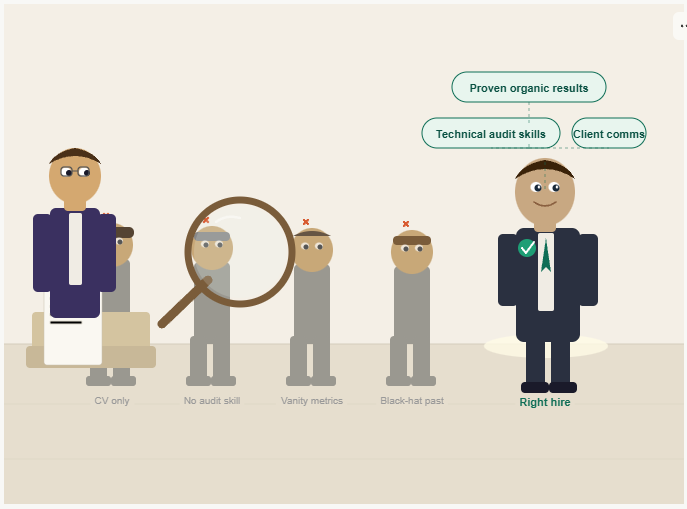
- Hire T-shaped SEOs, not isolated specialists: Siloed link builders and narrow-skill hires create gaps that become client problems. The most durable agency hires are deep in one discipline, competent across the full SEO stack, and capable of communicating findings clearly to a non-technical audience.
- Watch red flags in both the interview and the trial period: A candidate who cannot name their tools, explain their methodology, or walk through a real campaign outcome is not a junior professional developing their skills. They are the wrong hire at any level.
Knowing how to hire SEO experts is one of the most consequential decisions a digital agency makes.
The global SEO software market was valued at $74.6 billion in 2024 and is projected to reach $154.6 billion by 2030, according to Grand View Research.
As the market expands, so does demand for capable SEO professionals, and so does the cost of hiring the wrong one.
Most agencies approach hiring SEO specialists the same way they would hire any marketing professional: review the CV, run a general interview, and check references.
This process consistently fails to surface whether a candidate can actually perform under real conditions, with real clients, and inside the specific workflows of a growing agency.
This guide outlines the six most common hiring mistakes, the SEO specialist skills agencies overlook, the SEO job requirements worth defining before any interview, and the salary benchmarks needed to plan a realistic budget.
Each section includes diagnostic interview questions agencies can use immediately.
SEO Specialist Salary Benchmarks in the US
Before reviewing candidates, agencies need a realistic budget. SEO specialist salary figures vary significantly by experience level, location, and skill depth. Based on data from Salary.com, Jobicy, and Indeed, here are the current US benchmarks:
| Experience Level | Typical Annual Salary (US) | Key Responsibilities |
| Junior / Entry-Level | $42,000 – $56,000 | On-page tasks, reporting, content briefs, keyword research support |
| Mid-Level (2–4 years) | $60,000 – $80,000 | Campaign ownership, audits, link strategy, client reporting |
| Senior (5+ years) | $85,000 – $115,000+ | Full strategy, technical SEO, team leadership, client management |
| SEO Manager / Director | $115,000 – $130,000+ | Cross-team coordination, P&L responsibility, agency-wide SEO direction |
Agencies that budget for a senior-level hire but offer a mid-level salary consistently lose candidates to in-house roles or larger agencies. Defining the level accurately before posting a role prevents this mismatch and reduces time-to-hire.
Mistake 1: Skipping a Rigorous Knowledge Assessment
The most common failure when hiring an SEO expert is over-reliance on resumes and surface-level interviews.
As SEO specialist skills are difficult to verify from a CV alone, unqualified candidates regularly pass initial screening.
By the time the gap becomes apparent, the agency has already invested in onboarding and client-facing work.
Hiring an SEO expert is not a one-time transaction. An SEO specialist is someone who will adapt to Google’s constantly evolving search algorithms, represent the agency to clients, and influence strategic outcomes across multiple accounts.
What a rigorous screening process looks like:
- Project-based questions: Ask candidates to walk through a real campaign, specifically the challenge, the approach, which tools were used, and the measurable outcome. Vague answers indicate limited hands-on experience.
- Tool proficiency: Expect working knowledge of Ahrefs, Semrush, Screaming Frog, Google Search Console, and Google Analytics 4. A candidate who cannot name the tools they use daily is not ready for agency work.
- Algorithm awareness: Candidates should be able to explain how recent major updates affected strategies and what adjustments were made in response.
- Reference checks: Contact at least one reference with specific questions: “Describe a campaign they led and the result,” and “How did they respond to a ranking drop?” Generic character references reveal nothing useful.
Diagnostic Interview Question
“Tell me about a client whose rankings dropped after a Google update. How did you diagnose the cause and what steps did you take to recover traffic?”
A strong candidate names the specific update, identifies a probable cause (content quality, E-E-A-T signals, technical issues), and describes a structured recovery with measurable results. Anything vague is a red flag.
Mistake 2: Committing to Full-Time Hires Without a Trial Period
Many agencies default to permanent employment contracts before validating whether a candidate can perform within their specific workflows, client mix, and quality standards. This is expensive and avoidable.
A contract-to-hire model creates a structured probationary window where candidates demonstrate real value before any long-term commitment.
This is particularly useful when hiring an SEO specialist at the junior or mid level, where potential is high but track record is limited.
Why the contract-to-hire model works:
- Early-career SEOs frequently outperform expensive hires when mentored by senior team members. The determining variable is structure, not seniority.
- Defining success milestones at 30, 60, and 90 days before the contract begins makes performance conversations objective and reduces conflict.
- The freelance-first approach mirrors how much of the industry now operates. Many strong candidates are actively looking for a pathway from project work to permanent employment.
A contract-to-hire arrangement without defined deliverables is simply delayed risk. The structure must be in place before day one.
Mistake 3: Treating Technical SEO Skills as a Bonus
Many agencies evaluate candidates almost entirely on on-page content and link-building experience, treating technical SEO skills as a secondary consideration. This is one of the costliest oversights in the industry.
Technical SEO, covering crawlability, indexation, site speed, Core Web Vitals, structured data, and rendering, underpins every other SEO activity.
Without it, strong content and authoritative backlinks can underperform simply because search engines cannot properly access or evaluate the site.
A technically capable hire acts as a bridge between SEO strategy and web development.
They identify issues during a site audit, translate implications into plain language for developers, and prioritize fixes by ranking impact.
Technical SEO identifies crawlability, redirect structures, and Core Web Vitals as the foundational issues that must be resolved before any campaign can perform at its potential.
Technical SEO interview questions to use:
- How would you diagnose and resolve a crawl budget problem on a large e-commerce site with 50,000+ product pages?
- Walk through how you would investigate a Core Web Vitals failure, specifically a poor Largest Contentful Paint (LCP) score.
- What is the difference between a 301 redirect and a canonical tag, and when is each the correct solution?
- How would you implement structured data for a local business client, and which schema types would you prioritise first?
- If a site’s pages are indexed but not ranking for target keywords, which technical factors would you investigate first and why?
What a Strong Answer Looks Like
Candidates with genuine technical SEO skills answer these questions with tool names, specific diagnostic steps, and reference to how the fix affects ranking or crawl efficiency.
Candidates who respond with generalities, such as“I would audit the site”, lack the depth needed for agency work.
Mistake 4: Hiring Dedicated Link-Building Specialists
A dedicated link-building specialist and a well-rounded SEO professional are not the same role, and treating them as interchangeable creates real strategic problems.
Link builders operating in isolation often focus on volume metrics, such as Domain Authority, Domain Rating, number of placements, without understanding how link quality, topical relevance, and anchor text distribution affect long-term ranking performance.
Some default to tactics that carry algorithm risk, including paid placements, low-relevance guest posts, or private blog network (PBN) links.
The practical risks of siloed link building:
- No holistic view: A link builder who does not understand on-page or technical SEO cannot evaluate whether a backlink will move the needle for a specific page, or whether it will dilute anchor text diversity.
- Algorithmic exposure: Google’s link spam policies have grown increasingly sophisticated. Link acquisition that chases quantity over quality carries meaningful penalty risk that falls on the client’s domain.
- Cost inefficiency: Experienced link-building specialists in the US command salaries in the $78,000–$100,000 range—difficult to justify for smaller agencies when a well-rounded SEO professional can handle link acquisition as part of a broader strategy.
For agencies that need significant link-building capacity without the overhead of building a dedicated in-house team, outsourcing to a white-label link building service provider is a practical solution.
A reputable white-label partner handles manual blogger outreach services, vets placements for topical relevance, and delivers fully branded reports, so the agency retains the client relationship while the fulfillment runs behind the scenes.
Mistake 5: Hiring SEOs Without Writing and Data Skills
SEO without the ability to create content or interpret data produces limited results.
Many agencies hire narrowly, focusing on candidates with keyword research and link acquisition knowledge while overlooking whether the person can actually think, write, and analyse strategically.
The most effective SEO professionals combine three capabilities: search strategy, content production, and analytical thinking. This matters especially for smaller agencies where a single hire must deliver across multiple output types.
Why writing matters in SEO specialist skills:
- An SEO professional who understands how content quality is assessed under Google’s Helpful Content System makes better strategic recommendations than one optimising purely for keyword density.
- Writing-capable SEOs produce content, including blog posts, content briefs, case studies, and presentations, without requiring a separate writer for every output, reducing turnaround time and cost.
- Explaining complex concepts in accessible language is a direct commercial skill. When an SEO professional can present a technical audit to a non-technical client without losing the room, client retention improves.
Why data analysis matters:
- Competitive analysis requires interpreting backlink profiles, keyword gap data, and traffic trends in Ahrefs or Semrush, not just generating reports, but understanding what those reports mean and translating them into priorities.
- Data-literate SEOs build more persuasive performance reports that tie organic activity to business outcomes, such as qualified leads, conversion rate, and revenue, rather than impressions and session counts.
- Proficiency with Google Analytics 4 and Google Search Console enables early detection of ranking anomalies and coverage issues before they escalate into client crises.
Mistake 6: Undervaluing Communication and Relationship Skills
A technically excellent SEO professional who cannot communicate clearly with clients or cross-functional colleagues becomes a structural liability. Client-facing communication in an agency is not solely the sales team’s responsibility.
Where communication skills show up in practice:
- Client reporting: Monthly reviews require SEOs to translate raw data into a clear narrative. Clients need to understand what happened, why it happened, and what the next step is—without technical jargon.
- Expectation management: SEO timelines are routinely misunderstood. An SEO professional who proactively sets realistic expectations prevents the trust erosion that leads to churn.
- Cross-functional work: SEOs regularly work with developers, content teams, and paid media managers. Poor communication in these relationships causes delays, duplicated work, and missed opportunities.
- Industry networking: Events such as BrightonSEO and MozCon are where professionals share tools, test findings, and build referral networks that can benefit the agency directly.
How to evaluate communication in the interview:
- Ask the candidate to explain a technical concept, such as crawl budget or structured data, as though presenting to a non-technical client. The quality of the explanation reveals both comprehension and communication ability.
- Ask about a situation where they disagreed with a client’s requested approach and how they handled it. This tests professional judgment and interpersonal confidence simultaneously.
- Ask whether they contribute to industry publications, speak at events, or participate in communities such as Reddit or specialist Slack groups, which are signals of a professional who invests in continuous learning.
Red Flags to Watch for When Hiring an SEO Expert
Beyond the six structural mistakes, the following candidate behaviours during the interview or trial period are consistent warning signs that experienced SEO hiring managers recognise.
Red Flags: Reject or Proceed with Extreme Caution
During the interview:
- Claims guaranteed first page rankings within a specific timeframe. Google itself advises against any agency making this promise
- Cannot name the tools they use daily (Ahrefs, Semrush, GSC, GA4) or explain what they use them for
- Describes link-building methodology in vague terms like “outreach” without specifics on how targets are vetted
- Uses the word “traffic” as the sole measure of campaign success, with no mention of conversions, leads, or revenue
- Cannot explain what happened after a ranking drop, or claims a drop “never happened”
- Refuses to walk through a real case study or claims all past work is confidential
During the trial period:
- Produces reports full of data but makes no strategic recommendations based on that data
- Avoids raising technical SEO issues with developers, deferring instead to “content fixes”
- Focuses link-building activity on high-DA sites regardless of topical relevance
- Cannot explain work to a non-technical audience without using unexplained acronyms
SEO Interview Questions to Ask Before You Hire
The following SEO interview questions are grouped by skill area. Each is designed to surface a specific competency gap or confirm genuine expertise. They can be used across all experience levels, with stronger answers expected from senior candidates.
Strategy & Knowledge
- Which Google algorithm update has had the biggest impact on a site you managed in the past two years, and what did you do about it?
- How do you prioritize which SEO issues to fix first when inheriting a site with a long list of problems?
- Walk through how you would build a keyword strategy for a new client entering a competitive niche from scratch.
Technical SEO Skills
- How do you handle a scenario where important pages are being indexed but not ranking? What are the first five checks?
- A client’s Core Web Vitals score drops after a site redesign. How do you identify the cause and what is your process for fixing it?
- What is the difference between a noindex tag and a disavow file, and when would you use each?
Data & Analytics
- Describe how you would identify a traffic drop using Google Search Console and Google Analytics 4 together.
- How do you build a performance report for a client who cares about revenue, not just rankings or traffic?
Communication & Client Management
- Explain what a canonical tag is to someone who has never heard of it before.
- Describe a situation where a client pushed back on your SEO recommendation. How did you handle it?
Practical Screening Tip
For mid-level and senior candidates, consider adding a short paid audit task as part of the process. Ask them to audit one specific aspect of a site, including technical foundation, content quality, or link profile, and present findings as they would to a client. This single exercise reveals more than any number of interview questions about their real capability and communication style.
SEO Candidate Evaluation Scorecard
Use the following scorecard during the interview process to evaluate candidates consistently across the six core dimensions. Rate each criterion from 1 (poor) to 5 (excellent) and total the score for a comparable baseline across candidates.
| Evaluation Criterion | What to Assess |
| Industry Knowledge | Describes real campaigns with specific outcomes, tools, and decisions |
| Technical SEO Skills | Answers crawlability, CWV, schema and redirect questions with confidence |
| Content & Writing | Demonstrates or describes SEO content creation experience |
| Data & Analytics | Interprets GA4, GSC, and Ahrefs/Semrush reports fluently |
| Communication | Explains technical concepts clearly; navigates client-scenario questions well |
| Strategic Thinking | Connects on-page, off-page, and technical SEO into a coherent whole |
| Cultural Fit | Demonstrates curiosity, adaptability, and collaborative working style |

Frequently Asked Questions
What SEO job requirements should agencies define before hiring?
At minimum, a job description for an SEO hire should define the experience level (junior, mid, or senior), the primary skill area required (technical SEO, content, link building, or generalist), tool proficiency expectations, and whether client-facing communication is part of the role. Clear SEO job requirements reduce screening time and improve the relevance of applications.
What is the average SEO specialist salary in the US?
Based on 2025 data from Salary.com and Indeed, the SEO specialist salary in the US averages $70,000 per year for a mid-level professional. Entry-level positions start at $42,000–$56,000, while senior specialists typically earn $85,000–$115,000. SEO managers and directors can exceed $130,000 in major markets.
What is the difference between hiring an SEO specialist and an SEO manager?
An SEO specialist executes strategy—conducting audits, building links, optimising content, and reporting on performance. An SEO manager oversees a team, owns client relationships, and is accountable for strategic direction across multiple accounts. When an agency is hiring an SEO specialist, the role is execution-focused; when hiring a manager, leadership and communication skills carry equal weight to technical expertise.
What technical SEO skills should every SEO hire have?
Regardless of seniority, every SEO hire should demonstrate working knowledge of: crawl budget management, Core Web Vitals analysis, canonical and redirect implementation, structured data (schema markup), and indexation troubleshooting. These technical SEO skills are non-negotiable because they affect every other aspect of an SEO campaign’s performance.
How many SEO interview questions should be used in a screening?
A practical screening process uses four to six targeted SEO interview questions per stage: two covering strategy and knowledge, two covering technical ability, and one or two covering communication and data skills. More than eight questions in a single session rarely adds signal and can deter strong candidates.
Summary: Six Mistakes at a Glance
| Mistake | Core Problem | Recommended Fix |
| 1. Skipping knowledge tests | Unqualified candidates pass screening | Use project-based interviews and structured reference checks |
| 2. No trial period | Full-time commitment before performance is validated | 30 / 60 / 90-day contract-to-hire with defined KPIs |
| 3. Ignoring technical SEO skills | On-page focus misses critical site-health issues | Add structured technical questions to every interview |
| 4. Siloed link builders | Volume tactics carry algorithm and cost risk | Hire T-shaped SEOs; delegate volume link work to specialists |
| 5. No writing or data skills | Narrow skill set limits strategic output quality | Screen specifically for content and analytics proficiency |
| 6. Poor communicators | Client churn and cross-team friction | Include communication scenarios and client exercises |

Ananyaa
AuthorAnanyaa Venkat is a seasoned content specialist with over nine years of experience creating industry-focused content for diverse brands. At Stan Ventures, she blends SEO insight with strategic storytelling to shape a compelling brand voice. She has contributed to several leading SEO publications and stays attuned to evolving trends to ensure her content remains authoritative, relevant, and high-quality.


