A fresh review of AI Engine Optimization (AEO) and Generative Engine Optimization (GEO) tactics has brought surprising clarity to the table.
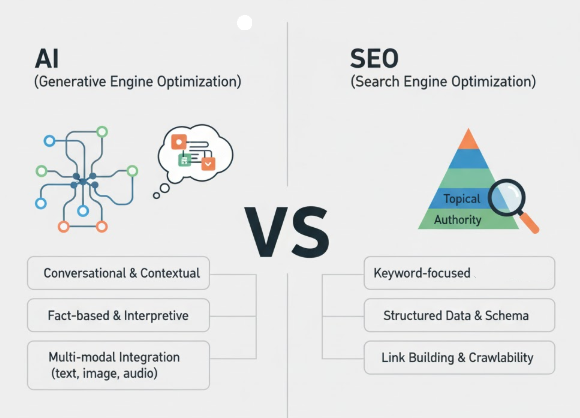
For months, SEOs have been debating whether GEO represents an evolution of search optimization or just marketing spin for good old-fashioned SEO fundamentals.
Now, Bing has stepped into the conversation with a new guide to AI search visibility and the verdict is in: AEO and GEO are not revolutions, they are refinements.
What Sparked the GEO vs. SEO Controversy?
The controversy started when a wave of consultants began branding new frameworks like GEO (Generative Engine Optimization) and AEO (Answer Engine Optimization) both promising to optimize for AI search experiences such as ChatGPT, Perplexity, or Google’s AI Overviews.
Critics in the SEO community were not convinced. Many argued that these so-called “new” strategies were little more than a rebrand of traditional SEO, focusing on structured content, clarity and authority.
But here is where Bing’s contribution matters. Their Principal Product Manager, Krishna Madhavan, published a comprehensive look at how AI assistants process and rank content.
The findings? Eye-opening and validating for those who’ve been following SEO fundamentals for years.
Do AI Engines Really Read Content Differently?
Yes but not that differently. Bing’s Madhavan explained that AI systems don’t read pages top to bottom like humans do.
Instead, they parse pages into smaller “chunks” or “modules,” evaluating these parts individually for context and relevance.
As he put it:
“AI assistants don’t read a page top to bottom like a person would. They break content into smaller, usable pieces, a process called parsing.
These modular pieces are what get ranked and assembled into answers.”
If this sounds familiar, that’s because it is. Google introduced Passage Ranking in 2020, an AI-based algorithm that analyzes specific passages within a page, rather than the page as a whole, to find the most relevant section for a user query.
Google explained it back then:
“By understanding passages in addition to the relevancy of the overall page, we can find that needle-in-a-haystack information you’re looking for.”
So, chunking is not new. It is simply the way modern search systems AI or not interpret and rank relevance.
For SEOs, the takeaway is simple: write modularly, not mechanically. Use subheadings, short paragraphs, and self-contained sections that can stand on their own.
Are Titles, Headings, and Meta Descriptions Still Relevant for AI Search?
Bing’s new guide reinforces that titles, descriptions, and H1s remain vital signals for AI systems trying to extract intent and hierarchy from a web page.
This shouldn’t surprise anyone who has optimized for Featured Snippets, Google Discover, or Top Stories.
Every algorithm update since Hummingbird has rewarded semantic structure.
The difference today is that AI assistants don’t just use these tags for ranking, they use them for summarization.
So if your title lacks clarity or your headings don’t map to real user intent, AI tools will likely skip your content entirely.
In other words: the old SEO best practices are still the new GEO best practices.
What About Lists, Tables, and Structured Data?
Bing recommends using bulleted lists and tables to present complex information in a scannable format, because AI systems can extract structured information faster that way.
For traditional SEOs, this sounds like schema or structured markup, but it goes deeper.
This concept is called structured information, meaning HTML elements like <ul>, <ol>, <h2>, and <table> that visually and semantically define content.
While structured data (like JSON-LD) is for machines only, structured information benefits both bots and readers.
It is the foundation of how AI systems parse meaning or what’s called disambiguation.
By making your content semantically precise, you’re not just improving accessibility, you’re helping AI systems “see” what each section means.
So yes, lists and tables are back in style. But this time, it’s not about keywords, it’s about clarity.
Do Question-and-Answer Pairs Really Improve AI Visibility?
Bing’s Madhavan highlighted that Q&A formatting is incredibly effective for AI search:
“Direct questions with clear answers mirror the way people search. Assistants can often lift these pairs word for word into AI-generated responses.”
It’s the same principle behind Featured Snippets of direct answers to direct questions.
Google’s own guidelines classify “content created solely for search engines” as low-quality or even spam.
So yes, Q&A structures help AI understand your page but only if they’re useful, human, and naturally embedded into your narrative.
The trick is to write for people, format for machines.
What Does “Semantic Clarity” Mean and Why Is It Now Critical?
Semantic clarity is about precision. It’s the art of saying exactly what you mean, with factual, context-rich phrasing that AI can interpret without confusion.
Madhavan’s guidance was straightforward:
- Avoid vague adjectives like “innovative” or “cutting-edge.”
- Anchor claims in measurable facts “42 dB dishwasher” instead of “quiet dishwasher.”
- Add contextual terms like “open-concept kitchens,” “low-noise design,” etc.
- Use synonyms and related terms naturally to reinforce meaning.
This is not just about readability, it is about trainability.
When AI systems train on your content, clarity helps them connect your brand or topic to the right queries and contexts.
As Madhavan summarized:
“Write for intent, not just keywords. Use phrasing that directly answers the questions users ask.”
If you have ever written a blog post for voice search or structured FAQ content, you are already halfway there.
So, Is GEO Really the Next Evolution of SEO?
Bing’s own conclusion might surprise the consultants marketing AEO as something new. Madhavan writes:
“Whether you call it GEO, AIO, or SEO, one thing hasn’t changed: visibility is everything.
…traditional SEO fundamentals still matter.”
That statement settles it.
AI search visibility does not require an entirely new discipline and it requires a smarter application of the same SEO principles that have always worked.
In other words:
- Write clear, structured, useful content.
- Organize it semantically for machines and humans.
- Keep your titles, meta tags and formatting clean.
- Build authority through consistent, factual storytelling.
Do that and you are already optimizing for AI, no extra acronym required.
The Real SEO Revolution Is Understanding the Reader
After all the hype, all the acronyms and all the debates, one truth remains, good SEO is timeless.
Google and Bing may use AI to understand pages differently but the ultimate goal has not changed: delivering the most helpful, precise and trustworthy content to users.
The difference now is who is reading first.
Before your customers see your content, AI systems read, interpret and summarize it , deciding whether your page deserves to be part of that next answer.
So maybe GEO is not a replacement for SEO. It is a reminder. A reminder that clarity, precision and usefulness are what have always made good content stand out, algorithm or not.
And as we have seen time and again, in SEO and beyond, the fundamentals never really go out of style.

Dileep Thekkethil
AuthorDileep Thekkethil is the Director of Marketing at Stan Ventures, where he applies over 15 years of SEO and digital marketing expertise to drive growth and authority. A former journalist with six years of experience, he combines strategic storytelling with technical know-how to help brands navigate the shift toward AI-driven search and generative engines. Dileep is a strong advocate for Google’s EEAT standards, regularly sharing real-world use cases and scenarios to demystify complex marketing trends. He is an avid gardener of tropical fruits, a motor enthusiast, and a dedicated caretaker of his pair of cockatiels.
