Google has once again clarified that visible anchor text remains a critical signal for understanding links, reinforcing that clarity for users and search engines still starts with what people can actually see and read.
Google has reiterated its long-standing position on how links should be structured, emphasizing that visible anchor text continues to play an important role in helping search engines understand the purpose of a linked page.
The clarification came when John Mueller from Google’s Search Relations team responded to a question raised by the SEO community on Bluesky.
The question touched on whether newer accessibility attributes, such as aria-label, have effectively replaced traditional link attributes like title, especially in the context of mobile-first indexing and limited support for title attributes on mobile browsers. Mueller’s response was clear and grounded in fundamentals.
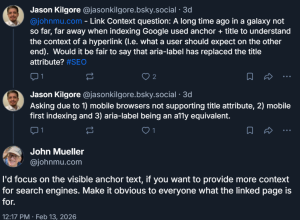
If the goal is to provide context for search engines and users, the focus should remain on visible anchor text that clearly describes where the link leads.
Why Google Is Emphasizing This Guidance Again
The renewed discussion reflects how web development practices have changed over time.
As mobile usage has grown and accessibility standards have matured, many site owners have leaned more heavily on behind-the-scenes attributes to explain links.
While these attributes serve an important role for assistive technologies, they do not replace the value of clear, descriptive text that users can immediately see.
Google’s message is not about introducing a new rule. Instead, it is a reminder that some of the most effective SEO practices are also the most user-friendly.
When a link clearly states what a user should expect on the other end, it reduces confusion, builds trust, and sends consistent signals to search engines about the relevance of the destination page.
Anchor Text, Accessibility, and Mobile-First Indexing
Accessibility and search optimization are often discussed together, but they serve different purposes.
Attributes such as aria-label are essential for screen readers and users who rely on assistive technologies. They help ensure that everyone can navigate the web effectively, regardless of how they access content.
However, from Google’s perspective, visible anchor text remains central because it aligns user experience with search understanding.
Mobile-first indexing makes this even more important. On smaller screens, users skim quickly, and search engines primarily evaluate what is presented in the mobile version of a page. Links that rely on hidden explanations risk losing clarity in both contexts.
Clear anchor text bridges this gap. It communicates intent instantly, without requiring additional interpretation from users or search systems.
What This Means for SEO Strategy Today
This guidance reinforces the importance of examining how links are written and used across a website. The wording of a link does more than guide users; it also shapes how search engines interpret a page’s relevance and context.
Internal links, navigation menus, and in-content links should all use language that clearly communicates the destination.
While generic phrases may seem convenient, they often weaken meaning and reduce the overall effectiveness of a site’s link structure.
That’s why a well-defined SEO strategy matters. Implementing best practices across large or complex websites can be challenging, particularly when design, accessibility, and performance considerations overlap. In these situations, professional SEO services become especially valuable, helping teams align technical choices with search visibility and user clarity.
This is where Stan Ventures can help by ensuring link structures, anchor text, and on-page signals work together cohesively to support both users and search engines.
Actionable Steps Site Owners Can Take
Here are several actionable steps site owners can follow to improve link clarity and overall usability:
- Begin with a focused review of existing content to identify links that may not be pulling their weight. Each key link should clearly convey its destination, even when viewed in isolation.
- Replace generic or unclear anchor text with descriptive phrasing that accurately represents the linked page, helping both users and search engines understand its intent.
- Assess how links render across devices (particularly on mobile) to ensure anchor text remains visible and meaningful, rather than being reduced to vague icons or labels.
- Maintain adherence to accessibility standards without compromising visible clarity. Strong implementations strike a balance between inclusivity and usability.
- Treat visible anchor text as the primary indicator of a link’s purpose, using accessibility attributes as supportive enhancements rather than stand-ins for clear wording.
Key Takeaways
- Google continues to rely on visible anchor text to understand link context.
- Accessibility attributes are important but do not replace clear, readable links.
- Mobile-first indexing increases the value of descriptive anchor text.
- Generic link phrases reduce clarity for users and search engines.
- A balanced SEO approach combines usability, accessibility, and clear link signals.

Zulekha
AuthorZulekha is an emerging leader in the content marketing industry from India. She began her career in 2019 as a freelancer and, with over five years of experience, has made a significant impact in content writing. Recognized for her innovative approaches, deep knowledge of SEO, and exceptional storytelling skills, she continues to set new standards in the field. Her keen interest in news and current events, which started during an internship with The New Indian Express, further enriches her content. As an author and continuous learner, she has transformed numerous websites and digital marketing companies with customized content writing and marketing strategies.
