


Top SEO Tools For 2026: A Curated List
Reading Time: 13 min read

Written by Ananyaa
- Updated on Dec 18, 2025

Table of Contents


Want to Boost Rankings?
Get a proposal along with expert advice and insights on the right SEO strategy to grow your business!
Get StartedMost SEO tool lists try to teach you everything about every tool.
That sounds helpful until you realize you’re 20 minutes in and still unsure which tool actually solves your problem.
That’s the gap this post fills.
In 2026, SEO isn’t about knowing every feature inside every platform. It’s about knowing which tool to open when a specific SEO task is on your plate—whether that’s fixing technical issues, finding content opportunities, or understanding why competitors outrank you.
This guide gives you a clear, practical overview of the best SEO tools we actively use at Stan Ventures to plan, execute, and measure SEO campaigns, covering what each tool is best used for, when it makes sense to rely on it, and where it fits in a real SEO workflow.

Top SEO Tools for 2026
Check out our best SEO tools list below.
1. Ahrefs
Ahrefs was launched in 2010 by Dmitry Gerasimenko, originally as a backlink analysis tool. It later expanded into a comprehensive SEO platform, with a strong focus on in-depth backlink analysis and competitor research.
User Base:
- Used by an estimated 40,000–45,000 paying organizations worldwide
- Adoption is largely team-based, especially across agencies and in-house SEO teams
- With an average of 2–3 active users per account, this translates to roughly 80,000–120,000 active users globally

Ahrefs is the tool you open when authority and competition are the real problem.
If rankings are stagnant even though your content looks solid, Ahrefs helps you understand why. It’s especially strong at showing how competitors earn visibility through backlinks, content depth, and topical coverage.
At a high level, Ahrefs is best used for backlink analysis and metric-driven competitor insights. It shows you which pages attract links, which keywords competitors dominate, and where your site falls short in terms of authority.
Key Features
- Industry-leading backlink and referring domain analysis
- AI-assisted content analysis for identifying ranking patterns
- Keyword clustering and content gap insights at scale
Use Ahrefs when:
- You want to analyze competitor backlink profiles
- You plan link building or brand mention campaigns
- You need to identify content gaps competitors already rank for
- You want to understand what actually drives organic traffic in your niche
Ahrefs is less about “what should I do today” and more about why competitors are ahead and what it takes to catch up. It pairs well with tools that handle planning or technical execution.
2. Semrush
Introduced in 2008 by Oleg Shchegolev and Dmitry Melnikov, Semrush started as a competitive intelligence and keyword research tool. Over time, it evolved into a full-scale SEO and digital marketing platform used by agencies and in-house teams worldwide. It’s acquired by Adobe in 2025.
User Base:
- As of late 2025, Semrush has approximately 1.19 million active users.
- The platform serves around 117,000–118,000 paying customers.
- Semrush is actively used across 143 countries, reflecting its global adoption.
Semrush is one of the top SEO tools you open when you need direction.
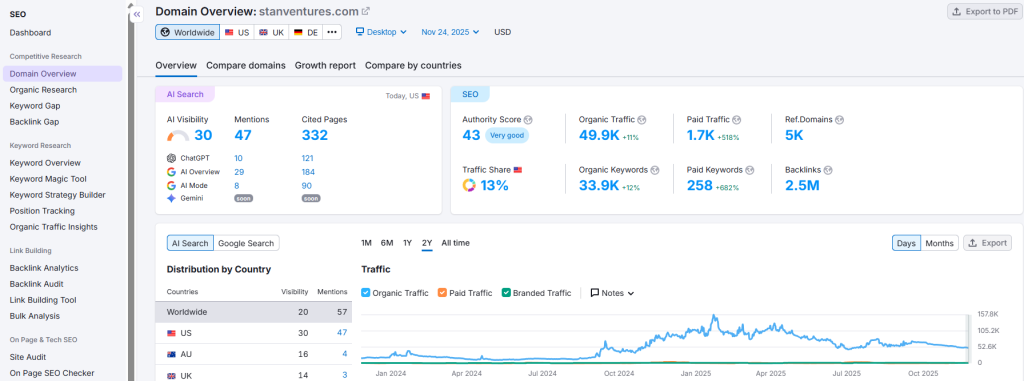
If you’re asking questions like:
- Where are my competitors winning?
- How do I outperform them?
- Which keywords or pages actually have ranking potential?
Semrush helps you get these questions answered faster.
Key Features
- Keyword and topic clustering powered by machine learning
- AI-assisted content brief creation and on-page optimization suggestions
- Competitive insights that adapt as SERP patterns change
The tool works best as an all-in-one planning and analysis platform. It connects keyword data, competitor insights, site health, and content opportunities into one view, making it easier to decide where effort will have the highest impact.
Use Semrush when:
- You want to plan content based on search demand and intent
- You want to benchmark your site against competitors
- You need a quick health check to spot SEO gaps
- You handle SEO management across multiple pages or projects
Semrush is especially useful for teams and agencies because it reduces tool switching. Instead of jumping between separate platforms for keywords, audits, and competitor research, Semrush gives you a consolidated starting point.
3. Ubersuggest
Ubersuggest began as a keyword suggestion tool and was acquired by Neil Patel in 2017. It was rebuilt and relaunched in 2018 as a simplified SEO platform focused on accessibility for small teams and solo marketers.
User Base:
- 250,000+ registered users across small businesses, agencies, and enterprises.
- Includes a mix of free users and paid subscribers, with tiered pricing plans.
- Attracts over 12.25K monthly visitors organically.
If you don’t want to get lost in advanced filters and massive dashboards, this is the best SEO tool, just enough data to validate ideas and move forward confidently.
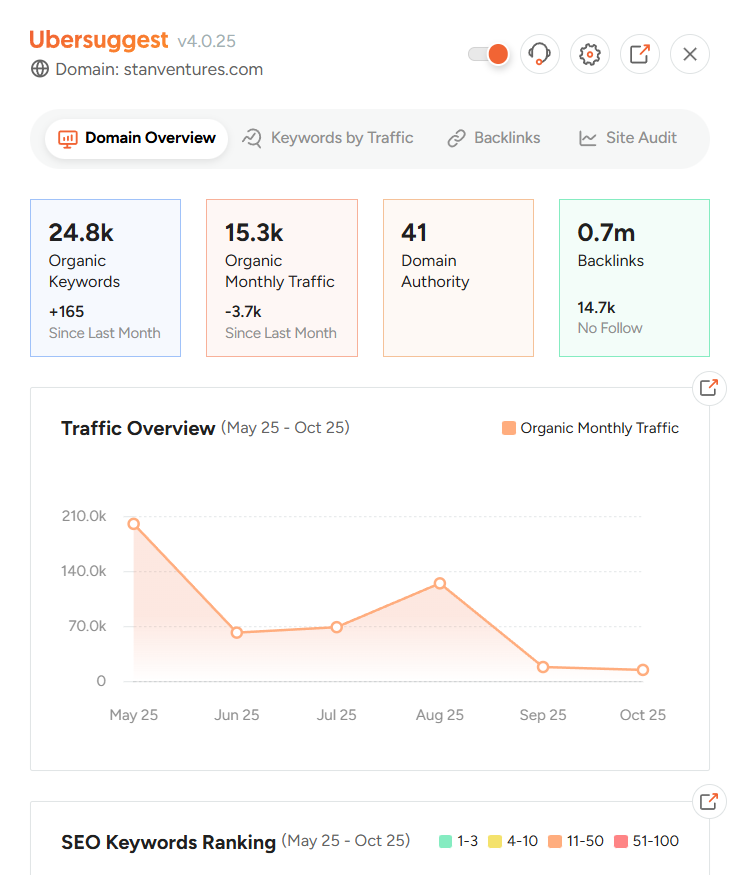
Ubersuggest works well as a lightweight, budget-friendly SEO tool. It covers keyword research, basic site audits, backlink insights, and competitor overviews without overwhelming you.
Key Features
- AI-powered keyword and content suggestions
- Simplified SEO insights designed for faster decision-making
- Beginner-friendly dashboards with automated recommendations
Use Ubersuggest when:
- You want to validate keyword ideas quickly
- You need a simple competitor snapshot
- You run SEO on a tight budget
- You want one tool that covers the basics reasonably well
This tool is not designed for deep technical audits or advanced competitive research, but for early-stage SEO and quick checks, it gets the job done efficiently.
4. Google Search Console
Google Search Console is a free SEO tool launched in 2006 as Google Webmaster Tools. It was later rebranded to reflect its broader role in monitoring search performance and site health.
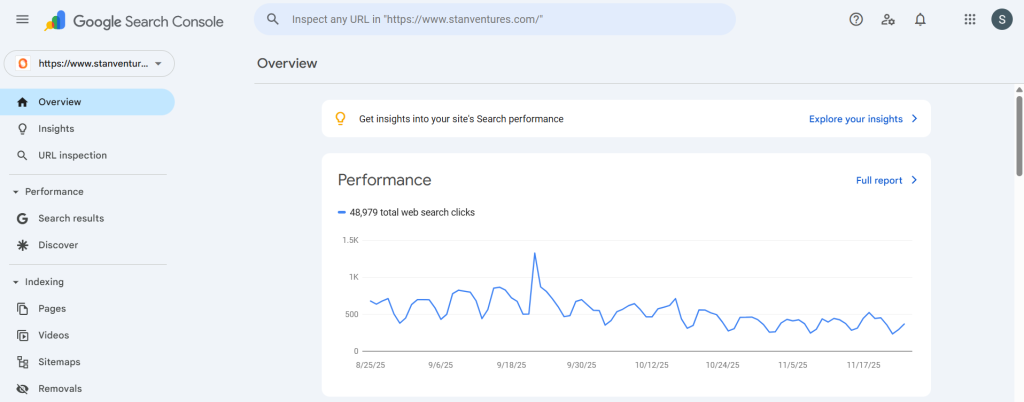
Google Search Console tells you how Google actually sees your site.
Unlike third-party tools that estimate performance, Search Console shows real data directly from Google, including impressions, clicks, indexing status, and technical issues that affect visibility.
This tool is essential for monitoring search performance and diagnosing critical issues.
Key Features
- First-party performance data directly from Google
- Indexing, crawling, and manual action diagnostics
- Query-level insights tied to real search visibility
Use Google Search Console when:
- Pages aren’t indexing or ranking as expected
- Traffic drops suddenly
- You want to see which queries trigger impressions
- You need to fix crawl errors or manual issues
If SEO decisions aren’t grounded in Search Console data, they are guesses. Most importantly, this can affect your ROI. That’s why this tool is foundational.
5. Google Analytics (GA4)
Google Analytics was introduced by Google in 2005 and has since become the standard for web analytics. GA4, its latest version, was launched to better track user behavior across devices and platforms.

While Search Console shows how users find your site. GA4 shows you a bigger picture of what they do after they land on your site.
User Base:
- Google Analytics is actively used by approximately 28.2 million websites worldwide.
- 14.2–14.8 million active websites have adapted to GA4, reflecting the industry-wide transition to the new analytics framework.
This tool helps you understand user behavior, engagement, and conversions. It connects SEO efforts to real business outcomes, not just rankings.
Key Features
- Machine-learning-driven predictive metrics
- Automated anomaly detection and insights
- Smarter attribution modeling across channels
Use Google Analytics when:
- You want to track conversions from organic traffic
- You need to identify high-performing or underperforming pages
- You want to analyze bounce rates, engagement and user journeys
- You want to see how SEO supports broader marketing goals
Without Google Analytics, SEO success is measured in traffic alone. With it, you measure SEO success in terms of conversions. That makes a huge difference.
6. Screaming Frog
Screaming Frog was founded by Dan Sharp and Graeme Radford in 2010 and is best known for its SEO Spider tool. It gained popularity for offering deep technical crawling capabilities used by SEO professionals worldwide.
User Base:
- Around 6000 companies use Screaming Frog as their SEO auditing tool.
- Holds a 16.82% share of the SEO auditing market, ranking #3 globally
- Used across enterprise-level companies at 22%, mid-market (14%), SMBs (9%) and micro SMBs (5%)
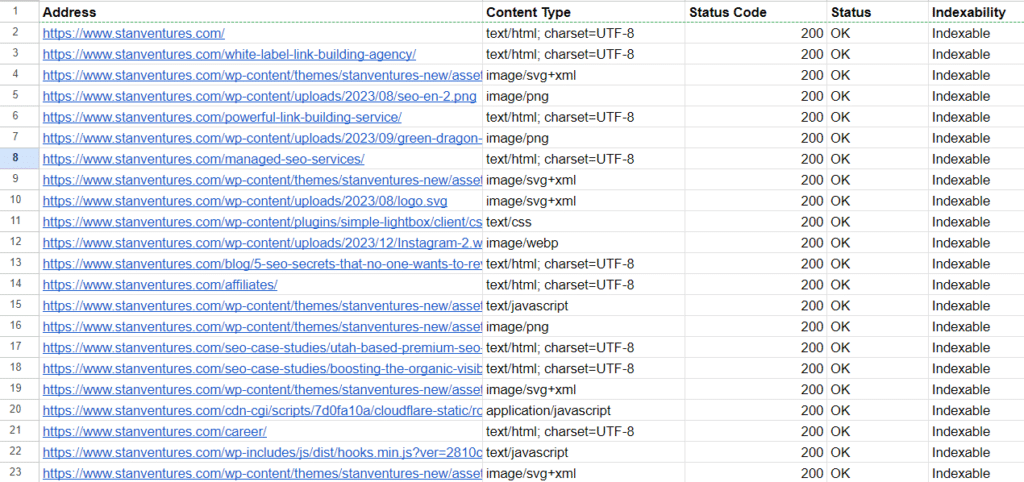
Screaming Frog is the tool you use when something is technically wrong, but you don’t know where the problem is.
This tool crawls your website the way search engines do and surfaces issues that silently block rankings, such as broken links, duplicate content, redirect problems, missing metadata, and more.
In short, Screaming Frog is best used for deep technical audits and quality control.
Key Features
- Full crawl-level visibility into technical SEO issues
- Flexible integrations for large-scale audits
- Reliable diagnostics for migrations and site cleanups
Use Screaming Frog when:
- You audit the site for technical SEO issues
- You’ve migrated or redesigned the website
- Rankings drop without obvious content or link issues
- You want a full crawl-level view of site health
This tool indirectly contributes to your SEO success by telling you what’s broken and needs fixing on your site.
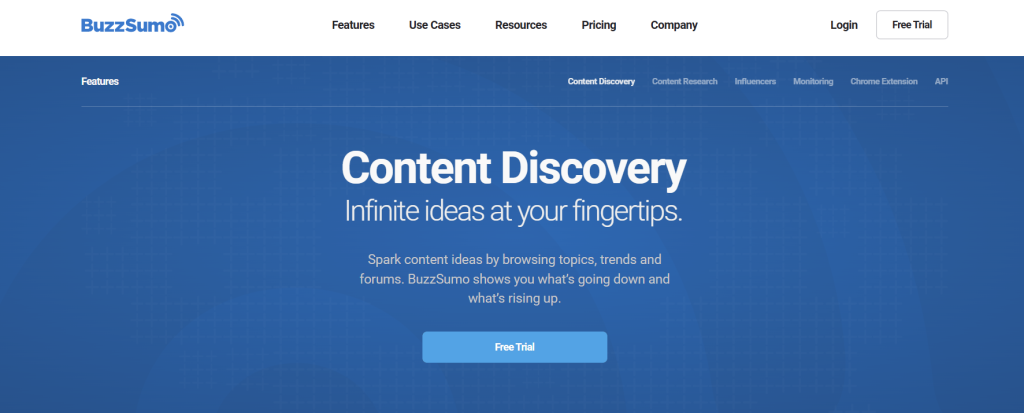
7. BuzzSumo
BuzzSumo was launched in 2014 by Henley Wing and James Blackwell as a content research and analysis platform. It was later acquired by Brandwatch in 2017 and Cision in 2021, expanding its role in content and audience intelligence.
User Base:
- 100K+ digital PR and content marketing professionals
- Used by 800+ digital agencies and enterprise companies
BuzzSumo helps you understand what content actually resonates with your target audience.
Instead of guessing topics or content formats, it shows which content gets shared, linked, and discussed across the web. That said, BuzzSumo is the best choice for content validation and ideation.
Key Features
- Data-driven identification of high-performing content
- Trend detection based on real engagement signals
- Clear visibility into formats and topics that earn traction
Use BuzzSumo when:
- You plan your content-focused campaigns
- You want to see what content performs well in your niche
- You refresh outdated content pieces
- You need proof that a particular content or idea drives traction
BuzzSumo doesn’t replace keyword research tools. It helps you validate what type of content actually earns attention, links, and shares.
8. Moz SEO Toolbar
Moz, founded in 2004 by Rand Fishkin and Gillian Muessig, introduced the Moz SEO Toolbar as a browser extension to provide quick SEO insights directly within search results and web pages.

User Base:
- Moz has over 500,000 active users with 1 million users accounting for the MozBar alone
- Over 5,289 companies use Moz as an SEO and SEM tool, with a significant concentration in the United States.
The Moz SEO Toolbar is built for quick metric-based insights, and not deep analysis.
It sits inside your browser and surfaces essential SEO signals the moment you land on a page, including page authority, domain authority, link metrics, and basic on-page indicators so you don’t have to switch tabs or open full dashboards.
Key Features
- Instant domain and page-level authority metrics
- SERP overlays for quick competitive context
- Fast credibility checks without opening full tools
Use Moz SEO Toolbar when:
- You want to scan competitor pages to assess relative authority
- You want to quickly evaluate link prospects during outreach
- You need a fast credibility check before prioritizing pages or domains
- You review SERPs and want context without breaking workflow
This tool’s value lies in reducing friction, helping you make faster, more informed decisions while staying focused on the task at hand.
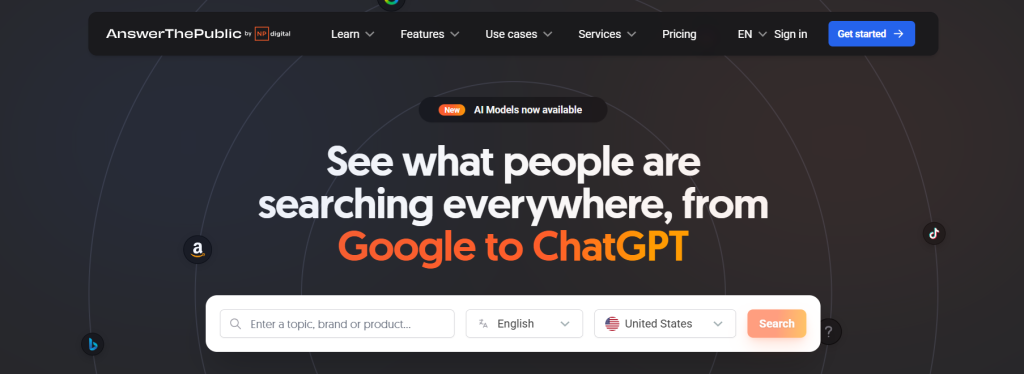
9. AnswerThePublic
AnswerThePublic was launched in 2014 by Gary Preston and Rachel Krish as a search listening tool. It was later acquired by NP Digital and continues to be used for understanding question-based search intent.
User Base:
- AnswerThePublic records approximately 1.08 million monthly visits.
- The user base is split between free users (limited searches/day) and paid subscribers on Individual, Business, or Enterprise plans.
AnswerThePublic is the tool you open when you are not sure how to leverage a content idea efficiently.
It pulls real search queries and presents them as questions, comparisons, and phrases, giving you a clear view of how people think about a topic. This tool is best for search-intent-driven content ideation.
Key Features
- Aggregates real search questions across platforms
- Groups queries by intent and phrasing patterns
- Strong support for long-tail and FAQ-focused content planning
Use AnswerThePublic when:
- You want to create high-performance blogs, FAQs, or guides
- You want to target long-tail and question-based queries
- You want to optimize content for featured snippets
- You need ideas that align with how users search
This tool is especially useful early in the content planning process, before keywords turn into outlines.
The best SEO tools don’t drive results on their own.How you use them and when you use them ultimately matter.
In 2026, successful SEO is less about stacking platforms and more about making clear, informed decisions at every stage of the workflow. Keyword research, competitor analysis, technical audits, content validation, and performance tracking each require a different lens. That’s why you should have the top SEO tools handy.
Again, the tools featured in this guide aren’t just random picks. They are tools we actively use at Stan Ventures to diagnose problems, uncover opportunities, and measure real SEO impact across client campaigns. Each tool has a clear role, a clear use case, and a place where it delivers the most value.
Start with clarity, build workflows around outcomes and let the best SEO tools bolster your strategy.
FAQs
Do I need all the best SEO tools to succeed in 2026?
Not necessarily. In fact, using fewer tools with clear intent is far more effective than juggling multiple platforms without a defined workflow.
Ahrefs Vs. Semrush: which is better?
Both Ahrefs and Semrush are among the best SEO tools. Each tool has its own strengths. Ahrefs excels at backlink analysis and competitive authority research, while Semrush is stronger for keyword planning, competitive insights, and all-in-one SEO workflows.
Do free SEO tools really deliver meaningful results?
Yes, Google Search Console and Google Analytics provide first-party data that no paid tool can fully replace. While paid tools like Ahrefs, Semrush, Ubersuggest and others add speed and depth, trusted free SEO tools are essential for monitoring performance and making informed decisions.
What are the best SEO tools for small teams?
If you are starting out or working with limited resources, Ubersuggest combined with Google Search Console offers a solid foundation. As your SEO needs grow, tools like Semrush or Ahrefs become more valuable for deeper analysis and scaling.
About the author


Share this article


Find out WHAT stops Google from ranking your website
We’ll have our SEO specialists analyze your website—and tell you what could be slowing down your organic growth.


Related Blogs


