A recent roundtable hosted by Stan Ventures’ SEO On Air brought together four agency founders to unpack the realities of running an SEO-first business in 2025.
The discussion was practical and dive into how modern agencies are balancing people, processes and the growing influence of AI in marketing.
The panel featured Andrea Salemi, Founder & CEO of Blue Noda; Steve Scott, Founder of Tampa SEO Training Academy; Michael Fleischner, Founder of Big Fin SEO and Lydia Martinez, Owner of Elle Marketing and Events.
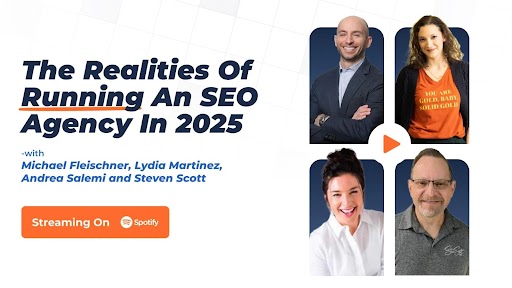
Each founder shared their personal journey, from building teams and defining culture to experimenting with AI tools and staying ahead of industry shifts.
What concluded from the conversation was more than just talk about SEO trends.
It was a reflection of how digital agencies are growing, from solo-driven beginnings to structured, strategy-led ecosystems built on adaptability, accountability and human connection.
From Layoffs to Leadership: The Modern SEO Founder Story
If you ask most founders how they started, the answers today sound surprisingly similar: survival, reinvention, and purpose.
That same story echoed across the table. For many, entrepreneurship was not the plan, it was the important take.
The pandemic era forced marketing professionals to find autonomy and stability on their own terms.
What emerged were agencies like Blue Noda, Big Fin SEO, Elle Marketing & Events, and Tampa SEO Training Academy, each built by founders who turned uncertainty into independence.
This new generation of leaders blends technical precision with emotional intelligence. They have seen the old SEO such as link farms, keyword stuffing, vanity metrics and deliberately built something better.
Today’s agency owner isn’t chasing algorithms and they are building ecosystems of trust, strategy and client education.
What Do Agency Owners Wish They Knew When They Started?
If there is one universal truth in agency life, it’s that growth comes with pain. Every founder reflected on the decisions that shaped and sometimes slowed their progress.
Hiring too late. Partnering too early. Not documenting soon enough.
These were the silent traps that each agency fell into at some point.
The modern SEO agency does not fail because of poor technical execution, it fails because of operational chaos.
Lack of systems, unclear expectations and inconsistent communication burn out both teams and clients.
As agencies mature, structure becomes the new creative superpower. Leaders who once resisted “process” now swear by it.
From project management tools like Teamwork and Trello to clear SOPs and onboarding frameworks, the agencies growing in 2025 are the ones that treat operations as a form of service quality.
The takeaway is clear: creativity scales only when structure supports it.
Defining Culture: The Differentiator Clients Actually Feel
Culture might sound like a big word but in an industry defined by deadlines and client churn, it is the unseen edge that keeps agencies stable.
In 2025, “agency culture” is not slack emojis, it is accountability, communication and curiosity.
Top-performing agencies are building cultures where quick client response, internal ownership and self-learning are non-negotiable.
Teams that can adapt, figure things out fast and collaborate transparently are outpacing those that rely purely on technical skills. For smaller agencies, culture is also brand identity. It is what attracts the right kind of clients and filters out the wrong ones.
Some firms are even reversing the client selection process which means presenting prospects with a list of “reasons not to hire us” to burn out incompatible relationships before contracts are signed.
The result? Stronger partnerships, less burnout and more consistent ROI delivery.
Accountability is Know “The New SEO KPI”
One of the most striking shifts in the discussion was how agency leaders now treat accountability as both an internal and client-facing KPI.
Too often, agencies are held hostage by unclear communication including delayed approvals, unreviewed content, missed deliverables — all blamed on the agency despite being shared responsibilities.
By setting accountability expectations upfront, agencies are regaining control of performance metrics.
It is no longer about “traffic reports”; it’s about showing clear, trackable collaboration between client and consultant.
In an era of AI and automation, human responsiveness, answering an email within hours, not days is becoming one of the most valued differentiators.
AI in Agencies: Tool, Not Threat
The AI debate dominated much of the conversation and the consensus was surprisingly calm.
Despite the hype, AI has not replaced marketers; it’s amplified them. Tools like ChatGPT, Gemini, Jasper and Perplexity are being integrated not as replacements, but as accelerators.
Agencies are using AI to handle research, data cleanup, draft ideation and code debugging, freeing human experts to focus on brand voice, strategic context and client relationships.
The smarter agencies are positioning AI as an internal efficiency engine, not a public product. They are using it to work faster and deliver higher value, while still marketing their differentiator: human creativity.
Yet, there is a critical insight that AI does not build trust; humans do.
Clients still want the emotional security of expert guidance. As one agency founder put it, “AI might write your paragraph but it won’t explain your purpose.”
The Rise of AIO: From SEO to AI Optimization
One of the most forward-looking ideas to emerge was the rise of AIO — AI Optimization.
With AI search overviews, zero-click results, and generative engines changing how people discover content, traditional SEO boundaries are dissolving.
Agencies are beginning to reframe their services beyond Google rankings — optimizing for visibility inside AI-driven environments.
From crafting content that trains AI systems accurately to ensuring brands appear correctly inside conversational tools like ChatGPT or Gemini, AIO is quickly becoming the next growth vertical.
SEO is no longer about “how Google reads your page,” but “how machines interpret your brand.”
The New Agency-Client Equation
2025 has also flipped the agency-client dynamic. Agencies are no longer just executors but they are educators, advisors and partners in business outcomes.
The founders agreed that many clients still approach agencies with outdated expectations: instant rankings, cheap deliverables and minimal involvement.
But successful agencies now make education part of their onboarding process and explain not just what they do, but why it works.
Some are even building “advisory-style” retainers that focus less on deliverables and more on strategic alignment. This shift from execution to consultation marks the next evolution of agency services.
What Comes Next: Truth, Trust, and Focus
When asked about the future, the founders’ predictions were strikingly human — not technological.
The next era of digital marketing, they believe, won’t be about AI dominance. It will be about trust restoration.
The internet is becoming polluted with misinformation, fake reviews, and synthetic content. That chaos will create a premium on agencies that can deliver verified, traceable and ethical marketing.
Meanwhile, the marketing arms race for “omnichannel presence” is slowing. The smarter strategy, they suggest, is doing fewer things exceptionally well.
Quality over quantity. Depth over visibility.
As Lydia Martinez put it, “Even with unlimited resources, you can’t do everything. Choose your corner of the internet and own it.”
From SEO to Human-Centered Intelligence
Listening to these agency leaders, one thing became clear that the future of digital marketing is not about AI taking over. It is about humans using AI to amplify what they already do best: connect, communicate and create clarity.
From Andrea’s culture-first leadership to Lydia’s authenticity-driven marketing, and Steve’s technical experimentation to Michael’s strategic foresight, every voice echoed the same truth:
“SEO is not dead. It is just evolving and so are we.”
Let’s see where this evolution takes us next. But one thing is certain, the agencies that stay adaptable, ethical and creative won’t just survive the next wave of digital transformation. They will define it.

Dileep Thekkethil
AuthorDileep Thekkethil is the Director of Marketing at Stan Ventures, where he applies over 15 years of SEO and digital marketing expertise to drive growth and authority. A former journalist with six years of experience, he combines strategic storytelling with technical know-how to help brands navigate the shift toward AI-driven search and generative engines. Dileep is a strong advocate for Google’s EEAT standards, regularly sharing real-world use cases and scenarios to demystify complex marketing trends. He is an avid gardener of tropical fruits, a motor enthusiast, and a dedicated caretaker of his pair of cockatiels.
