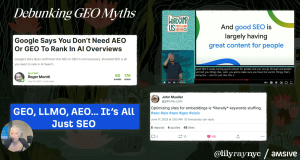
At MozCon 2025, SEO strategist Lily Ray unpacked the frenzy around “GEO,” “AEO,” and “LLMO,” reminding marketers that despite the flood of new AI terms, real success still depends on timeless SEO fundamentals, that is, quality, clarity, and credibility.
Artificial intelligence has become the centerpiece of modern search. Features like Google’s AI Overviews and platforms like ChatGPT are changing how people discover information. In response, new acronyms have emerged: GEO (Generative Engine Optimization), AEO (Answer Engine Optimization), and LLMO (Large Language Model Optimization), each suggesting a new way to “optimize” for the future.
Lily Ray, Vice President of SEO Strategy and Research at AMSIVE, offered a reality check.
Speaking at MozCon 2025, she explained that these buzzwords don’t mark the end of SEO but an extension of it.
According to Ray, AI may be changing how people discover information, but it still relies on the same web ecosystem that drives traditional search. The technology has evolved, yet the fundamentals of visibility remain just as vital.
The Story That Brought It Home
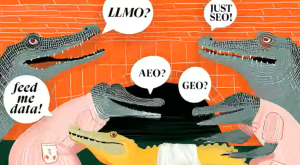
To drive the point home, Ray introduced an unexpected character, a golden alligator named GEO. In her story, AI SEO (GEO) represents the new generation of AI-driven search. He’s born into a family of older alligators, each one representing an earlier “SEO revolution”: mobile-first indexing, voice search, AMP, and Core Web Vitals.
Each time a new “child” was born, the SEO industry panicked. Predictions about “the death of SEO” flooded social media and conference stages. Yet, every time, SEO has evolved and remained central to digital visibility.
GEO, she explained, is just the latest addition to that family. The ecosystem looks different, but it still runs on the same nutrients, which include high-quality information, clear structure, and trust.
It was an effective metaphor. It reminded everyone that the industry has been here before, overwhelmed by change, yet still anchored by the same fundamentals.
The Facts: AI Still Relies on Search
Ray cited current data showing that Google search remains the dominant traffic source.

While ChatGPT, Gemini, and Perplexity have grown rapidly, most AI responses are grounded in indexed content pulled from search APIs.
That means visibility in AI results depends directly on SEO strength.
In many LLM-generated answers, the cited URLs are the same pages ranking organically on Google.
She also noted that LLM traffic, while attention-grabbing, is still a fraction of total organic visits for most websites.
In fact, AI-driven discovery often leads users back to search engines to verify results, reinforcing Google’s central role.
How Optimization Is Evolving
Although the fundamentals remain, Ray emphasized that the way content is read by AI systems differs from traditional search engines.
Instead of scanning full pages, large language models identify smaller, self-contained units of meaning.
This change places greater importance on structure. Clear headings, concise explanations, and logical formatting help both search engines and AI models understand and cite information correctly.
She also noted that AI tools frequently reference content from trusted public sources such as Wikipedia, Reddit, and YouTube.
Brands that contribute valuable, verifiable information to these platforms can improve their chances of being recognized by AI-powered systems.
Action Points for SEO Teams
Ray urged SEO teams to adjust metrics and monitor visibility across both search and AI platforms.
Her advice included:
- Keep SEO fundamentals strong. Focus on clarity, quality, and credibility.
- Structure content effectively. Use subheadings and concise sections that can be easily cited.
- Measure AI-driven visibility. Track mentions and traffic from AI tools as a separate metric.
- Update content meaningfully. Refresh only when information changes, not for timestamps.
- Participate authentically. Build authority in online spaces that AI systems reference.
Many agencies offering AI SEO services are already applying these principles. They rely on data-driven insights, strong content structure, and genuine brand storytelling to stay visible across both search results and AI-generated platforms.
The Bottom Line
Lily Ray’s message at MozCon 2025 is that SEO is maturing. The tools may evolve, and the acronyms may multiply, but the foundation of online visibility remains the same.
AI systems don’t replace search; they reflect it. And the content that earns attention in this new era will still come from the same place it always has—clear, credible information created for people first.

Zulekha
AuthorZulekha is an emerging leader in the content marketing industry from India. She began her career in 2019 as a freelancer and, with over five years of experience, has made a significant impact in content writing. Recognized for her innovative approaches, deep knowledge of SEO, and exceptional storytelling skills, she continues to set new standards in the field. Her keen interest in news and current events, which started during an internship with The New Indian Express, further enriches her content. As an author and continuous learner, she has transformed numerous websites and digital marketing companies with customized content writing and marketing strategies.
