


How to Track Brand Mentions in AI Search Results
Reading Time: 11 min read

Written by Ananyaa
- Updated on Jan 28, 2026

Table of Contents

Are you already optimizing your brand for AI search systems? That’s great. But how do you track that visibility?
AI search doesn’t give you a report that says, “Here’s where your brand showed up today.” It surfaces brands inside the generated answers. No rankings, no URLs, and often no backlinks or clicks.
That’s why it’s almost impossible to track AI brand mentions using SEO tools designed to monitor progress in traditional SERPs. But don’t worry. You are just about to find the solution.
In this write-up, I’ll explain how to track brand mentions in AI search results effectively to bolster your AI SEO efforts.
Too Busy to Read? Listen to the Deep Dive
What Is a Brand Mention in AI Search?
A brand mention in AI search is when your brand shows up in an AI-generated answer across platforms like Google AI Overviews, Gemini, ChatGPT, Perplexity and more. An AI brand mention can occur with or without a link to your website.
Unlike traditional search results, AI responses don’t always direct users to a list of web pages. Instead, they synthesize and summarize information from relevant sources they trust.
When your brand is mentioned in AI snapshots, it means your brand is already part of the conversation across the web.
Brand mentions can happen in the following ways.
- Direct Linked Mentions: When the AI explicitly names your brand and includes a clickable URL pointing to your site or a specific page.
- Unlinked Mentions: When the AI system mentions your brand but does not include any URL to your site.
- Implied Mentions: When your content surfaces in AI results without a direct mention of your brand.
When your brand shows up in AI search results, it’s a reflection of how visible and trusted your brand is in the eyes of users and next-gen search systems alike.
Why Track Brand Mentions in AI Results
Here’s why tracking AI brand mentions is essential at the moment.
- Visibility Check: With AI responses showing up at the top, people get their queries answered without actually visiting any website. You should make sure your content or brand shows up where your target audiences look.
- Authority Signal: When AI mentions a brand, it usually pulls from sources it already trusts. When your brand surfaces in AI responses, it is a strong authority signal.
- Bolster SEO: AI Search doesn’t replace SEO, but complements it. AI Search amplifies what traditional search engines trust, including content relevance, natural backlinks and brand mentions. Stronger SEO and AI search visibility go hand in hand.
- Competitor Watch: When you track AI mentions, you can review which competitors AI systems cite repeatedly, identify potential gaps and build a better AI SEO strategy for your brand.
How to Track Brand Mentions in AI Search
Here’s how you can track brand mentions in AI Search results.
Specialized AI Visibility Trackers & SEO Tools
Traditional rank tracking tools typically track positions, URLs, clicks and impressions. But AI responses don’t work that way.
In AI search, there’s no fixed ranking, no consistent URL placement, and often no clicks. So even if your brand shows up in an AI-generated answer, most rank trackers won’t surface it.
On the other hand, dedicated AI visibility trackers & SEO tools with AI monitoring features track brand mentions inside AI responses and surface cited pages or URLs for specific keywords. This way, they help you understand which sources AI systems rely on when answering queries.
Remember, AI visibility trackers don’t replace traditional analytical tools and rank trackers. Instead, they add an extra layer that allows you to connect your brand’s AI visibility back to other powerful SEO signals.
What are the best tools to track AI brand mentions?
- Dedicated AI Visibility Tools
These tools focus on how AI chatbots mention and recommend brands in direct responses.
- Otterly AI: Checks whether AI systems like ChatGPT or Gemini recommend your brand for specific queries and alerts you when your position in those responses changes.
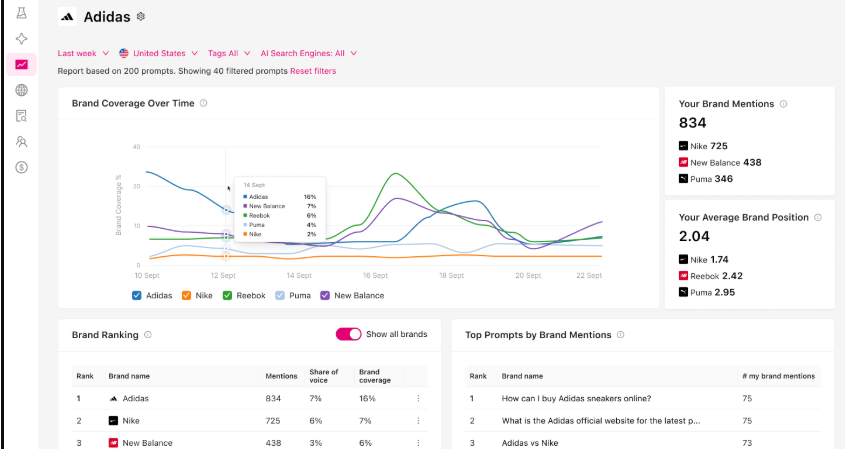
Source- Otterly AI
- Siftly: Measures how often your brand appears compared to competitors and calculates share of voice across AI responses.
- Peec AI: Monitors how AI describes your brand, tracks sentiment, and surfaces opportunities where you can improve AI search visibility.
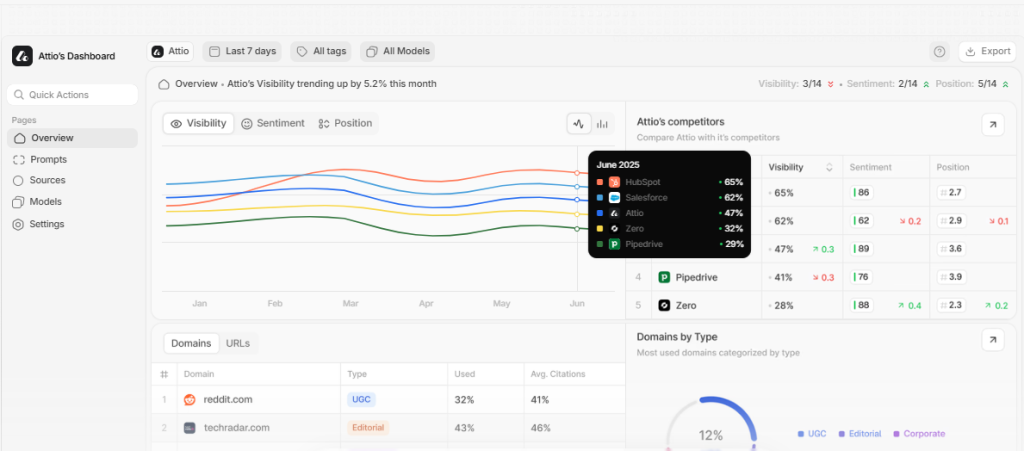
Source- Peec AI
- Profound: Maps AI brand mentions across different stages of the customer journey to show whether your brand appears during the awareness or decision-making stage.
2. SEO Platforms with AI Features
These tools extend traditional SEO platforms with AI visibility tracking, primarily within search-driven AI experiences.
- BrightEdge AI Catalyst: Tracks brand visibility inside Google AI Overviews and identifies the pages and sources AI uses to generate those results.
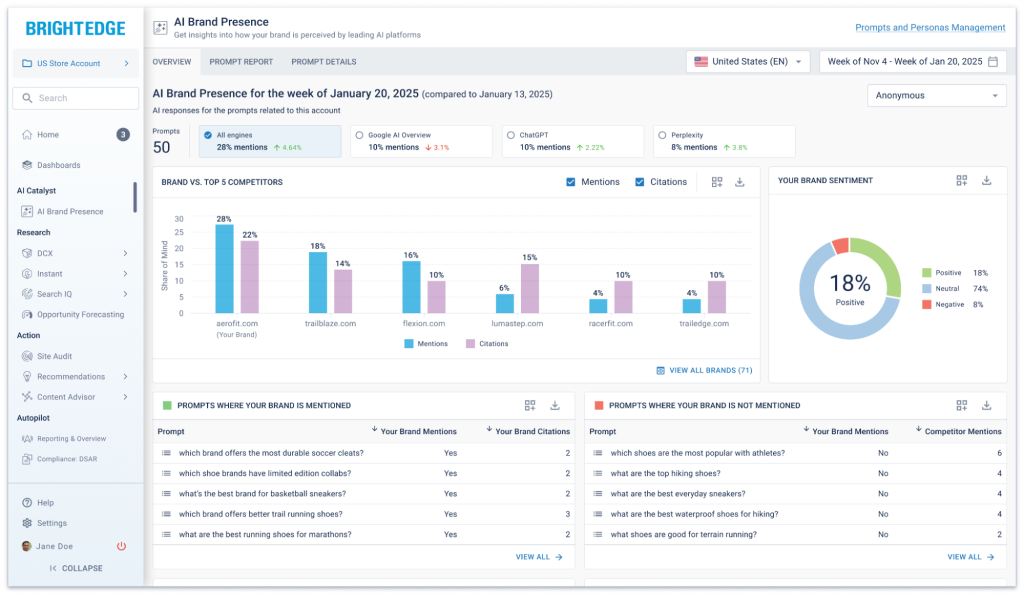
Source: BrightEdge
- Surfer AI Tracker: Shows which of your pages are being cited by AI models and helps identify content that needs updates to retain AI visibility.
- SEMrush Brand Monitoring Tool: Part of the broader SEMrush platform that lets you view AI visibility in Google AI Overviews alongside keyword rankings and other traditional SEO metrics.
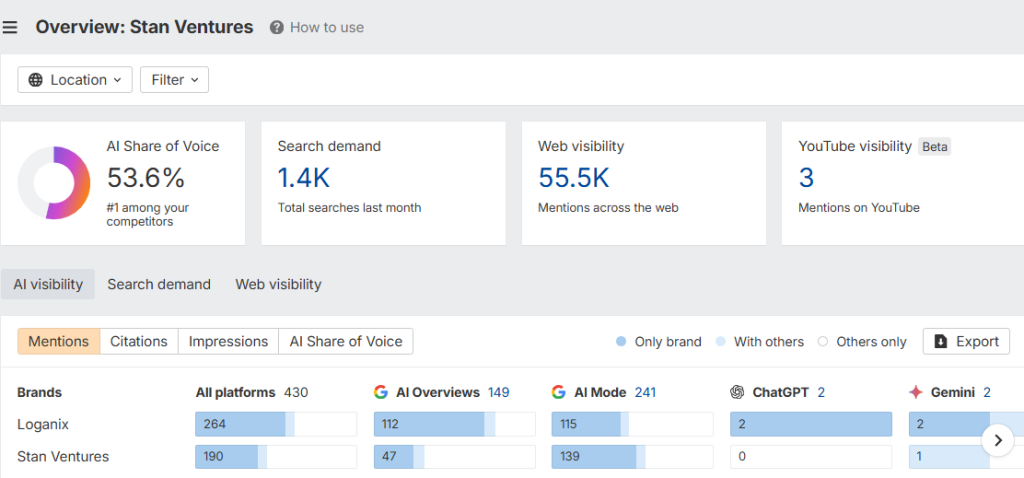
- Ahrefs Brand Radar: Uses a large prompt dataset to assess overall brand authority in AI systems and show which competitors appear most frequently across AI-generated responses.
Other Tools:
These tools monitor human conversations and content sources that often influence AI citations.
- Brand24: Tracks brand discussions across forums and social platforms, helping detect sentiment shifts that may later surface in AI responses.
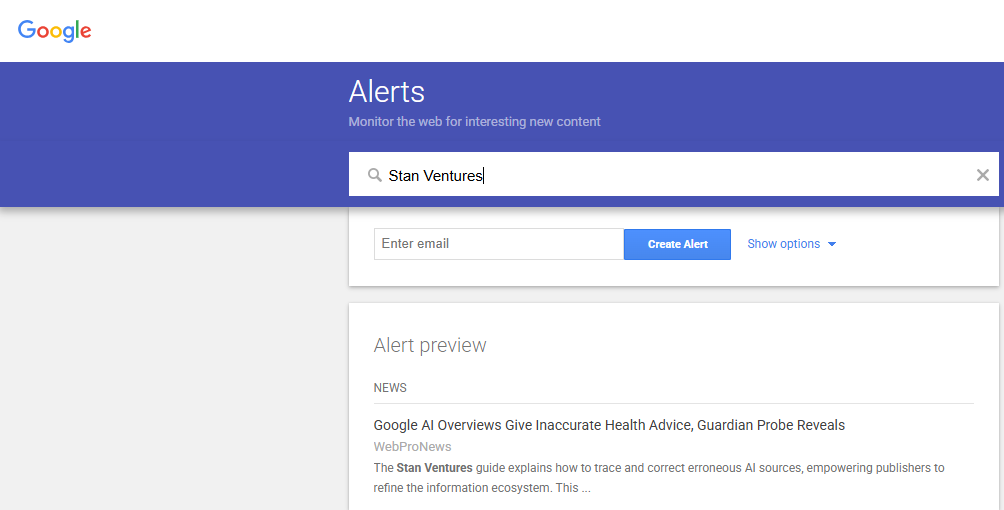
- Google Alerts: Alerts you when new web pages mention your brand, serving as a baseline for web-wide visibility outside AI search responses.
How to Set Up AI Brand Mention Tracking
Here’s your step-by-step guide to tracking AI brand mentions.
Step 1: Log in to the Platform
Sign in to one of the tools mentioned above to monitor brand mentions across AI models such as ChatGPT, Gemini, Perplexity, and Google AI Overviews. For demonstration purposes, let me show you how to track brand mentions in AI search results using Ahrefs.
Step 2: Configure Tracking Parameters
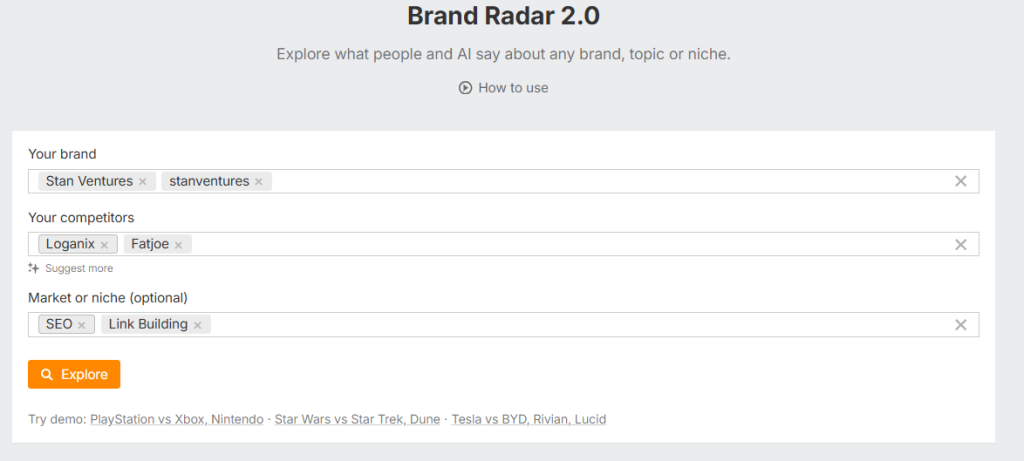
Add your brand name, the competitors against whom you want to track brand mentions in AI Search results, your niche and other parameters. Click “Explore”.
Step 3: Review AI Visibility Data
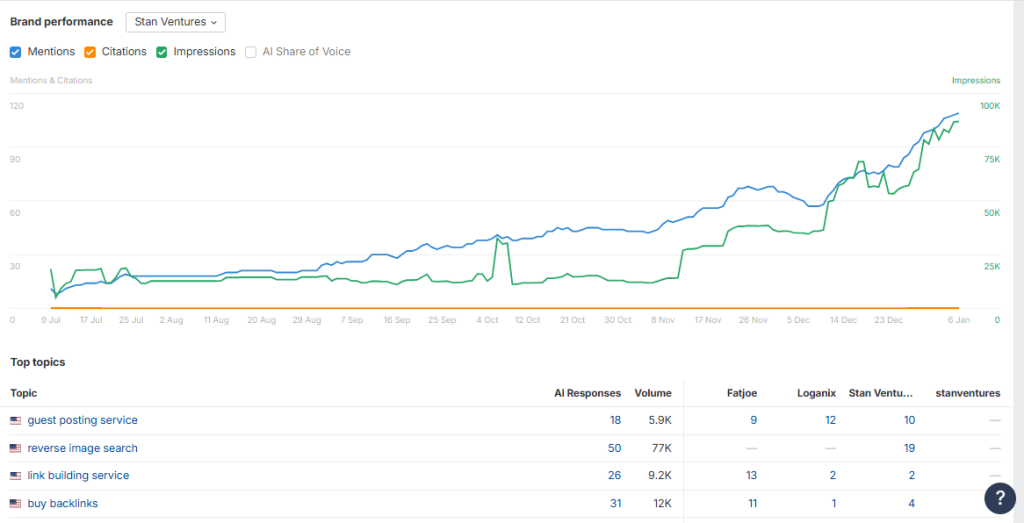
Use the dashboard to assess AI visibility levels, prompts where your brand appears, and the sources AI models rely on when generating responses.
Manual Prompt Testing
Manual prompting is one of the most direct ways to understand how your brand appears in AI search responses. It gives you a first-hand view of what AI tools surface when real users ask real questions, without waiting for reports or dashboards.
This approach works best when you rely on priority key terms or prompts rather than random testing. The idea is to mirror user intent and observe how AI behaves across different query types.
- Comparison queries: Check whether AI places your brand alongside competitors or excludes it entirely. Examples of comparison queries include “[Your brand] vs [Competitor]” or [Competitor] alternatives.
- Informational vs transactional queries: Use this method to know whether your brand appears only during early research or also when users are closer to taking a purchase decision.
- Competing brands mentioned: Know which competitors consistently surface alongside or instead of your brand for industry-related queries.
Manual checks help you spot patterns quickly and validate if the AI mentions data featured by specialized tools align with how AI systems are actually presenting your brand online
How to Run Manual Prompt Testing to Track AI Visibility
Here’s a simple way to manually check how your brand appears in AI-generated responses.
Step 1: List Your Priority Prompts
Start with a short list of queries tied to your brand. This usually includes comparison searches, category-level questions, and “best [service/tool]” prompts.
Step 2: Run the Prompts Across AI Platforms
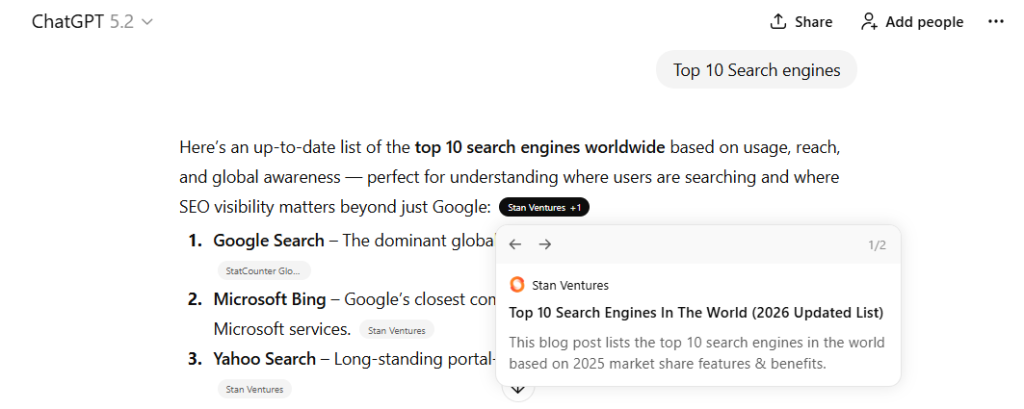
Enter the exact query into AI tools such as ChatGPT, Gemini, and Perplexity.
Step 3: Review Brand Visibility
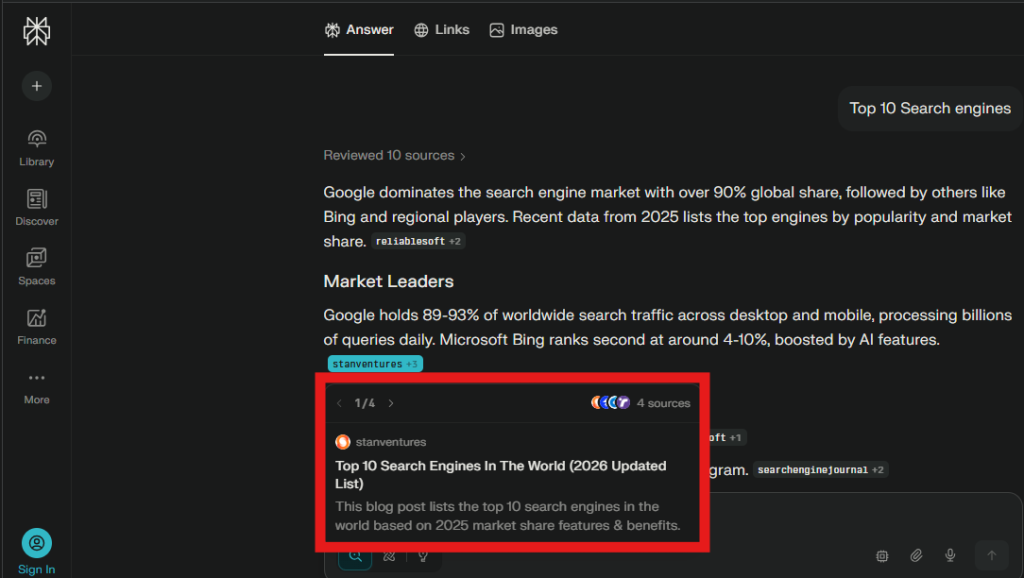
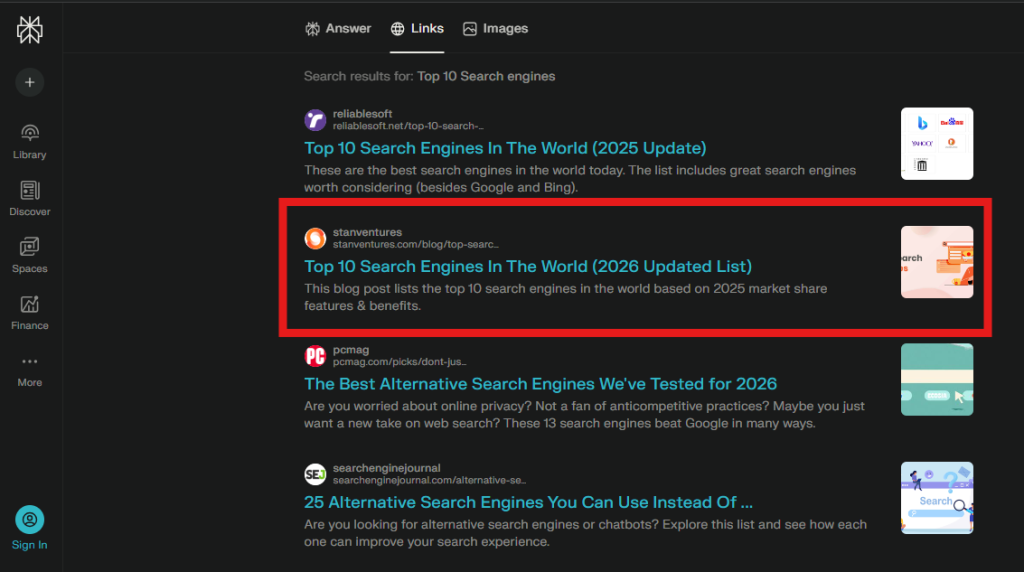
Check whether your brand appears in the response, where it appears, and how it is presented. It can be a reference, a recommendation or not mentioned at all. For example, as you can see in the screenshot below, Perplexity cites Stan Ventures as a source for the query “Top 10 Search Engines.”
Step 4: Note Down Competing Brands and Sources
Make a note of brands and websites that show up for a particular query. If your brand shows up among them, you can use this information to enhance your AI SEO efforts further. On the contrary, if you don’t appear in the results at all, you can use it to identify patterns that encourage AI search systems to choose your competitors over you.
Step 5: Repeat at Regular Intervals
Revisit the same set of prompts monthly or quarterly to track changes in visibility and see how AI responses shift over time.
Key Metrics to Track for AI Search Visibility
Tracking AI visibility works only if you focus on the right signals. Essential metrics to track include:
- Mentions & Citations: Measures how often your brand appears in AI-generated responses, either as a named mention or as a cited source supporting the answer.
- Sentiment: Analyzes how AI describes your brand based on whether the context is positive, neutral or negative. The more positive AI brand mentions you get, the stronger your authority.
- Sources Cited: Highlights pages or websites AI systems rely on when answering queries related to your niche.
- Share of voice: Compares how frequently your brand appears in AI responses relative to competitors across similar prompts and query types.
Tracking AI brand mentions helps you do a reality check and ensure AI search systems recognize your brand, trust your content and surface it for relevant user queries.
To make this process easier, copy this checklist into your project management tool or a simple document. Use it to run your first audit immediately.
Remember, without AI visibility tracking, it’s easy to assume progress when visibility is actually missing. This can tarnish your AI SEO efforts ruthlessly.
Leverage a mix of the right AI SEO tools and manual prompting methods to keep an eye on existing AI brand mentions and get data-backed insights to boost visibility in the AI+SEO era.
FAQs
Why is it important to track brand mentions in AI search?
AI answers often shape user perception before any click happens. Tracking brand mentions helps you understand whether your brand appears in those answers and how visible it is compared to competitors.
Do I need specialized software to track brand mentions in AI responses?
Not always. Manual prompting can give you a basic view, but specialized tools make it easier to track mentions at scale, monitor trends over time, and compare visibility across competitors.
What are the best ways to track brand mentions in AI search?
The best ways to track brand mentions in AI search include using AI visibility tools and manual prompt testing. A mix of these two techniques works well to get a bigger picture of how AI search systems perceive your brand.
What are the best tools to track ChatGPT brand mentions?
Tools like Otterly AI, Profound, Peec AI, SEMrush Brand Monitoring Tool and Ahrefs Brand Radar come in handy for tracking brand mentions in ChatGPT and other AI-powered search systems.
About the author


Share this article


Want to Boost Rankings?
Get a proposal along with expert advice and insights on the right SEO strategy to grow your business!
Get StartedRelated Blogs


