


Top 10 Link Metrics to Look for in 2026
Reading Time: 10 min read

Written by Ananyaa
- Updated on Dec 24, 2025

Table of Contents

Do you still rely on backlink metrics that look impressive in reports but fail to boost rankings and conversions?
That’s how most link-building strategies quietly fall apart. Authority scores spike up, spreadsheets look healthier every month, yet search visibility barely moves.
If you are encountering similar bottlenecks, let me tell you something that most SEOs and agencies don’t reveal. The issue isn’t execution. It’s believing that the wrong metrics represent real link value.
To help you out, I’ve compiled a list of the top 10 link metrics to consider before getting started with your link building campaign.

1. Link Relevance (Topical Authority)
A backlink is most effective when it comes from a website that covers topics closely related to your niche.
Search engines analyze the content of the linking page, the overall theme of the website, and how closely that content aligns with your subject matter. If the topics are unrelated, the link provides little or no contextual value.
For example, a backlink from a niche website that consistently publishes content in your industry can carry more weight than a backlink from a large website that is not topically relevant.
Relevant backlinks help search engines understand what your website is about and associate it with specific topics. When links consistently come from pages that cover similar topics, they reinforce your site’s topical relevance significantly.
2. Organic Traffic to the Linking Page
Organic traffic is a solid backlink building metric you should NEVER miss out on. Before you check any authority score, check if the target page gets considerable organic traffic.
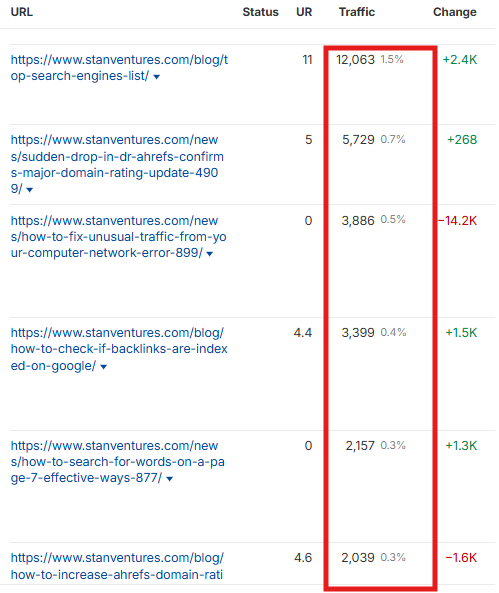
If a web page relevant to your niche receives consistent traffic from traditional search engines and AI-powered search systems, it means that the content is ranking better and is visible to users online. This suggests that the content meets quality and relevance standards.
On the contrary, backlinks from web pages with little or no organic traffic often have limited SEO impact. Even if authority metrics appear high for these pages, the lack of traffic indicates that search engines are not actively rewarding them.
That said, a backlink from a relevant page that ranks and receives substantial organic traffic is more likely to pass more SEO value to your website.
3. Referring Domains
The number of unique websites linking back to a website matters more than the total number of backlinks it has.
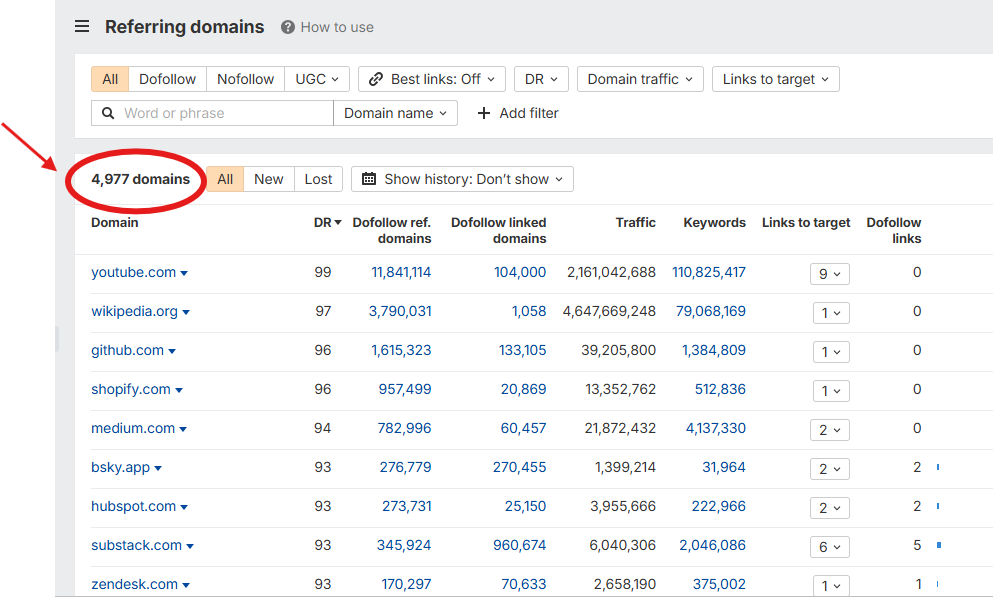
A backlink profile with a higher number of referring domains generally indicates broader citation across the web. When comparing two sites with similar link quality, the one with more unique linking domains is usually stronger.
This metric is also useful for identifying unnatural patterns. A site backed by voluminous links from a small number of unique domains is often a sign of link manipulation rather than organic growth.
Additionally, search engines like Google treat multiple links from the same domain as a single source of endorsements. On the other hand, backlinks from different domains represent independent references.
Make sure you prioritize websites with a higher number of fresh referring domains for link building purposes.
4. Majestic Trust Flow (TF)
Introduced by Majestic, Trust Flow measures how closely a website is connected to a set of manually selected, well-established websites within Majestic’s index.
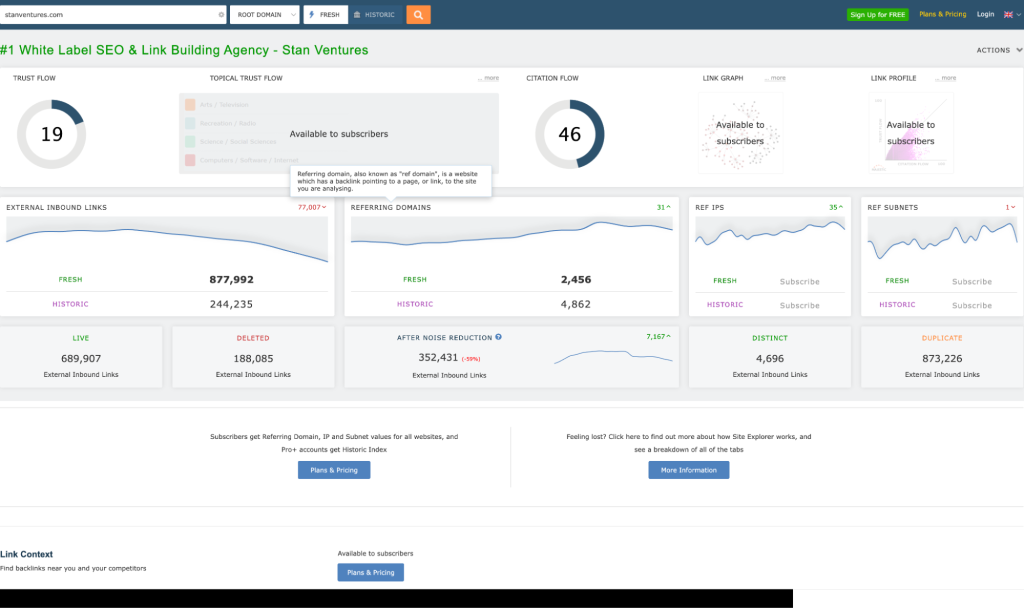
Instead of focusing only on the number of backlinks, this metric evaluates where those backlinks originate. Given the scenario, websites that receive links from credible, established sources score higher than websites whose backlinks come from low-quality or spam-driven sources.
As this metric relies on where a website’s backlinks come from rather than link volume, it is harder to inflate through mass link acquisition. This makes it useful for identifying websites whose backlink profiles are less likely to be manipulated.
5. Ahrefs URL Rating (UR)
Ahrefs URL Rating is an SEO metric that measures the backlink strength of a specific page, not the entire domain.
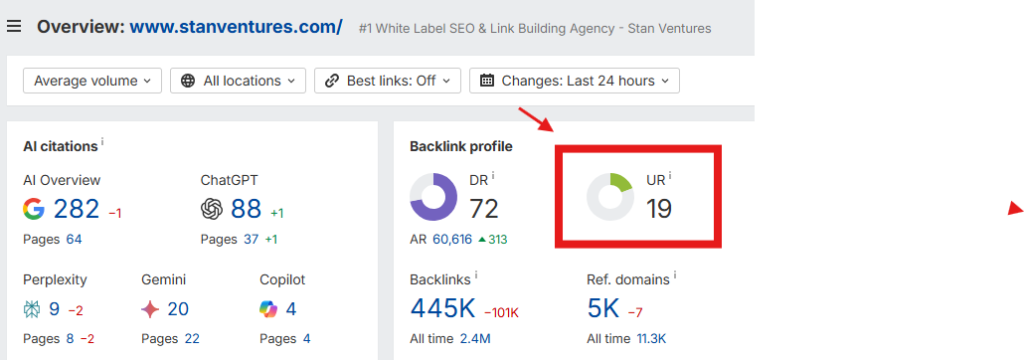
Pages with higher URL Rating tend to rank better because they are supported by backlinks of their own. When a backlink comes from such a page, it is more likely to positively influence your rankings than a backlink placed on a page with few or no backlinks.
This is why a single backlink from a high-UR page can have a stronger impact than multiple backlinks from weaker pages, even if those pages belong to high-authority domains.
6. Semrush Authority Score
Semrush Authority Score is a compound metric designed to evaluate more than just backlink volume. Unlike older authority scores that focus almost entirely on links, it incorporates organic traffic and spam-related indicators to calculate the score.
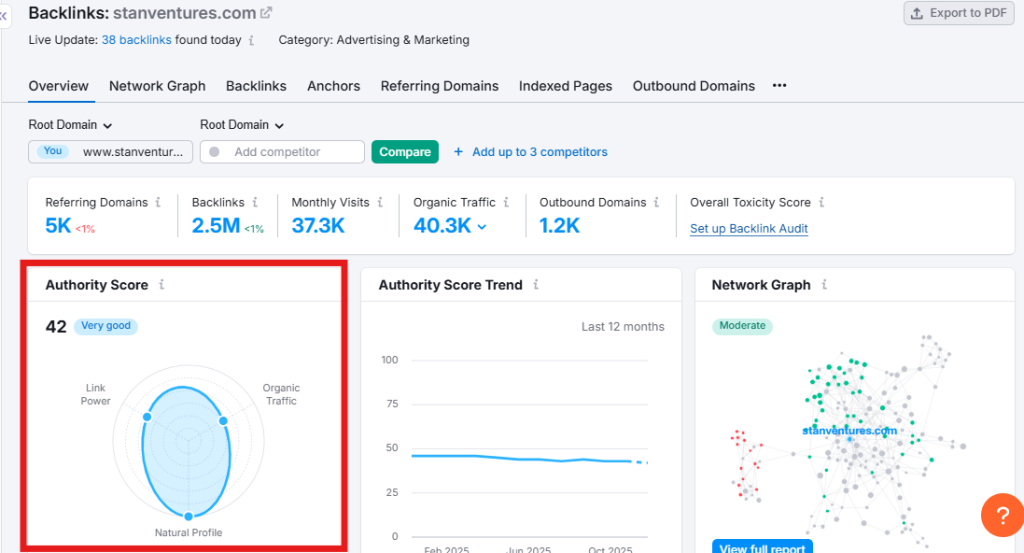
As this metric also includes traffic data, websites with large backlink profiles but little or no search visibility tend to score lower. This makes the metric harder to manipulate through link quantity alone. This metric also takes into account patterns that suggest unnatural linking behavior.
As a result, Semrush’s Authority Score provides a more holistic view of how a site’s backlink profile aligns with its actual search performance.
A high Authority Score typically indicates a combination of strong backlinks and consistent organic traffic, making it easier to identify high-quality backlink opportunities for your website.
7. Ahrefs Domain Rating (DR)
Ahrefs Domain Rating is widely used to quantify the overall strength of a website’s backlink profile. In link building, it has become a common shorthand for authority, often used to filter prospects or define minimum quality thresholds.
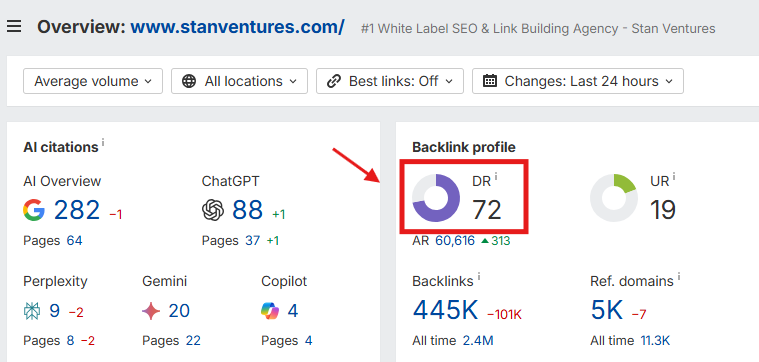
However, DR is a broad, domain-level metric. It measures link popularity, but not relevance, traffic, or content quality. Since this metric doesn’t account for how a site performs in search, it can be preposterous based on backlink volume, even when the organic visibility of the linking website is low.
Despite these limitations, DR remains useful for initial prospecting and comparison. A higher DR generally indicates greater link equity at the domain level, which is why many SEOs still use it as a starting point.
DR is most effective when evaluated alongside metrics like organic traffic and topical relevance, rather than used on its own.
8. Moz Domain Authority (DA)
Moz Domain Authority is one of the earliest domain-level link building metrics and is still widely recognized even outside the SEO community. With many clients still prioritizing DA as a growth indicator, this metric continues to appear in reports and client discussions.
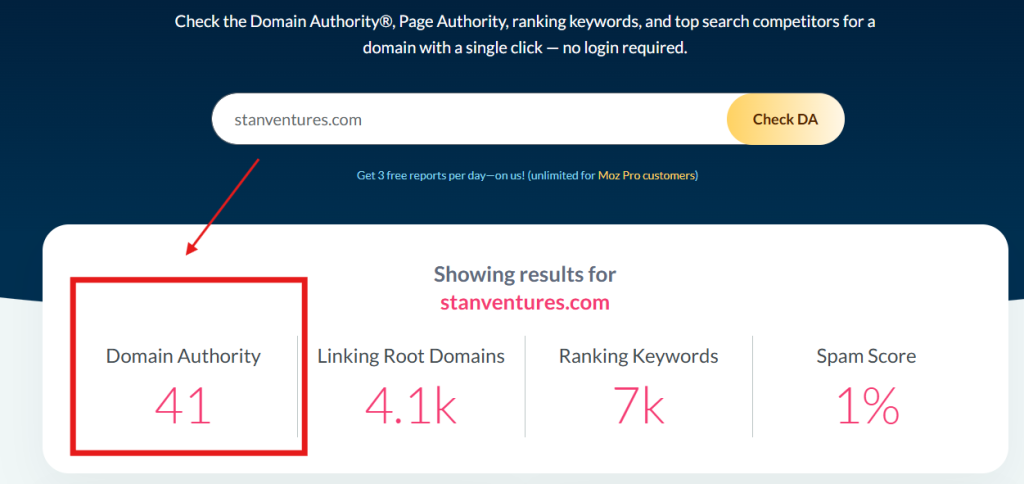
However, DA is a secondary metric for backlink evaluation. It is based on Moz’s link index, which is less responsive to industry dynamics compared to Ahrefs’ Domain Rating and Semrush’s Authority Score.
Also, just like other domain-level scores, DA does not account for relevance OR traffic and can be influenced by backlink volume.
With these limitations, DA is best used as a reference or communication metric rather than a standalone, decision-making metric.
9. Spam Score (Toxicity Score)
Not every metric helps you find good links. Some help you avoid bad ones. Spam score is one such backlink metric.
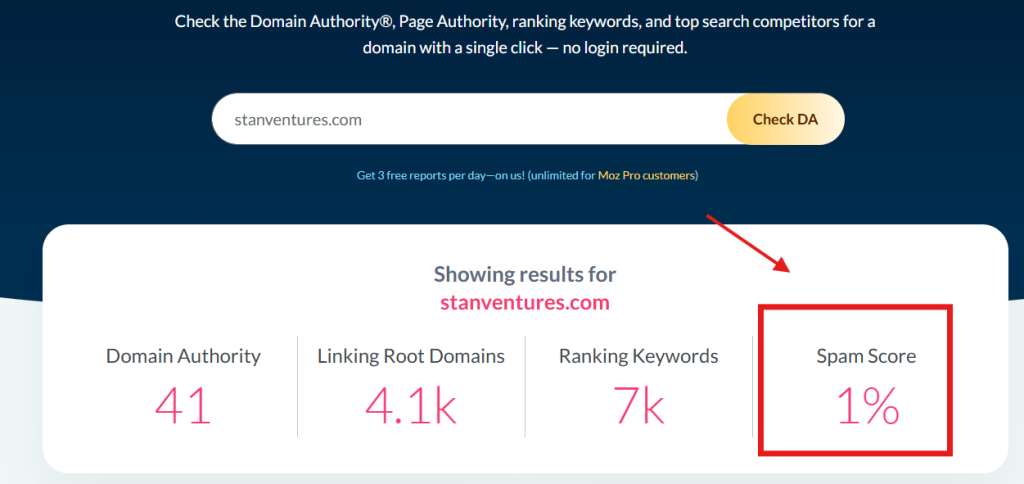
Moz Spam Score and Semrush Toxicity Score are safety metrics you can use to identify domains that show patterns commonly associated with low-quality or manipulative linking, such as excessive outbound links, suspicious backlink sources, or connections to spam link networks.
Checking spam scores before building links helps you avoid placements that may not contribute to ranking improvements or meaningful conversions. The lower the spam score, the better.
Note: Spam scores are not definitive judgments. However, they are effective for initial screening of sites for link building.
10. Anchor Text Profile
Anchor text is the clickable text used in a backlink. Search engines analyze anchor text patterns to identify unnatural or manipulative link building.
In the past, exact-match keyword anchors were commonly used to influence rankings. But today, search engines are smart enough to crack down on over-optimized anchor text distributions.
If a large part of backlinks use the same keyword-focused anchor, Google is likely to red-flag or ignore them. This can cut down SEO link building benefits for the sites these links point to.
On the other hand, a natural anchor text profile is typically diverse. It includes a mix of brand names, URLs, generic phrases, and limited keyword variations. This distribution indicates that links were acquired organically.
Backlink quality isn’t defined by a single score. It is rather shaped by relevance, real search visibility, trusted link sources, and natural linking patterns.
Metrics like DR, DA, and Authority Score still have value, but only when used alongside traffic and context. Relying on them in isolation is where most link building efforts lose momentum.
Use these ten metrics to filter out spammy sources and focus on building links that contribute to rankings, traffic, and sustainable SEO growth.
Need more help building high-quality backlinks for your website? Book a free link building consultation with us today.
FAQs
Why should I check link metrics for SEO?
Link metrics help you evaluate whether a backlink will actually contribute to rankings, traffic, and authority instead of just inflating reports. Checking the right link metrics helps you avoid low-quality link building that can hurt your site’s SEO.
What are some of the essential backlink metrics in 2026?
Link relevance, organic traffic to the linking page, referring domains, Trust Flow, URL Rating, and spam score are some of the top link metrics to look for in 2026.
Is DA still important for link building?
DA is still useful as a reference metric, especially for client communication and initial screening of sites. However, it should be evaluated alongside traffic, relevance and other link quality signals to avoid relying on misleading domain authority scores.
Do high-traffic links matter more than high-authority links?
Yes. Links from pages with real organic traffic often carry more SEO value than links from high-authority pages that hardly rank. Organic traffic signals that search engines trust the page and actively surface it to users.
About the author


Share this article


Want to Boost Rankings?
Get a proposal along with expert advice and insights on the right SEO strategy to grow your business!
Get StartedRelated Blogs


